

Kalshi, the US-regulated exchange that won approval for a Bitcoin perpetual in May, is preparing to ask the Commodity Futures Trading Commission to approve a perpetual futures contract tied to West Texas Intermediate crude oil, Reuters reported on Sept. 2. If approved, it would be the first oil perpetual to trade on a regulated US platform and would move a product structure built in crypto into the benchmark US oil market.
Crypto’s favorite derivative was built around assets that trade every hour, with a structure that lets traders keep the same position because the contract has no fixed expiration. Reuters said Kalshi plans to offer the WTI contract 24 hours a day, five days a week, leaving it closed during the period when an always-on oil price would be most useful.
While that trade-off may improve the contract’s chances in Washington, it will weaken its strongest use case. Bitcoin perpetuals can reference spot trading that runs continuously across many venues. Oil prices depend on physical supply and storage, while the futures market expresses those conditions through contracts for different delivery months. Those features stay with the commodity even when the derivative loses its expiration date.
A perpetual contract that still closes
Perpetual futures replace expiration with a funding mechanism. Payments between long and short positions are calculated at regular intervals to keep the derivative’s price close to a reference price. Traders can keep the same position open as the market advances through successive delivery months.
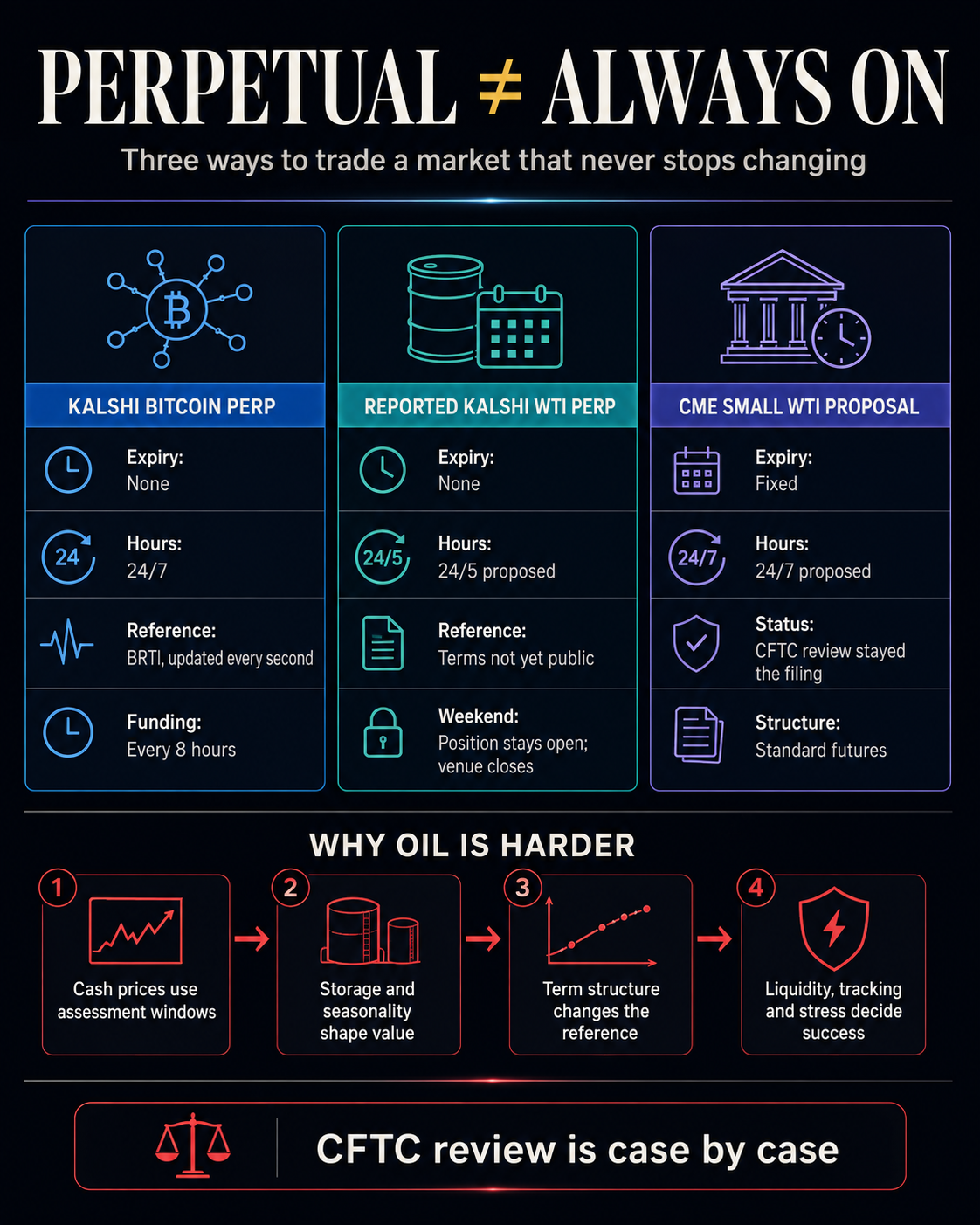
Kalshi’s existing Bitcoin perpetual shows the crypto model. It trades 24/7, uses the CF Benchmarks Bitcoin Real-Time Index, updates that reference every second, and applies funding every eight hours. The CFTC’s approval rested in part on Bitcoin’s globally distributed and continuously observable spot trading.
Kalshi’s reported plan separates contract maturity from trading hours and from the reliability of the market being tracked.
| Product design | Expiration | Trading schedule | Reference challenge |
|---|---|---|---|
| Kalshi Bitcoin perpetual | None | 24/7 | Continuous global spot Bitcoin index |
| Reported Kalshi WTI perpetual | None | 24/5 | Final index and funding terms are not yet public |
| CME’s proposed small WTI future | Fixed, standard-futures structure | 24/7 proposed | Weekend liquidity and benchmark effects remain under review |
CME’s separate proposal shows why trading hours and contract maturity require different regulatory answers. The exchange announced a small, cash-settled 10-Barrel WTI Crude Oil future with proposed 24/7 trading, while preserving fixed expiration. The CFTC later stayed CME’s self-certification while conducting a fuller review. The action leaves Kalshi’s case open and shows how closely the agency is examining extended-hours oil products.
Conventional WTI futures already trade for nearly 24 hours a day from Sunday evening through Friday, with a daily break. Kalshi’s weekday value would therefore come primarily from removing expiration because conventional WTI already covers almost all those hours. The 24/5 schedule also avoids many operational problems around weekend trading, while leaving positions exposed to news that accumulates during the closure and has to be absorbed when trading resumes.
A funding rate is only as credible as the price it is trying to follow. Bitcoin offers continuous spot transactions from which an index can be calculated. Physical crude trades through dispersed transactions and assessments during defined windows, providing no single, continuously observable spot market of the same kind.
In its review of energy perpetuals, the CFTC asked whether a perpetual could reference a physical assessment, a futures contract, or some composite of the two without creating an unreliable or easily manipulated price.
The sequence of oil delivery carries information that a single no-expiry price has to compress into one reference. Storage and financing costs help shape the futures curve, along with the value of having physical barrels available sooner. Contango, where later contracts trade above near-term ones, can reflect plentiful supply and the cost of holding oil. Backwardation, where near-term contracts trade higher, can reflect physical scarcity and the value of immediate access to barrels.
This also means a perpetual can remove the trader’s manual roll by transferring the economics behind it into the contract. If Kalshi’s reference follows the front-month future, the methodology still has to move into another contract as delivery approaches. The resulting roll cost or benefit would reappear through the reference price, the funding rate, or both.
The April 2020 collapse below zero shows why the reference choice is more than just a little technical detail affecting the price.
The expiring WTI contract fell below zero as storage at Cushing became scarce, while later-dated contracts stayed positive. A perpetual has no terminal delivery event, so Kalshi would have to decide whether its mark price should reproduce that kind of physical stress or follow a broader measure that smooths it out. Its funding and liquidation systems would then have to function at or below zero. The CFTC limited its Bitcoin approval to similarly structured perpetuals tied to digital commodities with deep, active, and continuous spot trading.
The strongest use case is the one Kalshi left out
If approved, the immediate benefit of this contract would be operational. Traders seeking sustained oil exposure could hold one instrument across successive delivery months, with the contract managing each transition while the position stayed open.
It could appeal to a company seeking a persistent hedge around oil-sensitive revenue or costs. Producers, refiners, transporters, and fuel users already hedge through futures, options, and swaps, however. The CFTC has asked for evidence that a perpetual would meet an additional commercial need and whether its users would be hedgers or primarily speculators.
The best evidence for an oil perpetual comes from the feature left out of Kalshi’s reported design. Dune’s study of trading on the crypto venue Hyperliquid examined 30 weekend closures and found that its WTI perpetual explained about three-quarters of the move when conventional futures reopened. During the 20 weekends when oil moved by more than 1%, the perpetual called the direction correctly every time, and 18 of those periods recorded more than $100 million in volume.
The result depended heavily on participation. Slippage on orders above $100,000 during the closure rose from 0.23 basis points in April to 3.19 basis points in August as the order book thinned. The venue’s Brent perpetual moved about three times as far as Brent futures over the same weekends, making it a poor guide to the reopen. Live price can process geopolitical or supply news while benchmark futures are closed, although 30 weekends on one venue leave its broader validity unproven.
Kalshi’s reported 24/5 design gives up that weekend price-discovery function. Its most obvious audience is therefore traders seeking large oil positions with relatively little collateral and automatic management of the transitions between dated contracts. A different schedule or an unusual funding treatment around closures could broaden that use case, with the terms staying undisclosed until Kalshi files.
The regulatory path for this contract is very narrow. The CFTC approved Kalshi’s Bitcoin perpetual on May 29, and its policy statement directs perpetuals tied to other asset classes into case-by-case review.
The agency’s later energy inquiry maps the problems Kalshi will have to solve. Most come from the same structural mismatch: federal oil-market rules were built around delivery months, while a perpetual has no spot month or final convergence event. The reference price, position limits, margin, and liquidation rules all have to account for that difference.
A relatively small collateral requirement can turn a modest oil move into a rapid loss, while funding obligations accumulate for as long as a position stays open. The contract specifications will determine who can trade, how large a position can be relative to its collateral, which assets Kalshi will accept, and when positions will be liquidated. Reuters did not disclose those terms, and Kalshi had yet to file the contract when the report was published.
Approval would begin the market experiment
Approval would establish that Kalshi’s design meets the legal and market-integrity threshold, but it’s trading that will determine whether the contract is actually useful.
Liquidity and tracking would quickly become one of the biggest issues with crude oil perps. Perps need enough natural participation on both sides for their price and funding rate to carry information instead of reflecting a handful of concentrated positions.
The market would watch how closely it follows the chosen WTI reference during ordinary sessions and around inventory reports, geopolitical shocks, and market reopening. Wide spreads or persistent deviations would make the contract costly to use and leave funding payments doing too much of the work.
Any kind of stress the market feels would expose the rest. Margin calls and forced liquidations protect the clearinghouse, while automatic selling into a falling market can intensify the move. Oil’s history of abrupt supply shocks and negative prices gives regulators real episodes against which to evaluate the system.
Kalshi is betting that one of the most interesting and unique products to come of the crypto market, exposure without expiry, can be adapted to physical oil while trading still pauses each week.
And while that compromise may help the contract through Washington, it removes the part of the crypto model that offers oil traders something beyond their existing market. If the product just moves roll management inside the contract while tracking nearly the same weekday market, it will become a simpler vehicle for speculation backed by relatively little capital and leave oil price discovery largely untouched. The filing will show whether Kalshi has found a broader purpose for it.
 Bitcoin
  Ethereum
  Tether
  BNB
BNB  XRP
XRP  USDC
USDC  Solana
  TRON
TRON  Figure Heloc
  Zcash
Zcash 