

USBC has registered a block of already-issued shares equal to almost its entire outstanding common stock for potential resale, creating a potential market overhang alongside a balance sheet that relies heavily on Bitcoin.
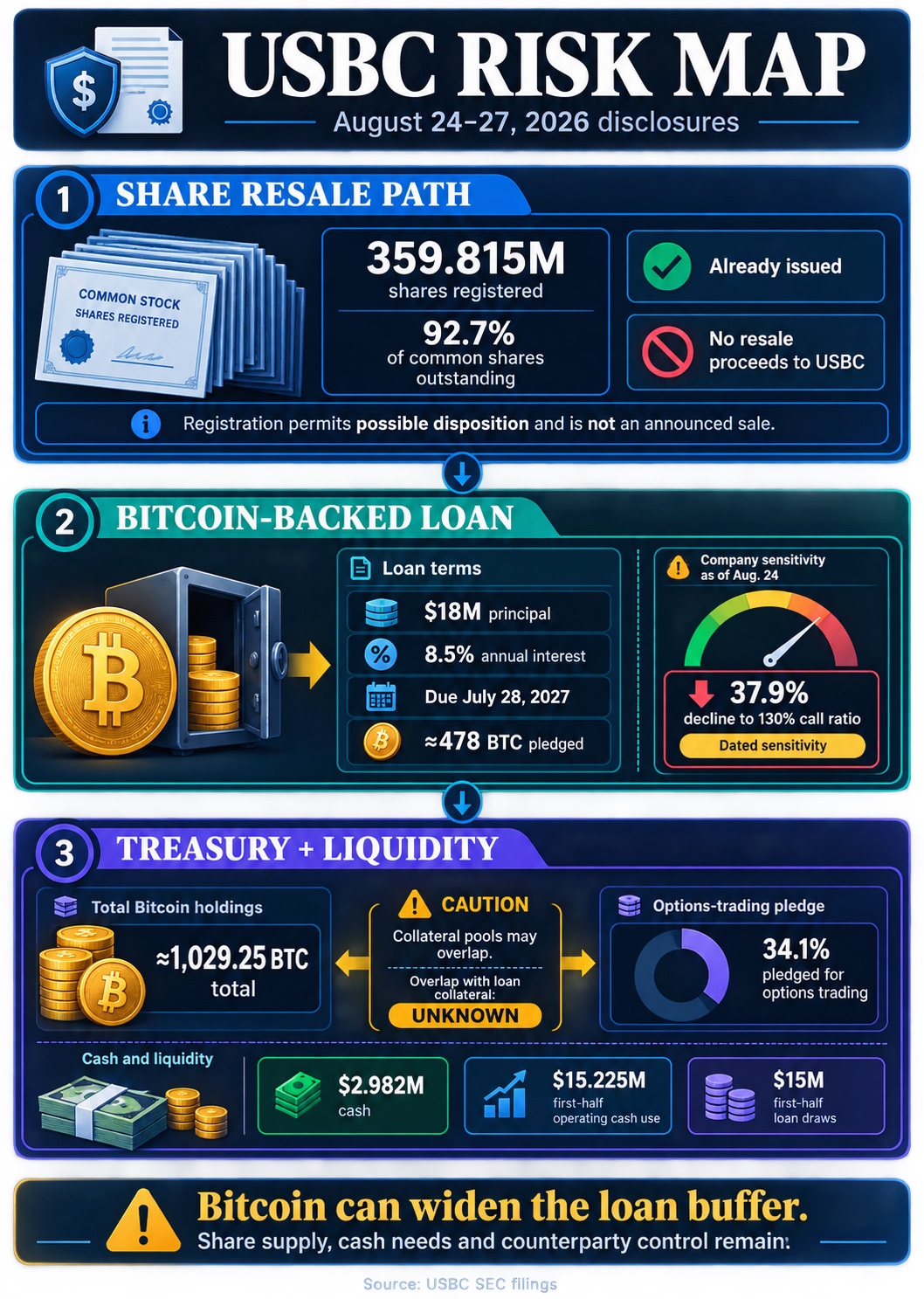
The company’s August 27 amended preliminary prospectus covers up to 359,815,000 shares held by selling stockholders. That equals about 92.7% of the 388,144,429 common shares outstanding as of August 24. USBC would receive no proceeds from any sale or other disposition by those holders.
No transaction is disclosed. The covered shares already exist, and the selling stockholders may dispose of all, some or none of them. The filing creates a route to market for a very large ownership block while leaving the current share count and control position unchanged until transactions occur.
| Risk layer | Latest disclosed figure | What it shows |
|---|---|---|
| Registered resale shares | 359.815 million | About 92.7% of common shares outstanding; resale proceeds go to selling holders |
| Payward loan | $18 million at 8.5% | Matures July 28, 2027 and is secured by approximately 478 BTC |
| Loan sensitivity | 37.9% decline as of Aug. 24 | Company-modeled drop in pledged BTC value to the 130% collateral-call ratio, assuming no repayment or added collateral |
| Options-trading pledge | 34.1% of treasury BTC | Separately disclosed; the filing does not say whether it overlaps with Payward collateral |
| Cash and equivalents | $2.982 million | June 30 balance, excluding $660,000 of restricted cash |
Most of the covered shares belong to Goldeneye 1995 LLC. USBC issued Goldeneye approximately 357.8 million shares in August 2025 in exchange for 1,000 BTC and $15 million in cash. Another 2 million registered shares are held by J3E2A2Z LP.
Goldeneye’s position is economic and corporate. The filing says it held about 92.2% of USBC’s voting power when it approved a proposed reverse stock split by written consent in June. That concentration allowed the holder to act without a special stockholder meeting.
A registration statement changes what the holder can do with the position. Ownership and voting power change only when shares are actually sold, transferred, pledged or otherwise disposed of, or when future issuances dilute the stake. The preliminary prospectus is subject to completion, and the covered shares cannot be sold under it until the registration statement becomes effective.
The filing therefore creates two distinct investor exposures. The first is potential supply: up to 359.815 million shares have a registered route to resale or other disposition. The second is control: Goldeneye retains its voting position unless transactions or dilution change it. A future sale could affect both, depending on its size and buyer, while a registration with no follow-through would affect neither the share count nor voting ownership.
The company receives no cash from selling-stockholder transactions even if they occur. That separates this registration from a primary offering that funds the issuer. Any liquidity created by a resale accrues to the selling holder; USBC continues to fund operations through its own cash, treasury activity and financing arrangements.
Bitcoin collateral provides room inside a fast-enforcement contract
USBC’s latest loan disclosure showed $18 million of principal outstanding under its credit facility with Payward Interactive. The borrowing carries an 8.5% annual interest rate, matures July 28, 2027 and was secured by approximately 478 BTC as of August 24.
The company modeled that pledged Bitcoin collateral could lose about 37.9% of its value from that dated snapshot before coverage reached the 130% collateral-call ratio, assuming USBC made no repayment and posted no additional collateral. It reported no collateral calls, mandatory repayments or liquidation events as of August 24.
That percentage describes a company sensitivity at one point in time. It moves with the collateral value, accrued fees, loan balance and amount of BTC posted. It provides a measure of room to the call ratio, not a forecast or an immutable Bitcoin price at which Payward must act.
The master loan agreement sets a rapid response once the cushion is exhausted. At the collateral-call ratio specified in the applicable term sheet, USBC has 24 hours to add collateral or repay enough loaned currency to restore the required margin. At or below the liquidation ratio, Payward may liquidate collateral without notice, charge a 1% liquidation fee and hold USBC responsible for any remaining shortfall.
Higher Bitcoin collateral values improve the ratio mechanically. Payward’s enforcement rights remain embedded in the contract, and the pledged BTC remains outside USBC’s unrestricted pool while it secures the loan.
The treasury disclosure adds another layer. USBC reported approximately 1,029.25 BTC in total holdings as of August 24. It separately reported approximately 478 BTC pledged to Payward and about 34.1% of its Bitcoin treasury pledged for options trading, with the options counterparty controlling the relevant private keys.
The filing provides no reconciliation between those two figures. The 478 BTC and the 34.1% cannot be added to calculate total encumbered Bitcoin because some or all of the pools could overlap. The disclosures establish multiple collateral and control arrangements tied to the treasury; they leave the aggregate amount unavailable for a reliable calculation.
That uncertainty changes the risk analysis. If the pools overlap, adding them would exaggerate encumbrance. If they are separate, substantially more of the treasury is committed than the loan figure shows on its own. Either structure leaves counterparty terms, margin requirements and asset control relevant to how much balance-sheet flexibility USBC retains during stress.
Financing-supported liquidity is the harder constraint
USBC’s June quarter filing showed $2.982 million of cash and equivalents at June 30, plus $660,000 of restricted cash. During the first half, it used $15.225 million of net cash in operating activities and received $15 million from loan draws.
The financing inflow nearly matched six months of operating cash use. Period-end unrestricted cash covered only a fraction of that first-half outflow. Those figures connect the Payward facility directly to USBC’s operating liquidity and explain why collateral availability matters beyond day-to-day Bitcoin volatility.
The $46.343 million first-half net loss included large accounting items. It incorporated a $29.710 million unrealized loss from changes in digital-asset fair value, $11.212 million of stock-based compensation and a $2.531 million credit-loss provision, partly offset by an $11.976 million deferred-tax benefit.
USBC also reported $2.228 million of net derivative income. The cash-flow statement removed that amount as a negative adjustment in reconciling net loss to operating cash flow. The line records income from the treasury strategy; it does not equal $2.228 million of unrestricted cash available at June 30.
The financial statements answer four separate questions. Net loss describes reported profitability. The operating cash-flow statement measures cash consumed by operations. Derivative income captures results from the options strategy. The balance sheet shows the cash available at the period end.
Together, the filings show risk moving across three connected channels. The August 24 collateral snapshot gave USBC room before a Payward call. The resale registration made a controlling holder’s stake ready for potential market disposition without raising cash for the company. First-half cash use remained dependent on financing secured by treasury assets, while another portion of the treasury supported options trading under an unreconciled collateral arrangement.
Bitcoin price strength can widen the loan buffer. It leaves the registered share supply, control concentration and operating cash requirement in place. The next changes that matter are actual selling-stockholder dispositions, repayments or new draws under the loan, movements in pledged BTC and a clearer reconciliation of the treasury committed to each counterparty.

 Bitcoin
  Ethereum
  Tether
  BNB
BNB  XRP
XRP  USDC
USDC  Solana
  TRON
TRON  Figure Heloc
  Hyperliquid