


Cryptocurrency projects have spent about $638 million repurchasing their own tokens so far in 2026, with decentralized exchange Hyperliquid and memecoin platform Pump.fun accounting for nearly 90% of the total, according to Allium Labs data cited by the Financial Times.
The total has already surpassed the $545 million recorded during the same period in 2025 and is sharply higher than the $366,000 reported in 2024.
Hyperliquid accounted for roughly $370 million of this year’s token purchases, while Pump.fun contributed nearly $200 million.
Token buybacks use project or protocol funds to purchase native tokens from the market. The mechanism is broadly similar to corporate share buybacks, though token holders do not necessarily have the same rights as shareholders.
Hyperliquid and Pump.fun Channel Revenue Into Buybacks
Hyperliquid directs about 99% of its revenue toward HYPE repurchases. The decentralized exchange reported $169 million in second-quarter revenue on Aug. 6, of which $141 million was allocated to buying back HYPE.
Pump.fun, meanwhile, uses about half of its net protocol revenue to repurchase PUMP. Based on average daily revenue over the preceding 90 days, the platform had about $420 million in annualized revenue.
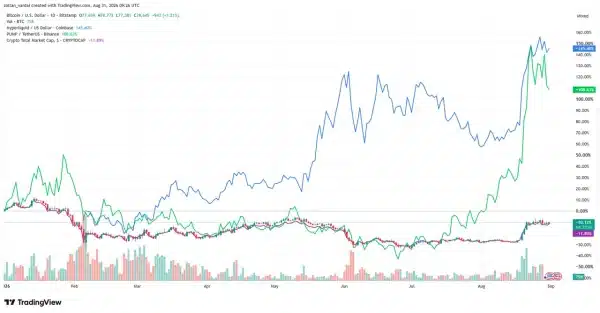
Both tokens have outperformed the broader cryptocurrency market this year. For context, HYPE had gained 145% and PUMP 109% year-to-date, according to TradingView data. Over the same period, Bitcoin was down 10%, while total cryptocurrency market capitalization had declined 11.9%.
Revenue-Funded Buybacks Expand Beyond HYPE and PUMP
Other crypto projects are also considering mechanisms that direct revenue toward their native tokens.
On Aug. 27, the Ethena Foundation opened a governance vote on a fee-switch proposal that would use 95% of net revenue paid to the foundation from Ethena’s core business lines to repurchase ENA tokens.
ENA rose 10.7% on the day after the proposal.
Bitwise Chief Investment Officer Matt Hougan said earlier in August that crypto valuations could double over the next two years as protocols increasingly use revenue to fund token buybacks and burns, returning more value to investors.
DisClamier: This content is informational and should not be considered financial advice. The views expressed in this article may include the author’s personal opinions and do not reflect The Crypto Basic opinion. Readers are encouraged to do thorough research before making any investment decisions. The Crypto Basic is not responsible for any financial losses.
 Bitcoin
  Ethereum
  Tether
  BNB
BNB  XRP
XRP  USDC
USDC  Solana
  TRON
TRON  Zcash
Zcash  Figure Heloc