

Bitcoin faces more downside pressure as buyers struggle to stop the ongoing price decline.
Analyst Ted Pillows identified $78,000–$79,000 as the next key support zone, citing more than $80 million in buy orders clustered within that range.
However, the concentration of buy orders does not guarantee a price rebound. Pillows noted that orders around $80,000 were filled the previous day, briefly lifting Bitcoin’s price before selling pressure returned.
Bitcoin Struggles to Hold $80,000
Bitcoin dropped to $79,278 on Monday before recovering to $80,291. Despite the rebound, the coin remains down about 5% over the past month.
Pillows also highlighted Bitcoin’s three consecutive weekly losses, warning that a weekly close below $80,000 would increase the risk of further declines.
Why the $78,000–$79,000 Zone Matters
The $80 million in buy orders across Binance, Bybit, and other trading platforms represents a source of support. However, much of this liquidity comes from futures markets rather than direct purchases of Bitcoin on spot markets.
Futures orders do not necessarily translate into demand for actual Bitcoin. Traders can also cancel orders before execution, meaning visible liquidity does not guarantee buyers will absorb incoming selling pressure.
Weak spot-market demand remains the central concern. Without stronger buying activity, Bitcoin faces difficulty maintaining its price even with substantial orders waiting below the market.
What Happens Next for Bitcoin Price?
Bitcoin’s direction hinges on whether buyers defend $80,000 and absorb selling pressure.
- Holding above $80,000: Bitcoin gains room to stabilize, although a sustained recovery still requires stronger buying demand.
- Breaking below $80,000: The $78,000–$79,000 zone becomes the next major support area to watch.
- Failure of support: If buyers cannot absorb selling pressure, Bitcoin faces further downside despite the concentration of pending buy orders.
The key question is whether the liquidity around $78,000–$79,000 translates into actual buying. Until demand strengthens, BTC remains vulnerable to another decline.
Weaker Buying Power as Stablecoin Reserves Hit a 12-Month Low
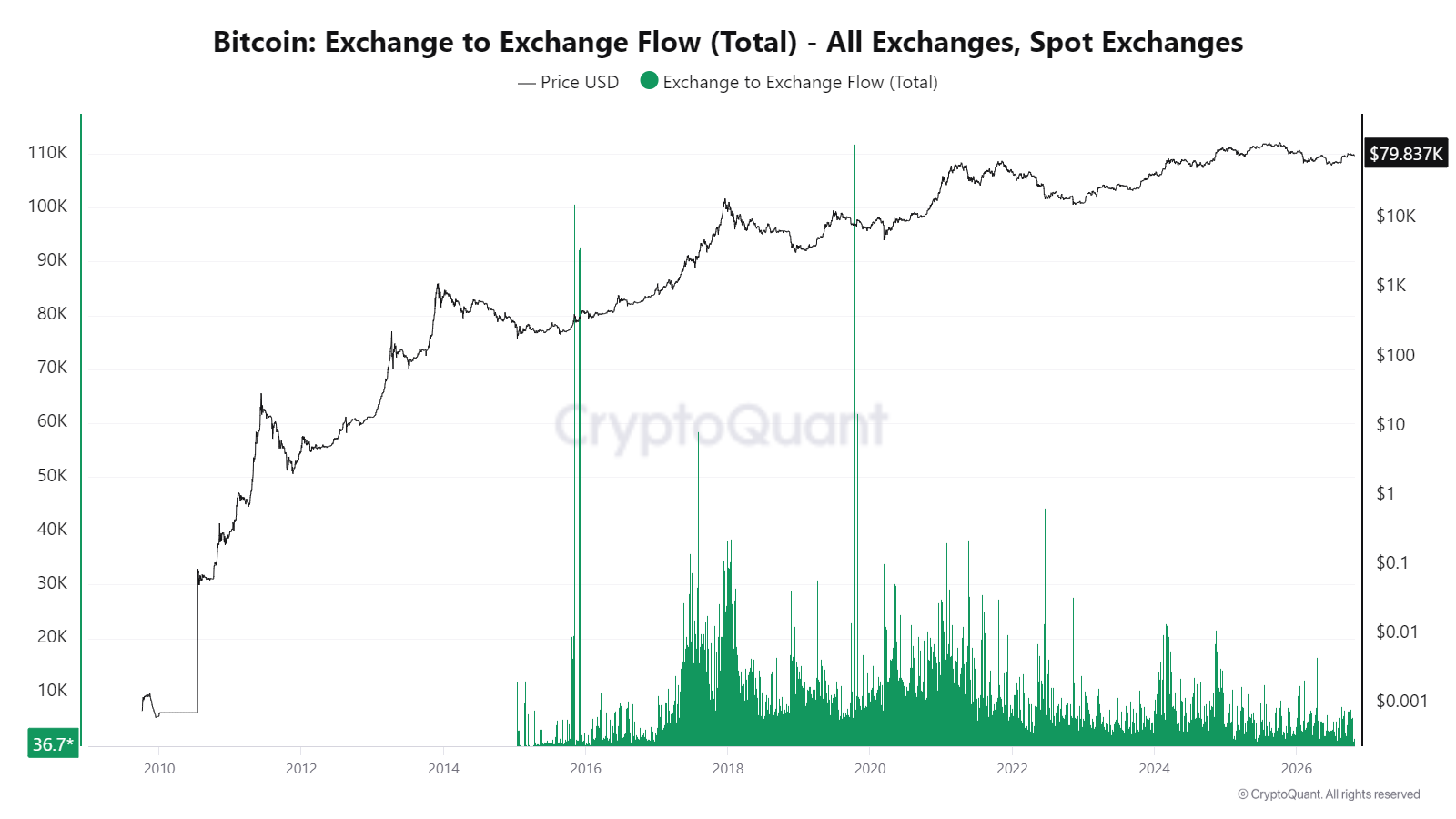
Alongside weakening support, Bitcoin faces a challenging market backdrop as flows between exchanges decline and stablecoin reserves on exchanges fall to their lowest levels in 12 months.
CryptoQuant analyst R3N noted that Bitcoin transfers between exchanges have declined significantly compared with previous market cycles. This suggests reduced movement between trading venues.
Separately, CryptoQuant contributor CryptoOnchain reported that stablecoin reserves on exchanges fell to $60.62 billion on October 24.
Netflows across all exchanges were negative, with a seven-day average outflow of $93.9 million. This points to reduced stablecoin liquidity available for trading.
These figures indicate that a smaller pool of stablecoins is available on exchanges to fund cryptocurrency purchases.
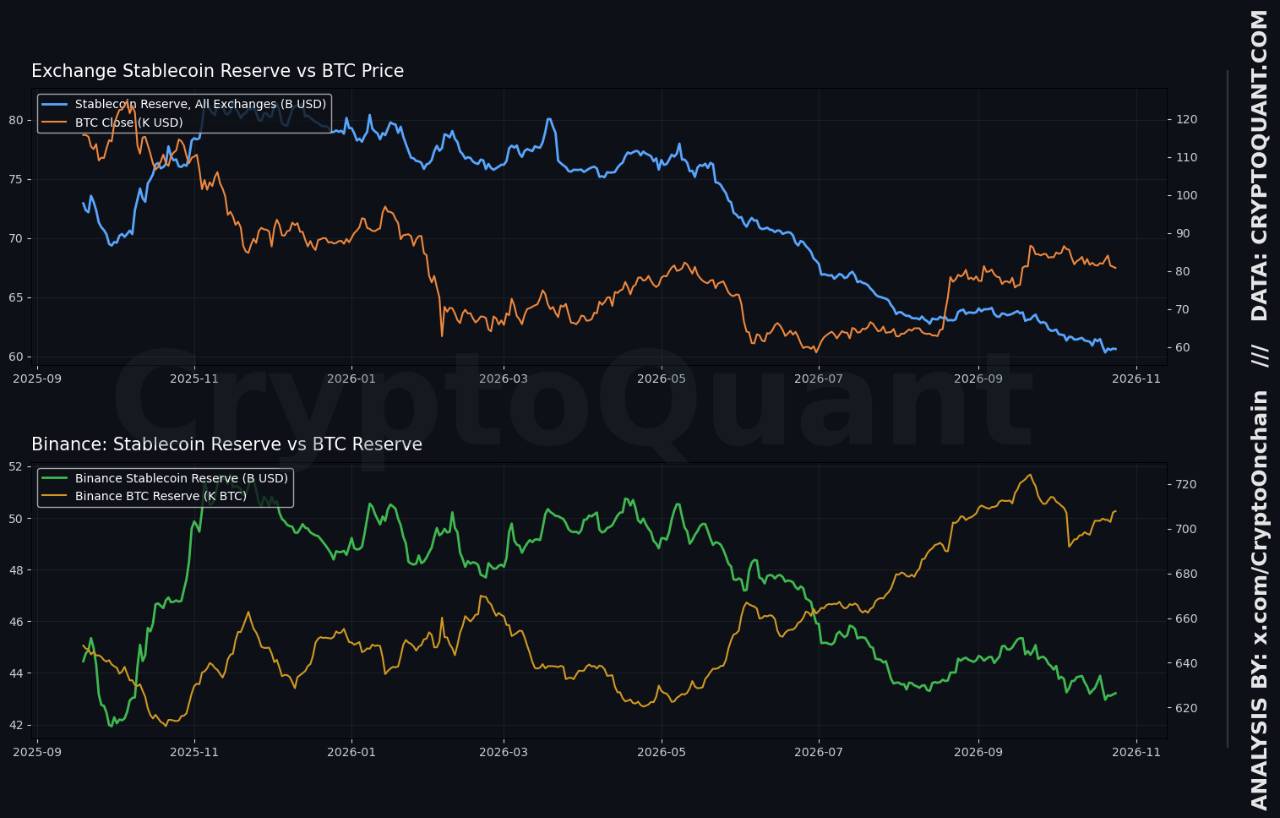
CryptoOnchain also highlighted a negative Coinbase Premium Index, indicating weaker US spot demand relative to other markets.
Together, these signals point to weaker buying conditions for BTC, which may help explain its struggles to hold above $80,000.
 Bitcoin
 Ethereum
 Tether
 BNB
 XRP
 USDC
 Solana
 TRON
 Figure Heloc
 Zcash
