

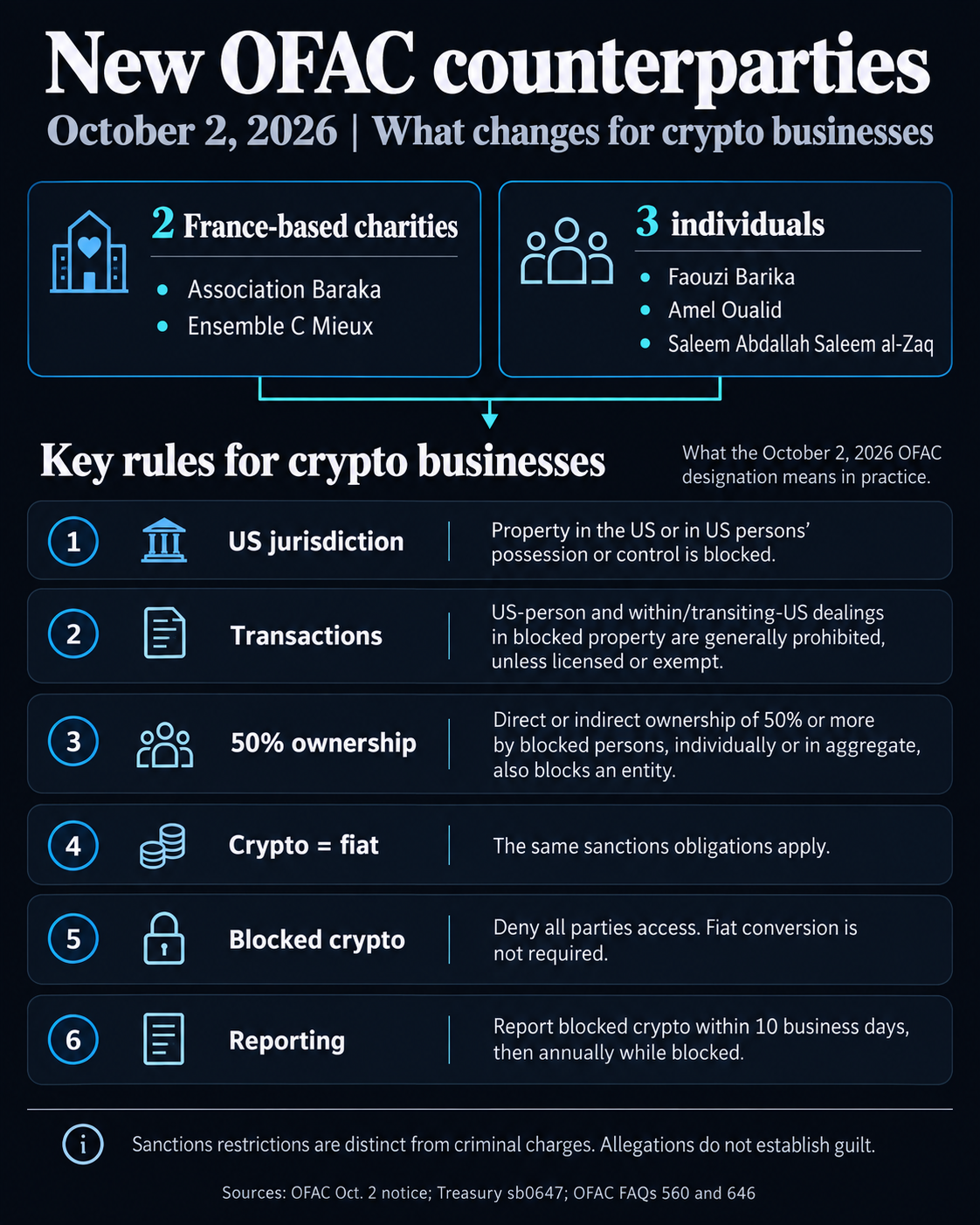
The US sanctioned two French charities and three individuals after alleging they helped channel cryptocurrency and other funds to Hamas.
The Treasury Department’s Office of Foreign Assets Control (OFAC) added Association Baraka, Ensemble C Mieux, Faouzi Barika, Amel Oualid and Saleem Abdallah Saleem al-Zaq to its sanctions list on Oct. 2, expanding the roster of counterparties that crypto exchanges and payment firms subject to US rules must screen.
Treasury alleges Barika and Oualid, both based in France, sent hundreds of thousands of dollars in cryptocurrency to al-Zaq, whom the agency described as a Gaza-based deputy battalion commander in Hamas’ military wing. The two fundraisers and associated organizations collected more than $2 million for Hamas between 2020 and 2026, according to Treasury.
The agency did not say that the entire $2 million was transferred using digital assets, distinguishing that broader fundraising figure from the cryptocurrency transactions it specifically attributed to Barika and Oualid.
The designations extend US efforts to disrupt Hamas financing networks at a time when authorities are increasingly tracing digital-asset transfers alongside traditional banking and cash-based channels. They also immediately bring the sanctioned parties within OFAC’s existing restrictions governing property held by US persons or moving through US jurisdiction.
Crypto firms face new screening obligations
US exchanges, custodians and payment processors must block property in which the designated parties have an interest when that property comes within their possession or control, unless an OFAC license or exemption applies.
That requirement also reaches companies owned 50% or more, directly or indirectly, by one or more blocked persons, meaning compliance teams may need to identify entities beyond the five names published by Treasury.
OFAC treats digital assets under the same sanctions framework as fiat currency and other property. A US-regulated crypto company that identifies assets belonging to a blocked person must deny access to them and report the property to the agency within 10 business days. Blocked assets are also subject to annual reporting requirements.
The agency does not require firms to convert frozen cryptocurrency into dollars, allowing custodians to keep the assets in their existing form while preventing sanctioned parties from accessing or transferring them.
The sanctions may also have consequences outside the US. Treasury warned that foreign financial institutions could face secondary sanctions for knowingly facilitating significant transactions for parties designated under the relevant authority, raising the potential compliance exposure for offshore exchanges and other intermediaries servicing the network.
That provision does not amount to a worldwide freeze on every blockchain transaction connected to the sanctioned parties. Enforcement depends on jurisdiction, ownership, the involvement of blocked property and, in some cases, the significance and knowledge surrounding a transaction.
The next test for crypto firms will be whether US authorities publish or identify additional wallet addresses, intermediaries or entities tied to the sanctioned network. Any such disclosures could broaden the screening burden beyond the names added this week and force exchanges to reassess historical exposure to the alleged fundraising operation.
 Bitcoin
  Ethereum
  Tether
  BNB
BNB  XRP
XRP  USDC
USDC  Solana
  TRON
TRON  Figure Heloc
  Zcash
Zcash 