

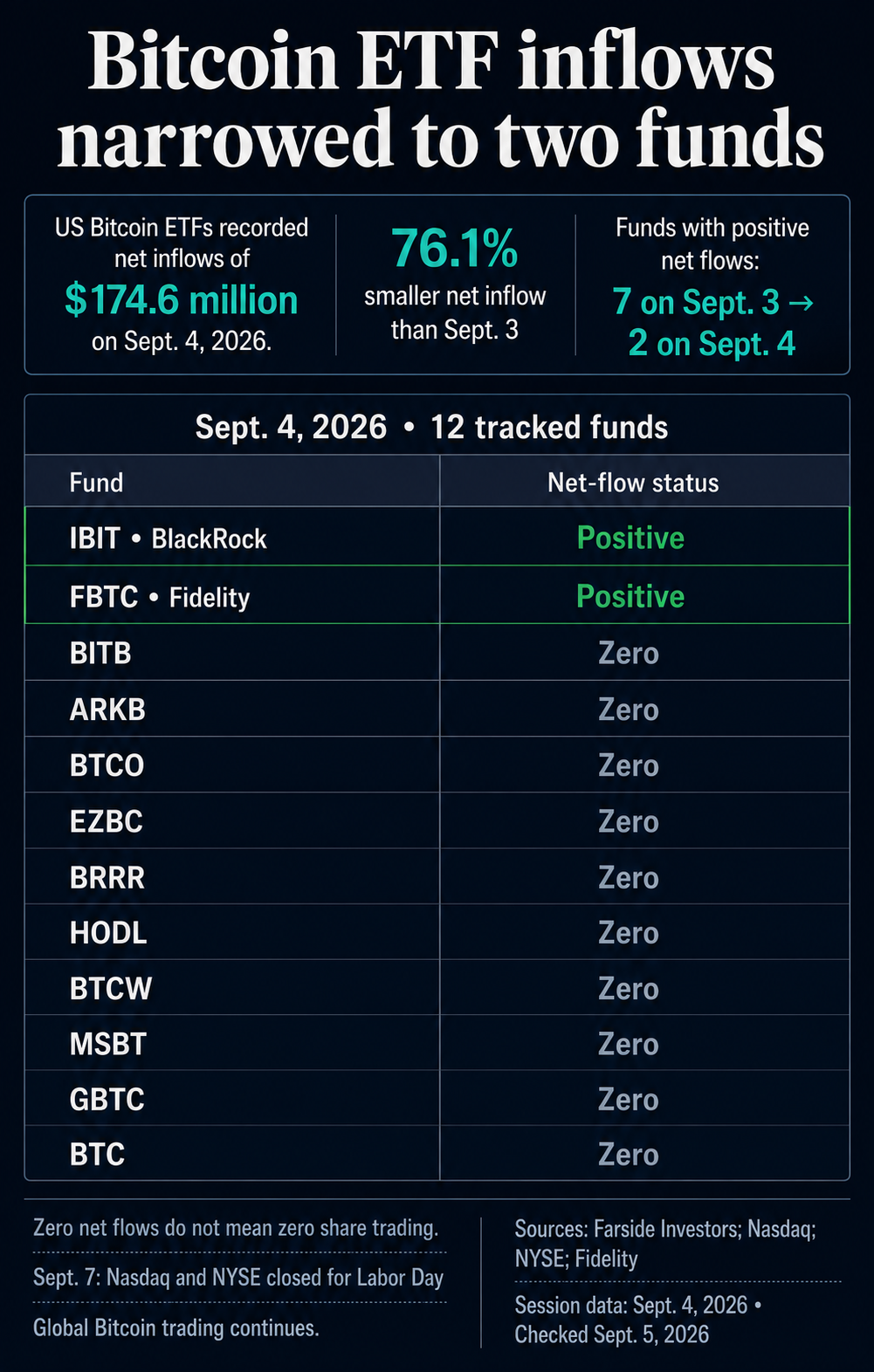
US spot Bitcoin exchange-traded funds recorded net inflows of $174.6 million on Friday, Sept. 4, 2026.
Only funds from BlackRock and Fidelity attracted positive net flows, according to Farside Investors’ daily table, leaving the final US exchange session before Labor Day’s closure dependent on two products for its net inflow.
The total was 76.1% below Thursday’s net inflow of $730.8 million on Sept. 3. Positive flows narrowed from seven of the 12 tracked funds to two. The slowdown followed the Bitcoin and Ethereum ETF surge in the preceding session, with Friday’s Bitcoin result smaller and less broadly shared across funds.
Thursday’s seven positive funds were IBIT, FBTC, BITB, ARKB, MSBT, GBTC and BTC. By Friday, the five products beyond BlackRock and Fidelity in that group had all moved to zero net flows.
BlackRock’s iShares Bitcoin Trust ETF, or IBIT, recorded net inflows of $117.4 million. The Fidelity Wise Origin Bitcoin Fund, or FBTC, recorded net inflows of $57.2 million. Those were the only positive entries in Farside’s Sept. 4 row.
The other ten products each showed zero net flows: BITB, ARKB, BTCO, EZBC, BRRR, HODL, BTCW, MSBT, GBTC and BTC. None recorded a net outflow. The smaller positive total therefore signals a slower pace of money entering the group, rather than net withdrawals from it.
A zero net-flow reading does not mean a fund’s shares went untraded. Fidelity explains that investors can buy and sell these products during stock-market hours, while authorized participants create and redeem fund shares. Those are separate activities: shares can change hands between investors without that trade itself creating or redeeming fund shares. The flow table measures the net result at fund level, rather than the volume of trading in its shares.
Bitcoin ETF inflows await Tuesday’s next session
Both Nasdaq and the NYSE list Monday, Sept. 7, as closed for Labor Day, making Tuesday, Sept. 8, the next scheduled regular session. Friday’s figures will remain the latest completed US exchange-session reading through the holiday break.
The closure does not stop global Bitcoin trading. Fidelity’s comparison of direct crypto and exchange-traded products distinguishes direct crypto trading that may be available around the clock from funds that trade during stock-market hours. The holiday calendar limits that exchange-traded route, rather than shutting the underlying market.
Friday’s figures do not identify the investors behind the flows or establish that a price move or payroll release caused the slowdown. The next completed session will show whether Bitcoin ETF inflows spread beyond IBIT and FBTC again; a single session cannot establish a lasting demand trend.

 Bitcoin
  Ethereum
  Tether
  BNB
BNB  XRP
XRP  USDC
USDC  Solana
  TRON
TRON  Figure Heloc
  Zcash
Zcash 