

Bitcoin is on track to log its best August performance since 2017, demonstrating remarkable resilience against back-to-back macro shocks as escalating US-Iran hostilities and a hawkish pivot from the Federal Reserve test the durability of the digital-asset rebound.
Data from CryptoSlate shows that the largest cryptocurrency is trading near $78,400 as of press time, bringing its monthly advance to more than 24%. This represents its strongest August rally in nine years and its biggest single-month gain since November 2024, per CoinGlass data.
The advance comes even as crude oil jumped above $90 a barrel following American airstrikes on Iranian targets and Tehran’s subsequent retaliation against US military positions in Jordan, unleashing a fresh wave of risk aversion across global equity and bond markets.
Yet, rather than retreating under the weight of geopolitical instability and renewed inflation anxieties, Bitcoin has preserved its monthly gains, suggesting that a shift in internal market mechanics may be shielding the token from traditional cross-asset contagion.
Bitcoin has already survived one major macro shock
The resilience on display following the Middle East military flare-up marks the second time in less than a week that digital assets have absorbed severe macro headwinds.
Last Friday, Bitcoin briefly dipped below $77,000 after Federal Reserve Chair Kevin Warsh delivered an unexpectedly hawkish debut address at the Jackson Hole Economic Policy Symposium.
At the event, Warsh explicitly challenged market expectations of monetary easing, warning that progress on lowering inflation has stalled well above the central bank’s 2% target and emphasizing that policymakers’ primary focus must remain on price stability.
Warsh also dismantled the Fed’s traditional forward-guidance framework, cautioning that excessive verbal commitments risk creating a “hall of mirrors” between policymakers and financial markets.
The Fed Chair pointed to resilient corporate investment, much of it tied to AI infrastructure, alongside unemployment near 4.1% and consumer spending growth above 2%, as evidence the economy can withstand tighter policy.
The remarks sent Treasury yields higher and lifted the market-implied probability of a 25-basis-point rate hike at the Fed’s September policy meeting to 60%.
While traditional risk assets buckled under the prospect of prolonged monetary tightness, Bitcoin staged a rapid weekend recovery, reclaiming the $78,000 handle just before geopolitical headlines broke.
Oil adds another inflation problem for the Fed
The renewed outbreak of fighting in the Middle East has introduced a secondary inflation impulse that threatens to further complicate the Fed’s policy path.
Over the weekend, US forces struck two Iranian rocket launchers on Larak Island in the first direct American military action against Tehran in more than a month.
US Central Command confirmed the operation, noting the launchers were reportedly preparing to deploy naval mines into the Strait of Hormuz. In an X statement, the authorities said:
“[US] took limited, precise action against IRGC minelaying forces posing an imminent threat in the Strait of Hormuz. In essence, Iran created the threat, and the US military eliminated it to protect civilian mariners, commercial shipping, and the free flow of global commerce.”
Iran retaliated by targeting American installations in Jordan, where Jordanian air defenses intercepted eight inbound missiles.
The clashes pushed Brent crude up more than 3% to around $91 a barrel on Monday, bolstered further by signals from Washington that the US plans to intensify secondary sanctions on Iranian oil exports.
The transmission mechanism from the Persian Gulf to digital assets is direct: higher oil prices reignite headline inflation risks, reinforce the Fed’s higher-for-longer rate posture, and reduce broader dollar liquidity.
However, commodity strategists caution that the geopolitical risk premium in crude is facing structural limits.
Ole Hansen, head of commodity strategy at Saxo Bank, said:
“These developments have once again reduced the prospects of bringing the conflict to an end.”
Yet Hansen noted that catastrophic supply disruptions remain unlikely in the immediate term, pointing out that an estimated 6 million to 8 million barrels per day of crude continue to flow uninterrupted through the Strait of Hormuz, capping upside risk for global benchmark prices.
By keeping the energy shock contained, the steady maritime flow has prevented a broader liquidity panic, giving Bitcoin room to consolidate rather than capitulate.
Bitcoin’s Cycle Structure Turns More Constructive
Beyond the macro backdrop, Bitcoin’s internal market structure has strengthened after months of weakness.
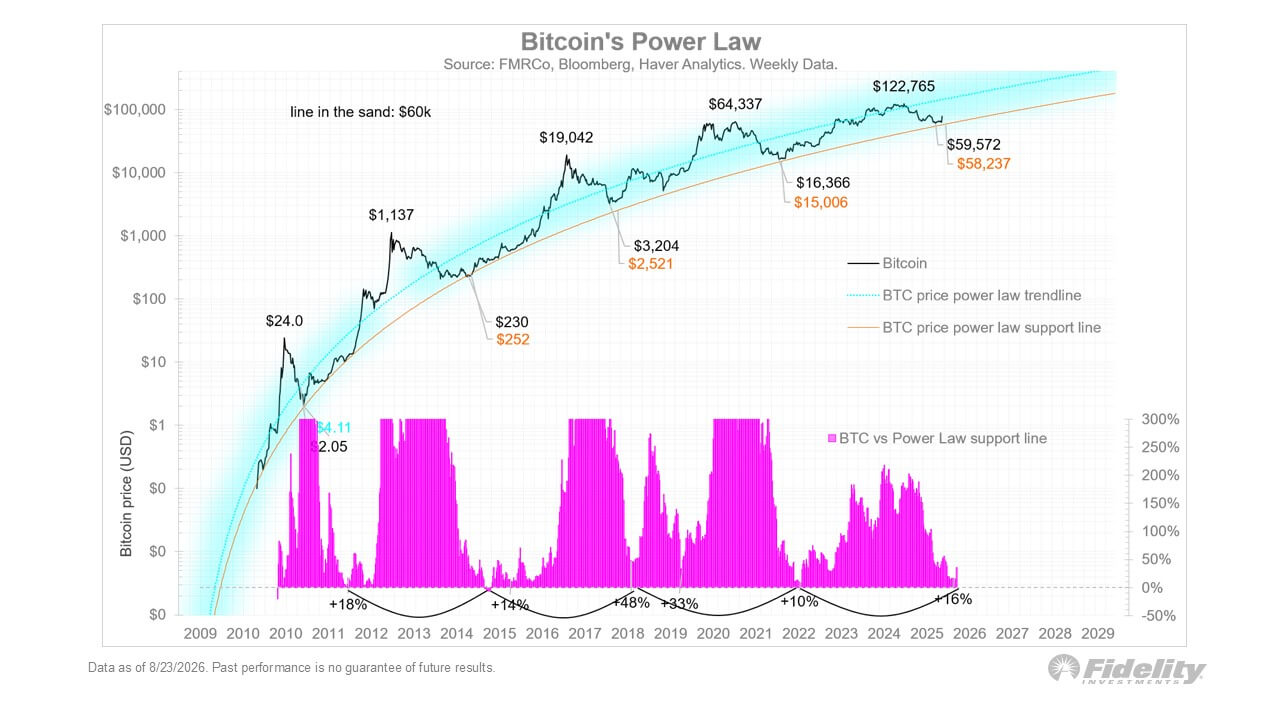
Fidelity Investments Director of Global Macro Jurrien Timmer said Bitcoin’s recent price action suggests the corrective phase may have matured.
Timmer said Bitcoin has held the lower boundary of his power-law curve while spending enough time correcting to satisfy what he describes as the time component of a mild four-year-cycle winter.
Under Timmer’s framework, Bitcoin’s recent cycle low near $59,572 remained above power-law support around $58,237, leaving the cryptocurrency within roughly 2.3% of the model’s lower boundary before rebounding.
We can’t, however, assume from the framework that Bitcoin has definitively completed its correction, nor does Bitcoin’s historical four-year cycle guarantee future price behavior.
Timmer’s analysis instead suggests the latest downturn has met both the price and duration conditions for a cyclical correction to have matured.
That more constructive long-term setup is being tested against weaker evidence of fresh capital entering the market.
Analysts at market analytics firm Bit Official said growth in aggregate stablecoin market capitalization, a widely followed gauge of deployable crypto liquidity, has remained largely stagnant. While Circle’s USDC has recorded modest supply growth, Tether’s USDT has shown little material expansion.
That contrasts with the expansion between August 2024 and October 2025, when USDT grew from $120 billion to $196 billion, and USDC climbed from $35 billion to $75 billion.
Without a sustained resumption of fiat-to-stablecoin creation, market watchers warn that the current advance may rely too heavily on derivatives positioning rather than durable spot accumulation.
$80,000–$82,000 Becomes the Confirmation Zone
Bitcoin’s improving derivatives positioning is running ahead of activity in the underlying spot market, leaving the strength of the August rebound still short of full confirmation.
Bit Official said Bitcoin’s options skew has flipped positive for the first time since October 2025, reflecting stronger demand for call options relative to downside-protective puts. September implied volatility surged from 33.8% to 41.1% before moderating to 38.5%, while traders have rolled shorter-dated calls into October and December expirations or sold calls against existing Bitcoin positions.
However, BTC’s spot trading tells a less convincing story.
CryptoQuant data shows exchange volumes remained near levels last seen in September 2023 despite Bitcoin’s sharp August advance, extending the subdued activity recorded in July. The divergence suggests the price recovery has yet to draw the kind of trading participation that accompanied previous market peaks.
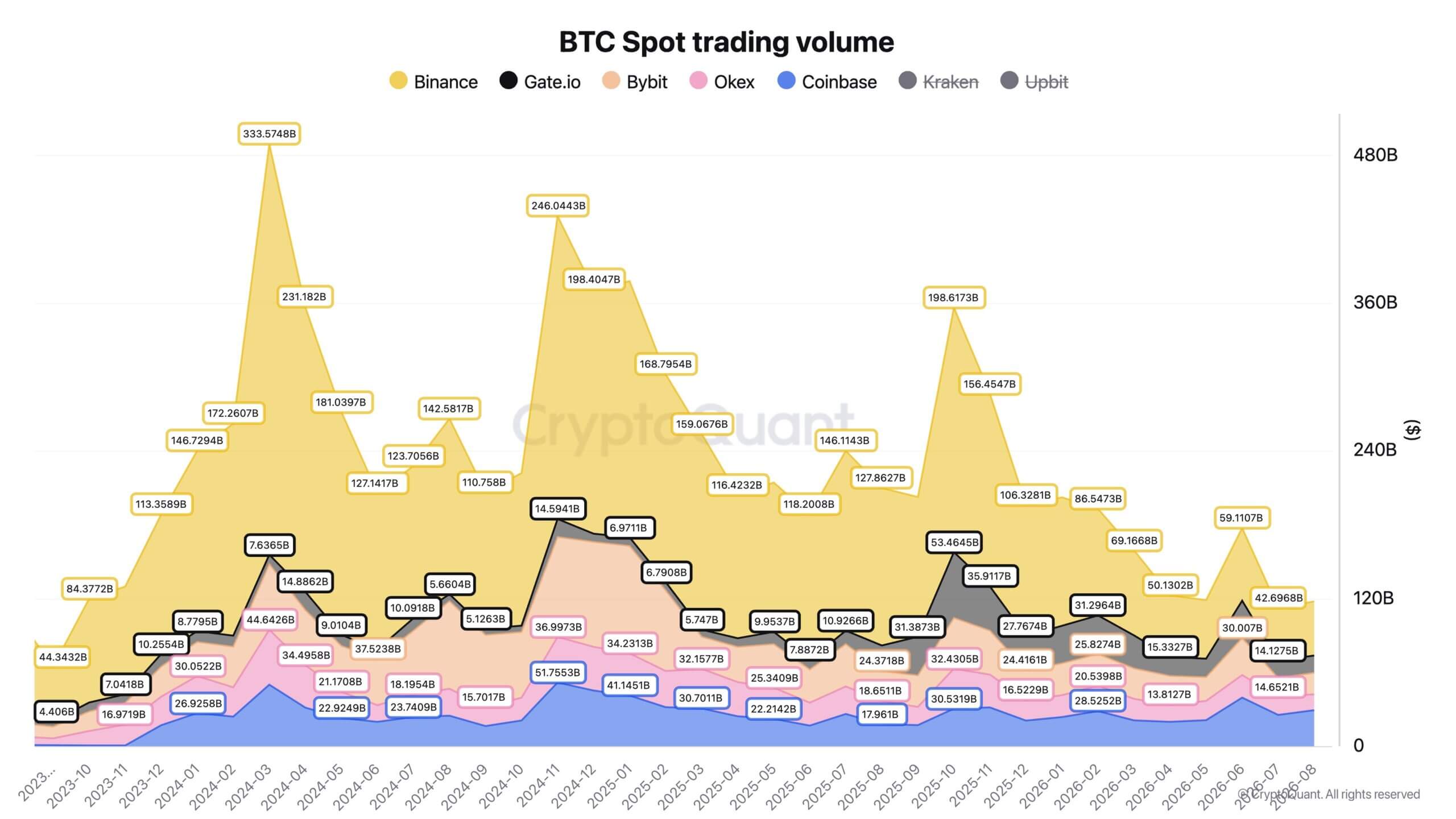
The contrast is particularly stark against October 2025, when Bitcoin reached its previous market top. Monthly spot volume on Binance has fallen to about $44 billion from $198 billion, while Gate’s volume dropped to $14 billion from $53.4 billion and Bybit’s declined to $17.4 billion from $41.2 billion.
That amounts to an average decline of roughly 70% across the three exchanges.
However, early signs suggest the contraction may be stabilizing. Binance’s August volume was about $1.6 billion higher than in July, while overall activity across the major exchanges remained broadly around the previous month’s levels rather than deteriorating further.
CryptoQuant said the stabilization could indicate that investor disengagement reached an extreme during the summer. A sustained recovery in volume alongside rising prices would provide stronger evidence that Bitcoin is entering another expansionary phase.
That leaves the price itself facing an equally important test.
Bitcoin is negotiating overhead resistance between $78,214 and $82,139. Bit Official said a decisive break and hold above $82,000 would strengthen the bullish thesis, while $70,973 remains an important level for preserving the broader uptrend.
Barring a sharp reversal, Bitcoin will close August with its strongest performance for the month since 2017. But the next leg of the rally may require something largely absent so far: a meaningful return of spot trading activity.
A sustained move through $80,000 and $82,000 accompanied by rising exchange volumes would provide stronger confirmation that the rebound is broadening beyond price momentum alone.
 Bitcoin
  Ethereum
  Tether
  BNB
BNB  XRP
XRP  USDC
USDC  Solana
  TRON
TRON  Zcash
Zcash  Figure Heloc