

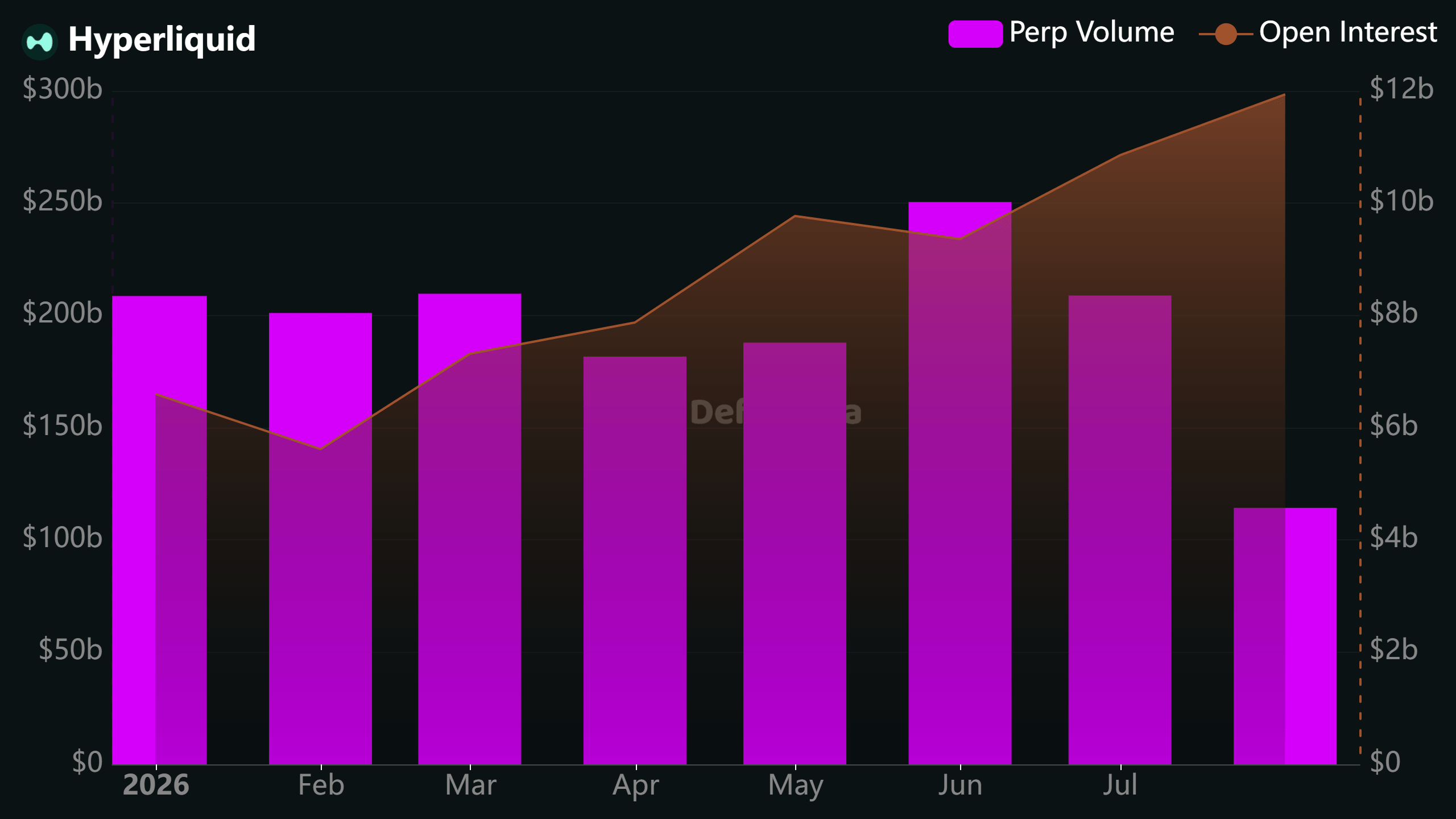
President Donald Trump said Aug. 19 that CFTC Chair Michael Selig is working to bring Hyperliquid to the US in a fully compliant, legal way.
Hyperliquid’s official interface currently keeps US persons off the platform, part of the regulatory geography that let crypto’s largest perpetual futures venue grow up outside American oversight.
Hyperliquid processed over $114 billion of perpetual futures trading volume in August and carries open interest above $10 billion. It has crossed $5 trillion in cumulative perpetual volume and generates close to $50 million in protocol fees every month.
HYPE rallied past $70 again for the first time since early July, up 20% since Trump’s remarks.
| Metric | Approximate figure | Why it matters |
|---|---|---|
| 30-day perpetual volume | ~$200B | Shows active trading scale |
| Open interest | $10B+ | Shows the size of live leveraged exposure |
| Cumulative perpetual volume | $5T+ | Shows long-term market relevance |
| Monthly protocol fees | ~$50M | Shows the economic value of U.S. access |
| HYPE move after Trump remarks | +20% | Shows the market interpreted the comment as material |
Selig’s own remarks are the real policy hook
Speaking to the agency’s Innovation Advisory Committee on Aug. 20, Selig said that if the CLARITY Act stalls in Congress, the CFTC will use its existing authority to start building a crypto market regime on its own.
He said he had directed staff to explore rules that could designate both current registrants and non-registrant crypto exchanges as a type of designated contract market called a crypto asset market.
That designation would allow leveraged or margined crypto trading under rules built specifically for that purpose. He added that staff would engage directly with developers of on-chain finance protocols to find legal, compliant ways to offer those protocols inside the US.
That detail turns Trump’s comment from a presidential aside into policy substance. A crypto asset market designation, if it becomes real, would create another category that on-chain and offshore venues could try to enter.
Regulators already solved a narrower version of this problem in May, when the CFTC approved KalshiEX’s BTCPERP contract, a genuine perpetual contract tied to spot Bitcoin and listed on a registered US exchange.
Selig said at the time that the absence of a workable US pathway had pushed perpetual trading offshore for years, fragmenting liquidity and putting US firms at a disadvantage.
Hyperliquid tests whether the venue itself, an on-chain, wallet-native market built entirely outside the conventional US brokerage stack, can become compliant without losing the architecture that made it successful.
What a compliant version of Hyperliquid would require
CFTC rules were written around centralized intermediaries: registered exchanges, clearinghouses, futures commission merchants and brokers with clear obligations attached to each role.
Hyperliquid does not map cleanly onto any of those categories, and Selig has acknowledged as much, saying the agency’s existing framework needs rethinking for wallets, decentralized protocols and other on-chain systems.
A workable path would have to resolve several things at once, such as who counts as the regulated operator when a protocol runs on-chain but a front end sits somewhere identifiable, and where identity verification happens, at the interface, the broker layer, or somewhere else entirely.
Selig’s language framed the outreach to on-chain developers as separate from the exchange designation question.
| Question | Why it matters | Possible compliance layer |
|---|---|---|
| Who is the regulated operator? | CFTC obligations need an accountable party | U.S. entity, affiliated market operator, or registered front end |
| Where does KYC happen? | U.S. access requires identity and jurisdiction controls | Interface, broker layer, wallet-gating, or account system |
| Who monitors trading? | Leveraged markets require surveillance for manipulation and abuse | Registered market operator or compliance partner |
| How is leverage controlled? | Perpetuals create liquidation and customer-protection risks | Product limits, margin rules, risk engine oversight |
| Who safeguards collateral? | Customer assets and stablecoin margin need clear treatment | Clearing structure, custodian, FCM, or segregated account model |
| Which parts remain permissionless? | The U.S. path must decide what can stay on-chain | Protocol layer versus regulated access layer |
A reusable template for the whole industry
If regulators build a working crypto asset market category, the significance extends well past Hyperliquid gaining US access. Other offshore and on-chain perpetual venues would finally have a concrete checklist after years of regulatory guesswork.
Competition among them will become a question of who can satisfy the new US framework without abandoning the model that built their liquidity in the first place.
The SEC’s Aug. 18 Regulation Crypto Assets proposal and the March SEC-CFTC harmonization framework both point toward keeping crypto activity inside US oversight. Hyperliquid is now the concrete market both agencies’ efforts would have to work against.
A public registration application, a confirmed legal entity to operate a US business, a disclosed list of required protocol changes, a published KYC architecture, and a confirmed list of tradable products all remain outstanding.
Trump said regulators are working toward a compliant path, stopping short of announcing an approval.
Whether the Hyperliquid template becomes real
The bull case is that the CFTC formalizes its crypto asset market category for both registrants and non-registrant crypto exchanges. Hyperliquid becomes the first major test case, and rival venues gain a genuine checklist to follow.
Offshore and on-chain perpetual markets are starting to compete for US liquidity under federal oversight.
The bear case has regulators concluding that meaningful US access still requires routing activity through a conventional designated contract market, clearing, and brokerage stack.
| Scenario | What regulators build | What happens to Hyperliquid | What it means for the industry |
|---|---|---|---|
| Bull case | A purpose-built crypto asset market category | Hyperliquid enters through a clear U.S. pathway while preserving much of its on-chain model | Rival offshore/on-chain venues get a reusable compliance template |
| Base case | A limited pathway with strict front-end controls | Hyperliquid can serve some U.S. users, but through a gated or modified structure | U.S. access expands, but only gradually and with product limits |
| Bear case | Existing DCM, clearing, and brokerage rules remain dominant | Hyperliquid must centralize, partner, or restrict U.S. access heavily | On-chain perps come onshore, but mostly through conventional intermediaries |
| Failure case | No workable category emerges | Hyperliquid remains geofenced from official U.S. access | Offshore liquidity remains outside U.S. oversight |
Hyperliquid would need to centralize key functions, limit which products US customers can access, or partner with an existing US intermediary. Its eventual US presence would look much more like Coinbase or CME than the platform that built its current volume.
Trump gave regulators a name, and Selig gave them a possible structure. What still has to happen is the hardest part: building a category that can hold a $200 billion-a-month on-chain market without turning it into something it was never designed to be.
 Bitcoin
  Ethereum
  Tether
  BNB
BNB  XRP
XRP  USDC
USDC  Solana
  TRON
TRON  Figure Heloc
  Zcash
Zcash 