


South Korea is nearing an Aug. 11 deadline for public comments on proposed crypto seizure rules that could give exchanges just seven days to disclose customer holdings once served with a court order.
The Supreme Court’s proposed amendments to the Civil Execution Rules would create a standardized process for creditors to freeze, identify and liquidate virtual assets held by debtors. If finalized on the current timetable, the rules are expected to take effect Oct. 1.
That would leave exchanges and other virtual asset service providers roughly seven weeks after the consultation closes to prepare for a more formal role in civil debt enforcement.
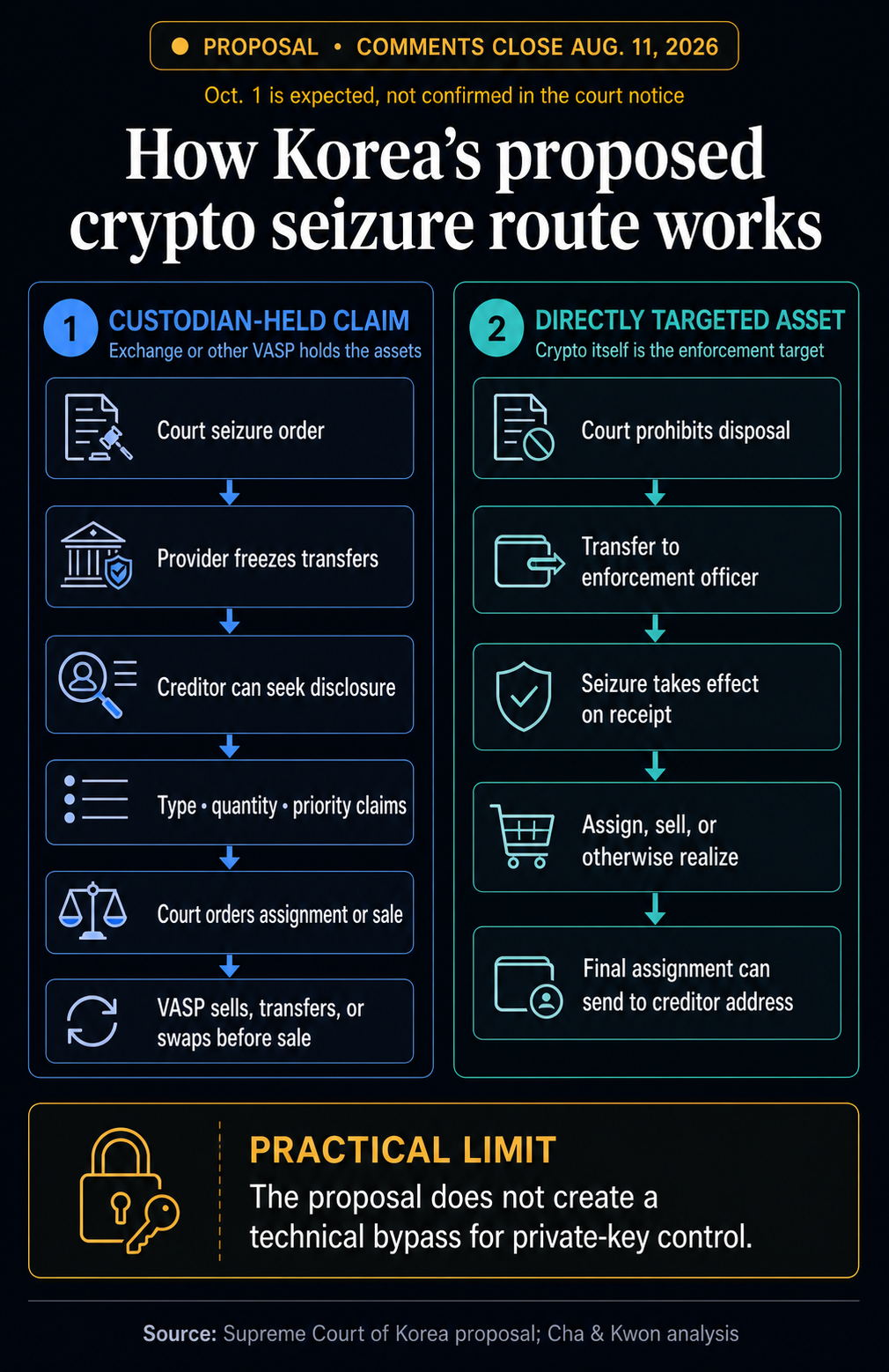
For crypto held through a custodian, a court could attach the debtor’s right to receive the assets rather than initially seizing the coins themselves. Once served, the provider would be barred from transferring the corresponding assets to the debtor, who would also lose the ability to dispose of the claim.
Creditors could then ask the court to require the provider to disclose what it holds. The exchange would have one week to state whether it recognizes the debtor’s claim, identify the type and quantity of assets, and disclose competing seizures, provisional orders, or priority rights.
The framework could have broad reach in one of the world’s most retail-heavy crypto markets. As of February 2025, 16.29 million people held accounts across South Korea’s five largest exchanges, equivalent to nearly 32% of the population. The figure exceeded the roughly 14.2 million people who held domestic listed stocks at the end of 2024.
Once assets are identified and frozen, courts could assign them to creditors or order their liquidation. A virtual asset service provider could execute the sale, while crypto could also be transferred to an enforcement officer’s account or converted into more liquid assets before disposal.
However, the process becomes harder when a debtor controls the crypto directly.
A court could prohibit disposal and order a transfer to an enforcement officer, but seizure would take effect only when the officer actually receives the assets, leaving private-key control as a practical constraint.
The proposal also fits into South Korea’s broader effort to build formal rules around a crypto market that has moved deep into the financial mainstream.

Authorities have already introduced statutory protections for virtual asset users and are tightening exchange registration and anti-money laundering requirements, including planned expansion of the travel rule and additional controls around personal wallets and stablecoins.
The seizure rules would extend that regulatory build-out into civil debt collection. They would also apply to proceedings already underway when they take effect, making the period between the Aug. 11 consultation deadline and the proposed Oct. 1 rollout particularly relevant for exchanges preparing to handle court orders.
 Bitcoin
  Ethereum
  Tether
  BNB
BNB  XRP
XRP  USDC
USDC  Solana
  TRON
TRON  Zcash
Zcash  Figure Heloc