


Strategy’s new Bitcoin Banking Adoption Index gives 25 major banks and financial institutions an overall 32% score based on activity across custody, trading, investment products, lending, and leadership support.
The figure is a depth score, measuring how far banks have built out Bitcoin-related services across the institutions Strategy tracked.
Bitwise’s Q3 2026 Crypto Market Review estimates that individuals hold 66.1% of Bitcoin’s 21-million maximum supply, equivalent to about 13.9 million BTC, dwarfing the 7.8% held by businesses and the 7.2% held by funds and ETFs.
Combine those last two categories and businesses plus funds and ETFs still control only about 15% of the supply, worth roughly 3.15 million BTC, a fraction that leaves individuals holding close to 4.4 times more Bitcoin than both groups put together.
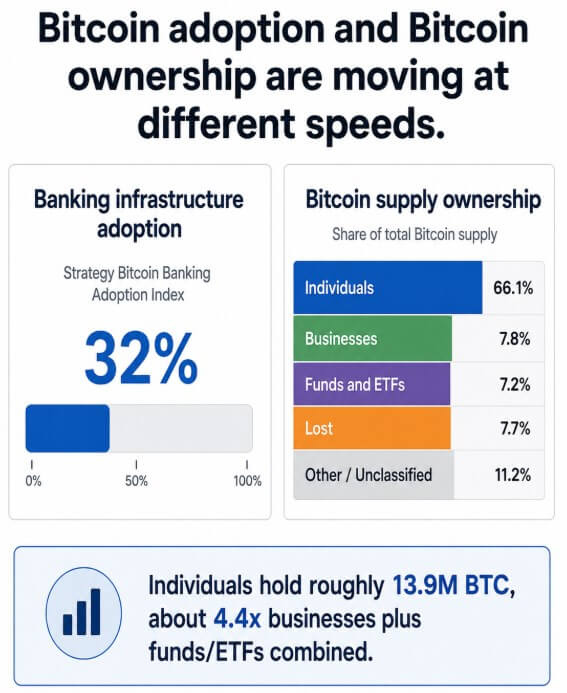
Individuals built the ownership base first
Strategy’s index tracks how far banks have built the plumbing around Bitcoin, scoring institutions across custody systems, trading desks that execute orders, investment products, lending programs, and public statements that signal institutional comfort with the asset.
A bank scoring well on that index has built the infrastructure to custody, trade, lend against, and package Bitcoin for its own clients. Ownership of the coins themselves sits outside what the score attempts to measure.
This is where the power of retail shows up in the numbers, the reason banks are building at all.
Banks are responding to a mix of customer demand, ETF growth, corporate treasury activity, regulatory changes, and competition from crypto-native firms.
Customers already own and use Bitcoin at a scale banks cannot ignore, and the 32% score reflects banks responding to demand that individuals created years before any bank built a custody desk for it.
The large ownership base gives banks an existing pool of holders to compete for rather than having to create a market from scratch.
That gives the coming contest a different shape than most institutional-adoption stories. Banks compete first against exchanges, specialist custodians, and self-custody tools for the accounts individuals already use, well before they compete for coins individuals might sell.
Ownership and control are splitting apart
A bank can custody a customer’s Bitcoin, execute trades, administer collateral, and charge for those services while the customer may remain the beneficial owner. The customer’s exact rights depend on the custody, brokerage, or lending agreement, including whether the assets can be transferred or rehypothecated.
That separates control of the customer interface from legal ownership of the asset. Banks could gain more influence over access, reporting, and collateral terms as more holders use intermediary accounts, but the index does not establish that banks already hold an advantage over exchanges or self-custody providers.
To illustrate the scale, if 10% of the 13.9 million BTC attributed to individuals moved into bank-controlled custody or brokerage accounts, roughly 1.39 million BTC would sit on bank-run infrastructure. The remaining 90% would stay outside those accounts, whether in self-custody or with other intermediaries.
At 25%, about 3.47 million BTC would sit on bank-controlled rails. At 50%, the figure would approach 6.94 million BTC. In each scenario, customers’ ownership and withdrawal rights would depend on the custody, brokerage, or lending agreement.
| Example share of individually held BTC moving into bank-controlled rails | BTC affected | What banks gain | What individuals retain |
|---|---|---|---|
| 10% | ~1.39M BTC | Custody fees, trade execution, reporting visibility, account relationship | Beneficial ownership of most coins |
| 25% | ~3.47M BTC | Major foothold in Bitcoin custody, brokerage, and lending infrastructure | Ownership, but less direct control if held through intermediaries |
| 50% | ~6.94M BTC | A central role in Bitcoin custody and customer access, with potential influence over collateral markets | Beneficial ownership subject to custody terms, while account access and execution shift to banks |
What happens from here
The SEC’s SAB 122 rescinded SAB 121, which had directed entities safeguarding crypto assets for platform users to recognize a liability and corresponding asset on their balance sheets. The change removed an accounting treatment that industry participants had cited as an obstacle to offering crypto custody at scale.
The Federal Reserve withdrew its requirement that state member banks give advance notice before starting crypto-asset activities, folding that oversight into ordinary supervision.
The OCC has said national banks can buy and sell crypto assets held in custody at a customer’s direction as part of permissible custody services. The Basel Committee’s disclosure framework for bank cryptoasset exposures became effective within the Basel Framework on Jan. 1, 2026, calling for qualitative and quantitative disclosures by internationally active banks in member jurisdictions that implement the standard.
In one possible path, Bitcoin-backed lending could become a more common wealth-management product, allowing banks to earn fees from collateralized loans without owning the underlying Bitcoin.
Holders could borrow against Bitcoin while retaining price exposure, while crypto-native lenders could face margin pressure if banks offer lower rates or broader account integration.
In the resistance path, custody outages, withdrawal limits, fees, or counterparty risks keep individually held Bitcoin in self-custody and on crypto-native platforms.
Banks still capture ETF flows and the clients who want a regulated wrapper. Direct custody of individually held coins stays out of reach, and exchanges built for Bitcoin from the start keep the relationships banks are chasing.
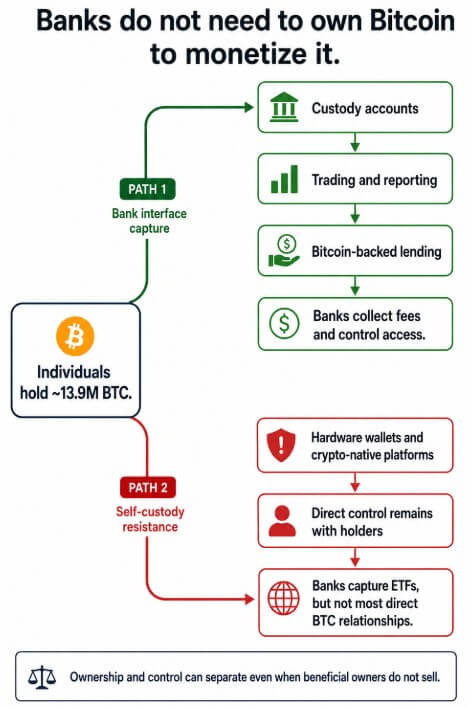
Bitcoin’s institutional phase is running in an order that few financial products follow. Individuals built the ownership base first, years before banks built the custody, lending, and wealth-management systems now competing for a piece of it.
Whatever share of that 13.9 million BTC eventually moves into bank-controlled accounts, the coins already belong to the people banks are trying to reach, and that ownership arrived long before the invitation did.
 Bitcoin
  Ethereum
  Tether
  BNB
BNB  XRP
XRP  USDC
USDC  Solana
  TRON
TRON  Figure Heloc
  Zcash
Zcash 