


Ripple Chief Legal Officer Stuart Alderoty said crypto is moving deeper into mainstream American finance, citing a new National Cryptocurrency Association report that found 67 million Americans now own or use digital assets.
Speaking with NYSE on May 28, Alderoty, who also serves as president of the National Cryptocurrency Association, framed crypto adoption as increasingly less about a separate financial system and more about the gradual integration of digital assets into everyday payments, investing, custody and treasury infrastructure.
Alderoty said Ripple’s role in that shift is tied to its enterprise focus. He described the company as a provider of crypto infrastructure for large and medium-sized businesses looking to add payments, custody, tokenization, liquidity or treasury management capabilities. Ripple, he said, has become “a one-stop shop” for enterprises adopting crypto into their platforms.
Ripple CLO Says Crypto Has Hit Mainstream America
The broader argument, however, centered on the NCA’s latest State of Crypto Holder Report. Alderoty said the association partnered with Harris Poll for the second year in a row and surveyed 40,000 Americans, a sample size he called “enormous” for this type of research.
“We found that 67 million Americans today own or use crypto,” Alderoty said. “So, crypto is no longer a niche product. I think it is creeping more into the mainstream.”
The report also found that 12 million more Americans entered the crypto economy over the past year, based on the comparison between the 2025 and 2026 State of Crypto Holder reports. Alderoty said that growth is not concentrated in the industry’s older stereotypes of Silicon Valley engineers, financial technologists or “crypto bro” early adopters.
Instead, he pointed to a broader demographic spread. “That growth is coming from women,” Alderoty said. “It’s coming from construction workers. It’s coming from manufacturing employees.”
For the Ripple CLO, that matters because it suggests crypto adoption is becoming less geographically and culturally concentrated. He said the NCA’s website includes an interactive map showing where crypto holders live across the United States, including state-level and congressional district-level data. The takeaway, he argued, is that crypto holders are distributed across the country rather than clustered in a few technology or finance hubs.
Alderoty also tied the adoption trend to the increasing overlap between traditional finance and crypto. He said users are no longer being forced into a binary choice between digital assets and legacy financial services. Instead, he argued, the two are beginning to merge inside familiar financial apps and consumer interfaces.
“It’s not an either or,” the Ripple CLO said. “It’s not where you either use crypto or use traditional financial services. I think we are now in a world where we’re using both, and both are becoming interchangeable and interoperable.”
That interoperability, in his view, will define the next phase of adoption. Alderoty compared the process to the smartphone transition, arguing there was no single moment when consumers collectively abandoned flip phones. The change happened incrementally because the technology became useful enough to fade into daily life.
He said crypto may follow a similar path as traditional finance platforms make digital assets available through products that consumers already use. In that model, crypto does not need to announce itself at the point of sale. It becomes one more funding source inside a broader financial stack.
“I’m going to be able to show up at the Walmart checkout registry and use my OnePay app,” Alderoty said. “And I can set that OnePay app to say, ‘Do I want to pay in cash? Do I want to pay using my debit card? Do I want to pay using my credit card? Or do I want to pay using my crypto wallet?’ And that transaction will be sort of all happening behind the scenes.”
The Ripple CLO added that consumers would not need to make “some big announcement” that they are paying with crypto. Instead, he said, it could become as seamless as tapping with Apple Pay.
The NCA report also broke down adoption by age. Alderoty said 18% of new holders are between 18 and 24, while 28% of holders are older than 55. That split gives the report a wider generational signal: younger users are entering a financial world where crypto already exists as part of the product suite, while older users are also adopting the technology rather than sitting outside the market.
Alderoty said the industry remains young at roughly 15 years old, but argued that Gen Z, millennials and Gen X users will increasingly treat crypto as a normal part of finance.
“They’re never going to grow up in a world where crypto was not part of the financial suite of products that they can use,” he said.
At press time, XRP traded at $1.32.
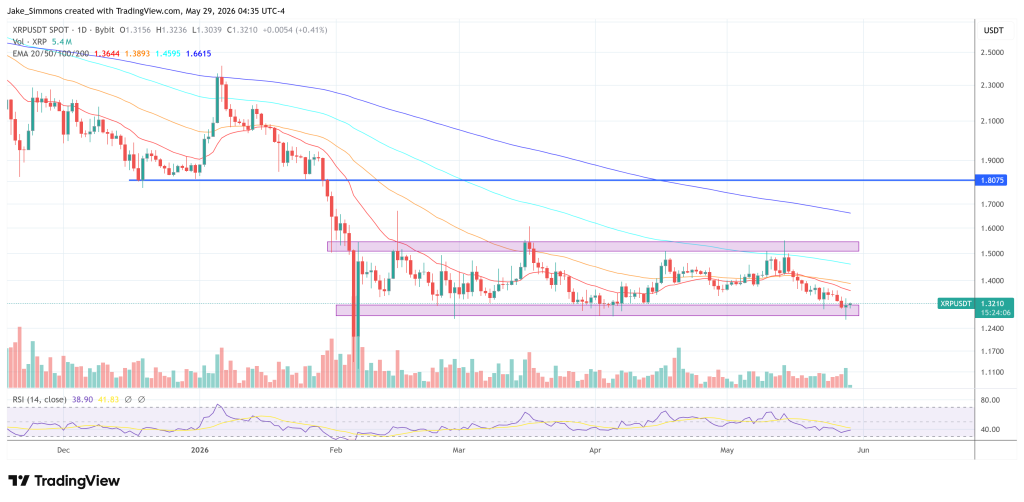
Featured image created with DALL.E, chart from TradingView.com

Editorial Process for bitcoinist is centered on delivering thoroughly researched, accurate, and unbiased content. We uphold strict sourcing standards, and each page undergoes diligent review by our team of top technology experts and seasoned editors. This process ensures the integrity, relevance, and value of our content for our readers.
 Bitcoin
  Ethereum
  Tether
  BNB
BNB  XRP
XRP  USDC
USDC  Solana
  TRON
TRON  Figure Heloc
  Zcash
Zcash 