



The tariff refund trade has moved from court hypothesis to Treasury accounting, and the macro picture looks more consequential than traders initially framed it, with traders increasingly watching whether the process can improve Bitcoin price’s macro outlook.
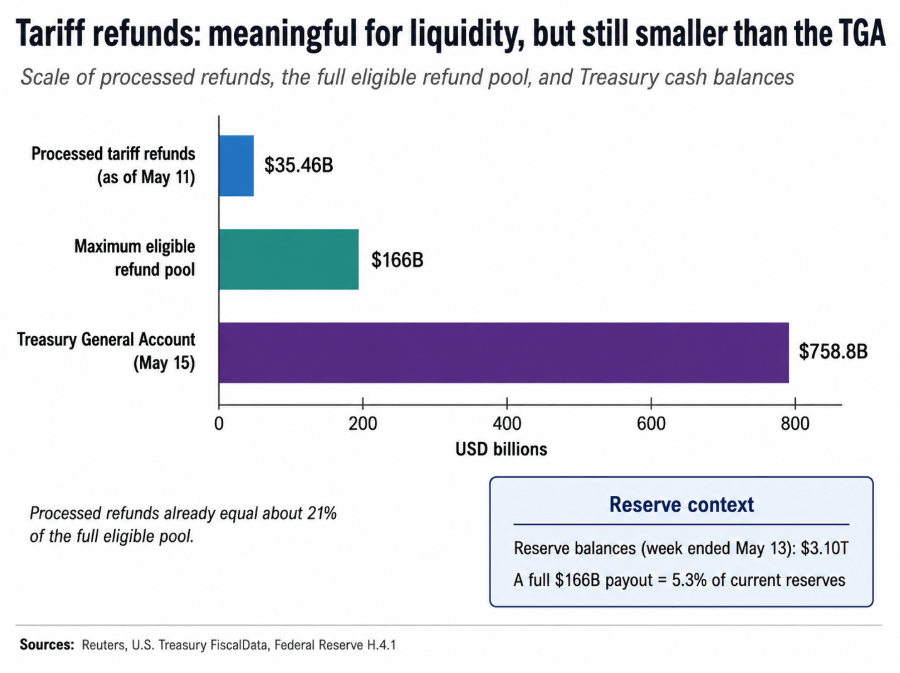
The US Customs and Border Protection had processed $35.46 billion in tariff refunds as of May 11, including interest, validating 86,874 applications covering 15.1 million entries and finalizing 8.3 million shipments.
Up to $166 billion in IEEPA tariff collections qualify for repayment, money owed to more than 330,000 importers across roughly 53 million entries, with a Supreme Court ruling having stripped the President Donald Trump administration’s authority to impose them.
The processed pool already represents about 21% of the potential maximum, and the rest of the eligible volume is large enough to move both reserves and pricing behavior if payments proceed quickly.
Most Bitcoin framing around the refund pool follows a channel in which money leaves the Treasury General Account, bank reserves rise, and risk assets catch a bid.
Fed Governor Christopher Waller’s balance sheet explanation confirms the accounting, noting that when the Treasury makes a payment, the Fed debits the TGA and credits the recipient bank’s reserve account, so refund disbursements paid from existing cash balances push reserves higher without any new issuance.
The TGA held $758.8 billion on May 15, against reserve balances of approximately $3.10 trillion for the week ended May 13. A full $166 billion payout would equal roughly 5.3% of current reserves.
That liquidity shift matters because Bitcoin liquidity conditions remain tightly linked to reserve balances and Treasury cash movements.
BofA’s public tariff commentary says the effective US tariff rate peaked at 11.3% in October 2025, fell to 8.7% in March 2026, and the bank expects it to settle between 6% and 8% by year-end.
The bank reads the lower tariff path as a supply-chain event, in which firms may delay future price increases, and the pricing benefit flows to corporate margins rather than to consumer rebates.
Government refunds flow directly to importers, and the disinflationary channel runs through importers, supply chains, and future CPI prints.
Why both channels need to work for Bitcoin price
Persistent inflation pressure and elevated Fed rates continue to shape the broader outlook for Bitcoin’s price rally.
April CPI rose 3.8% year over year, and core CPI rose 2.8%, while energy prices climbed 17.9% and gasoline 28.4%. March PCE rose 3.5% year over year against a core reading of 3.2%.
The Dallas Fed estimated that tariff collections added approximately 0.8 percentage points to 12-month core PCE inflation through March 2026, and that core inflation excluding tariff-related effects would have been 2.3 percentage points.
The EIA expects Brent crude to hold around $106 per barrel in May and June on Strait of Hormuz disruption risk, with global oil inventories set to fall by an average of 8.5 million barrels per day in the second quarter.
| Indicator | Latest reading | Article relevance |
|---|---|---|
| CPI YoY | 3.8% | Inflation still elevated |
| Core CPI YoY | 2.8% | Underlying inflation remains above target |
| Energy prices | +17.9% | Importers still face cost pressure |
| Gasoline | +28.4% | Keeps inflation expectations sensitive |
| Core PCE YoY | 3.2% | Fed’s preferred inflation gauge remains hot |
| Tariff contribution to core PCE | +0.8 pp | Shows why refunds can matter at the margin |
| Brent crude forecast | ~$106/bbl | Energy may offset tariff relief |
| Drewry container index | $2,553 / 40-ft container | Freight costs absorb refund benefits |
Drewry’s World Container Index surged 12% to $2,553 per 40-foot container in the week of May 14, driven by higher transpacific and Asia-Europe rates. In that environment, refund cash flows toward energy and freight absorption first.
Bitcoin price was trading near $77,507, below its 200-day moving average of around $82,000, with CoinShares recording $982 million in Bitcoin product outflows during the week of May 18.
The Federal Reserve held rates at 3.50%-3.75% in April, with inflation still elevated, and markets were pricing in extended holds or possible hikes.
A modest disinflation signal could ease the yield constraint at the margin, and the reserve boost from TGA outflows would need that yield backdrop to cooperate, allowing liquidity to flow into risk assets rather than into bond supply.

When both channels fire
If $125 billion to $166 billion in refunds processes quickly and primarily from existing TGA balances, the reserve injection reaches 3% to 5% of current balances, enough to shift reserve optics without requiring new issuance.
At the same time, if importers deploy refunds to absorb higher freight and energy costs and keep price-hike schedules off the calendar, the Dallas Fed’s 0.8% tariff contribution to core PCE begins to unwind at the margin.
Even a partial reversal of that contribution, such as the realistic base case of core PCE relief sitting around 5-15 basis points, given that BofA still sees services and energy driving the bulk of inflation, would be enough to ease the yield path that has capped Bitcoin’s recovery.
In that scenario, Bitcoin price reclaiming the 200-day moving average near $82,000 becomes a macro-driven trade, one where reserve dynamics and inflation data drive the setup.
The refund pool delivers the Bitcoin argument through two simultaneous conditions: TGA balances falling faster than Treasury rebuilds them through bill issuance, and importers gaining enough margin breathing room to defer scheduled price hikes.
Both outcomes feed into the same Bitcoin price argument of lower yields, stronger Treasury liquidity, and improving risk appetite across risk assets.
In the bear case, refund processing could be slow, legally contested, or unevenly distributed across importers. Firms with the largest refund claims may direct cash toward balance-sheet repair rather than pricing decisions.
If Treasury simultaneously replenishes the TGA through bill issuance, reserve balances stay flat, and the liquidity channel closes. Energy and services inflation can dominate any relief in goods prices and keep core PCE well above the Fed’s 2% target through year-end.
In that scenario, Bitcoin stays a yield-sensitive risk asset, the yield constraint from elevated rates holding firm. BofA’s 3.1% year-end core PCE forecast already prices in some tariff reversal, so even a fully processed $166 billion refund pool may land as expected.
| Scenario | Refund path | Inflation channel | Liquidity channel | Bitcoin implication |
|---|---|---|---|---|
| Bull case | $125B–$166B processed quickly | Importers delay price hikes; core PCE relief becomes visible | TGA falls, reserves rise 3%–5% | BTC gets a stronger macro tailwind; $82K 200-day average becomes key |
| Base case | $50B–$100B processed over months | 5–15 bps of core PCE relief | Partial reserve lift, partly offset by issuance | Modest support, but BTC still needs yields to stabilize |
| Bear case | Slow, contested, or uneven refunds | Firms keep cash as margin repair; services and energy dominate | Treasury rebuilds TGA through bill issuance | BTC remains yield-sensitive and vulnerable near $75K–$78K |
Markets pricing extended holds or hikes keep financial conditions tighter than the reserve number alone would imply. Bitcoin outflows continue while BTC price holds or loses the $75,000-$78,000 support zone.
The refund pool is large enough to matter, but it gives Bitcoin price a macro tailwind only when reserves rise faster than Treasury replaces them. Importer margin relief slows future price hikes enough to give the Fed room to signal an extended pause.
Tracking CBP’s weekly processing totals alongside the TGA balance and core goods inflation prints offers the cleanest real-time read on whether the two-channel thesis is playing out or stalling at the margin.

 Bitcoin
  Ethereum
  Tether
  BNB
BNB  USDC
USDC  XRP
XRP  Solana
  TRON
TRON  Figure Heloc
  Hyperliquid