



A hotter-than-expected April inflation report has put Bitcoin back at the center of the Federal Reserve trade, reviving the higher-for-longer rates problem that has capped crypto markets for much of the year.
The Bureau of Labor Statistics (BLS) reported on May 12 that headline CPI rose 3.8% year over year in April, above the 3.7% consensus estimate and the highest annual reading since January 2024.
Core CPI, which strips out food and energy, rose 2.8% year over year and 0.4% month over month. Bond markets moved on the news, with the 2-year Treasury yield climbing 3 basis points to 3.98%, the 10-year increasing 4 basis points to 4.45%, the dollar index gaining 0.3% to 98.29, and major US equity indexes fell at the open.
These reactions are a common near-term bearish setup for Bitcoin, as higher yields make Treasuries more competitive and compress tolerance for risk assets. A firmer dollar also tightens dollar-denominated liquidity globally, and a delayed rate-cut calendar removes one of the clearest catalysts for crypto outperformance.
The Federal Reserve left rates at 3.50%-3.75% on Apr. 29. Bank of America and Goldman Sachs each pushed their first-cut forecasts further out this week, with traders now pricing the current rate range through year-end.
April’s CPI confirmed a trajectory markets had already started pricing in.
| Metric | April reading / move | Why it matters for Bitcoin |
|---|---|---|
| Headline CPI (y/y) | 3.8% | Hotter inflation raises the odds of higher-for-longer rates |
| Headline CPI vs. estimate | 3.8% vs. 3.7% est. | The upside surprise is what tightened the macro backdrop |
| Core CPI (y/y) | 2.8% | Sticky core inflation is harder for markets to dismiss |
| Core CPI (m/m) | 0.4% | Reinforces concern that underlying price pressure remains firm |
| 2-year Treasury yield | +3 bps to 3.98% | Higher short-end yields reduce odds of near-term Fed easing |
| 10-year Treasury yield | +4 bps to 4.45% | Higher long-end yields tighten financial conditions |
| Dollar index (DXY) | +0.3% to 98.29 | A firmer dollar tightens global dollar liquidity |
| Fed rate range | 3.50%–3.75% | No cut relief yet for liquidity-sensitive assets |
| Immediate market read-through | Fewer cuts, higher yields, stronger dollar | Near-term bearish setup for Bitcoin and other risk assets |
Energy led the headline
Energy rose 3.8% in April and accounted for more than 40% of the monthly all-items increase, with gasoline up 28.4% year over year. Shelter rose 0.6% for the month, rent and owners’ equivalent rent each gained 0.5%, and airline fares jumped 2.8%.
The BLS also flagged a one-time rent adjustment tied to the government shutdown, which temporarily inflated core inflation.
Taken together, the report carried enough breadth in shelter, rent, and airfares to deny markets a clean “transitory” read, which is why bond traders pushed yields higher.
If markets treat April as a temporary fuel pass-through, crypto-specific demand and policy catalysts have room to reassert themselves. If the stickiness in shelter, rent, and airfares reads as core reacceleration, the higher-for-longer trade gets another leg, and Bitcoin’s near-term liquidity setup tightens before it eases.
Fidelity has documented a strong historical relationship between Bitcoin and global M2 growth, and the asset has served as a hedge against monetary debasement over multi-year horizons.
BlackRock frames Bitcoin’s real-rate sensitivity similarly to gold, since when real yields are falling and dollar purchasing power eroding, the case for scarce, non-sovereign money attracts structural inflows.
Over a multi-year horizon, sticky inflation can build Bitcoin’s monetary narrative and support long-term accumulation. Over the next three sessions, Fed reaction, Treasury yields, and dollar strength tend to dominate.
Both arguments operate on different clocks, and traders betting on the inflation-hedge thesis today still have to survive the macro repricing that comes first.
What Bitcoin’s reaction to the print actually said
Bitcoin declined on May 12, briefly losing $80,000, but recovered and traded between $81,000 and $80,000.
Matt Mena, senior crypto research strategist at 21Shares, said that the market had positioned for a hot print, absorbed the data, and held above $80,000, the level that had served as support through April’s macro volatility.
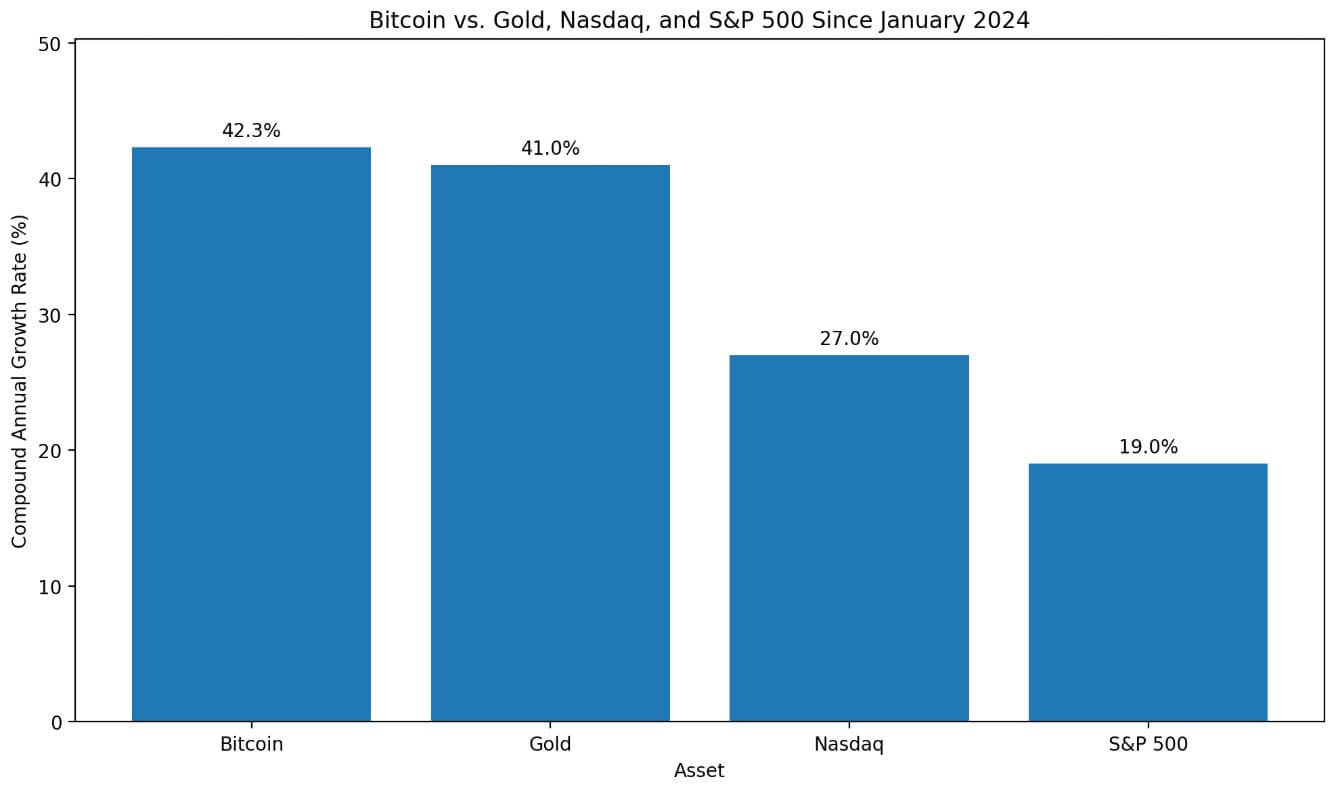
Mena also placed the print inside a longer-run performance frame, as 3.8% annual CPI is the highest reading since January 2024. Since then, Bitcoin’s compound annual growth rate has reached 42.3%, outpacing gold’s 41%, the Nasdaq’s 27%, and the S&P 500’s 19%.
That track record documents an asset that has compounded through periods of comparably adverse macro conditions and continued to appreciate, even as the near-term liquidity setup tightens.
Three concrete near-term catalysts could provide Bitcoin with a potential offset to macro drag.
The Senate Banking Committee has confirmed a markup hearing for the CLARITY Act on May 14 at 10:30 a.m. ET. Traders on Polymarket now price in roughly a 70% probability of approval, up from approximately 50% at the start of May.
A clean markup vote would represent the clearest legislative catalyst for the broader market in months.
White House crypto adviser Patrick Witt told attendees at Consensus Miami last week that a “big announcement” on the Strategic Bitcoin Reserve was coming “in the next few weeks,” citing a breakthrough in the legal framework that would allow the executive branch to act before Congress codifies new acquisition authority.
The US already holds an estimated 328,372 BTC from prior seizures, and any announcement involving new buying, or one that only reaffirms the existing reserve structure, will determine how much of a catalyst it proves to be.
Spot Bitcoin ETF inflows have run as a separate structural floor for six consecutive weeks, absorbing more than $3.5 billion in that stretch. Daily inflows peaked at $629.8 million on May 1 and $532.3 million on May 4, then turned negative on May 7 and May 8.
Net flows through May 11 stayed positive at approximately $1.29 billion, creating demand that compressed the downside even as prices stalled near resistance.
| Driver | Current status | Bullish implication for Bitcoin | Bearish risk | Timing |
|---|---|---|---|---|
| CLARITY Act markup | Senate Banking Committee markup scheduled | Legislative progress could improve market structure outlook and sentiment | Delay, weak vote, or messy process reduces policy tailwind | May 14, 10:30 a.m. ET |
| Strategic Bitcoin Reserve | White House adviser signaled a “big announcement”; U.S. holds 328,372 BTC | Any credible path to additional buying or stronger reserve framework could support BTC | A symbolic update with no new buying may disappoint | “Next few weeks” |
| Spot Bitcoin ETF flows | Six straight weeks of inflows; more than $3.5B absorbed | Structural demand can cushion downside even under macro pressure | More negative daily flows would weaken the support bid | Ongoing / daily |
| Peak recent ETF inflows | $629.8M on May 1; $532.3M on May 4 | Shows strong demand can still appear quickly | Peak days may prove temporary if momentum fades | Early May |
| Net ETF flows through May 11 | Approx. +$1.29B | Confirms net demand remained positive despite stalled price action | A reversal would strengthen the macro-bearish case | Through May 11 |
| Next macro test: PPI | April PPI ahead of catalyst window | In-line or cooler PPI could stabilize yields and help BTC hold support | Hot PPI could extend higher-for-longer and pressure BTC below support | May 13 |
The two-sided technical setup
Mena stated that a clean daily close above $82,000 opens the path to $85,000 and a retest of the $88,000-$90,000 zone, particularly if the CLARITY Act markup clears without a major setback and a Strategic Bitcoin Reserve announcement introduces credible acquisition optionality.
That bull case requires the macro data to stop deteriorating, so the PPI needs to come in at or below expectations on May 13, Treasury yields need to stabilize, and the dollar needs to stop firming.
If those conditions hold, the three crypto-specific catalysts could push Bitcoin past the resistance that has capped it since early April.
For the bear case, a hot April PPI print on May 13 is sufficient to extend the higher-for-longer trade, push yields higher, and test whether $80,000 support can hold against renewed macro selling. Below that, $75,000 comes back into play.
Bitcoin absorbing the CPI print without a breakdown gives the bull case its footing, with PPI arriving as the next test before any of the crypto-specific catalysts resolve.

 Bitcoin
  Ethereum
  Tether
  BNB
BNB  USDC
USDC  XRP
XRP  Solana
  TRON
TRON  Figure Heloc
  Hyperliquid