

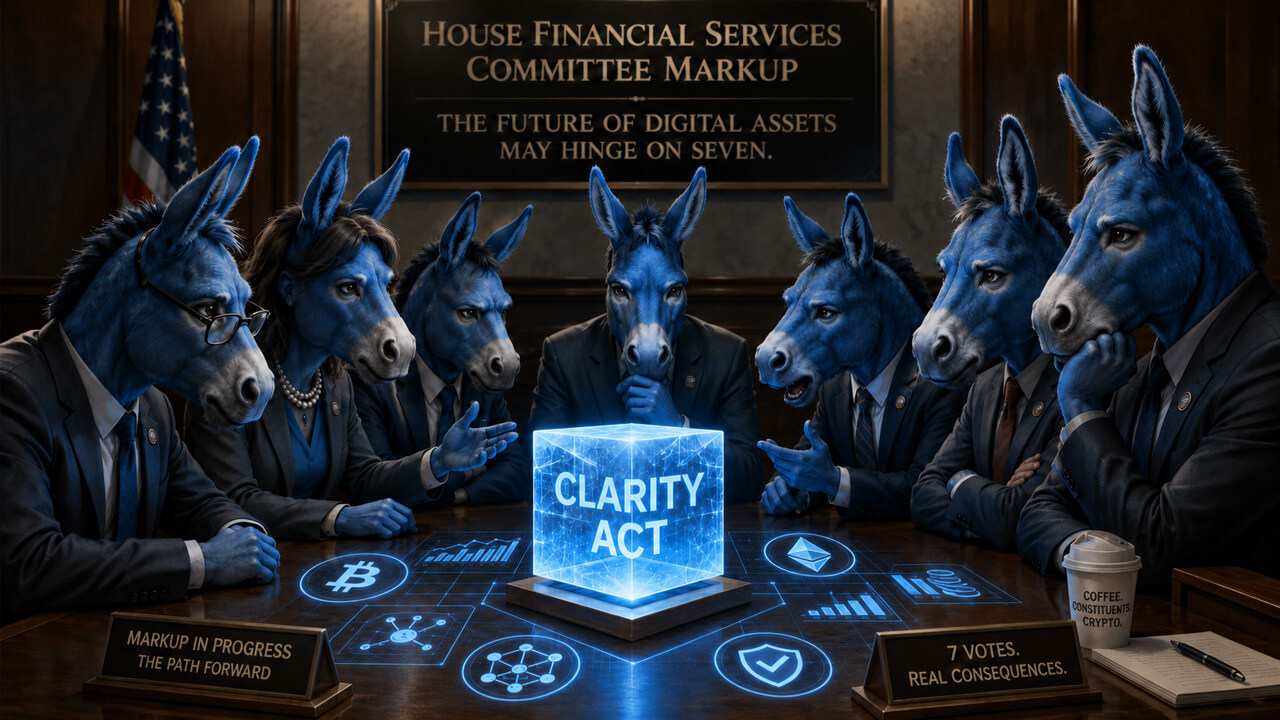


The CLARITY Act is heading back to the Senate Banking Committee on May 14 after months of stalled negotiations, putting a small group of Democrats at the center of the crypto industry’s push for a federal market-structure law.
The markup comes after the bill was slowed by disputes over stablecoin rewards, anti-money laundering safeguards and ethics provisions.
Those fights have turned a committee vote that Republicans may be able to win on numbers into a broader test of whether the measure can attract enough Democratic support to remain viable on the Senate floor.
Republicans hold 13 of the committee’s 24 seats, giving the bill a plausible path out of the panel if the party remains aligned.
However, the more important signal will come from Democrats. A vote that attracts several Democratic members would give the bill stronger footing for the Senate floor, where major legislation usually requires 60 votes.
On the other hand, a mostly party-line vote would leave the measure vulnerable to the same political resistance that has slowed crypto bills in previous sessions.
These Democrats could shape CLARITY Act’s path
Galaxy Research has identified seven Democratic members of Senate Banking as the key votes to watch, including Ruben Gallego of Arizona, Angela Alsobrooks of Maryland, Mark Warner of Virginia, Catherine Cortez Masto of Nevada, Andy Kim of New Jersey, Raphael Warnock of Georgia and Lisa Blunt Rochester of Delaware.
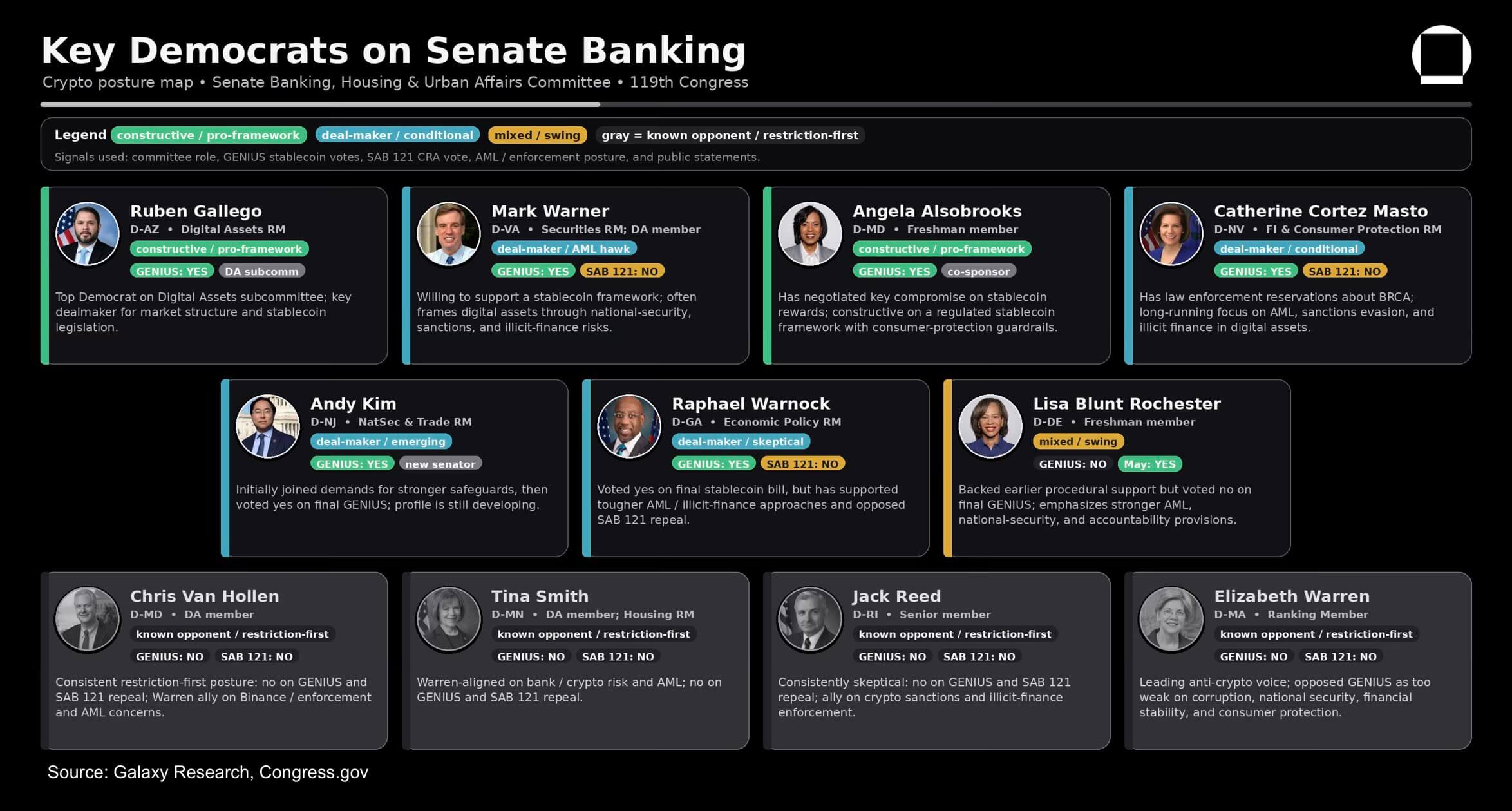
The firm’s posture map classifies Gallego and Alsobrooks as constructive or pro-framework, Warner, Cortez Masto, Kim and Warnock as conditional dealmakers, and Blunt Rochester as a swing vote.
Gallego has a central role as the top Democrat on the digital-assets subcommittee. His support would help give the bill a Democratic policy anchor rather than leaving it as a Republican-led effort.
Alsobrooks has also become important after helping negotiate compromise language around stablecoin rewards, one of the provisions that had slowed the bill’s progress.
The conditional bloc may carry more weight. Warner, Cortez Masto, Kim and Warnock have shown willingness to support crypto legislation, including the GENIUS Act, but their votes are tied to safeguards around illicit finance, sanctions evasion, national security and consumer protection.
Their posture gives the bill a possible route to bipartisan support, while also creating room for last-minute negotiations over enforcement language.
Blunt Rochester is harder to place. She supported earlier procedural movement on stablecoin legislation but opposed the final GENIUS Act, making her position dependent on the final CLARITY text and the strength of any added guardrails.
Meanwhile, four other Democrats on the committee are seen as unlikely supporters: Elizabeth Warren of Massachusetts, Jack Reed of Rhode Island, Tina Smith of Minnesota and Chris Van Hollen of Maryland.
These lawmakers have taken a more restrictive approach to crypto legislation and are expected to press the case that the bill remains too favorable to the industry.
Considering the above, CLARITY Act supporters need to keep Gallego and Alsobrooks aligned, win enough backing from the conditional Democrats and avoid a committee vote that casts doubt on the bill’s ability to build a workable Senate coalition.
What next after CLARITY Act markup?
If the CLARITY Act clears Senate Banking, the bill would still face a more difficult path through the full Senate, where supporters need a broader bipartisan coalition to overcome the 60-vote threshold that governs most major legislation.
The measure would also need to be aligned with other Senate work on digital assets and reconciled with the House version before it could reach the president’s desk. Notably, reports have revealed that the Trump administration is targeting July 4 for the passage of the CLARITY Act.
That process leaves little room for a narrow or heavily partisan committee vote, especially with lawmakers still divided over stablecoin rewards, illicit finance and ethics language.
For crypto firms, the markup is therefore only the first test in a longer campaign for a federal rulebook.
Asset manager Grayscale has argued that the legislation would support the next phase of digital-asset innovation and capital formation by replacing regulatory uncertainty with a clearer legal framework.
According to the firm:
“The CLARITY Act can catalyze the next phase of innovation and capital formation in digital assets by replacing uncertainty with structure, providing developers, business, and investors with a long-awaited asset and regulatory legal framework.”
 Bitcoin
  Ethereum
  Tether
  BNB
BNB 