



Bitcoin’s brief drop below $80,000 during the last 24 hours has exposed a more fragile market after weeks of gains, but options traders are not yet treating the pullback as the start of a deeper breakdown.
According to CryptoSlate data, the retreat erased part of a rally that had carried Bitcoin about 37% higher since early April, when traders began rebuilding exposure after a bruising first quarter. BTC has recovered to $80,360 as of press time.
Yet, a deep dive into options pricing, volatility metrics, and on-chain behavior reveals a market that is consolidating rather than capitulating.
Unlike the brutal drawdowns of the past, which were often catalyzed by macroeconomic headwinds, this week’s decline appears to be a mechanical byproduct of the cryptocurrency’s internal market structure.
With traditional equities like the S&P 500 and the Nasdaq Composite lingering near record highs, Bitcoin’s localized weakness points to a combination of exhaustion, profit-taking, and the unwinding of over-leveraged long positions.
How Bitcoin’s market structure drove the break below $80,000
Bitcoin’s brief fall below $80,000 was driven less by a shift in macro sentiment than by pressure inside the crypto market itself.
The first source of stress came from profit-taking. After rallying about 37% from its April lows, Bitcoin pushed a large group of recent buyers back into profit, giving traders who had spent months underwater a reason to reduce exposure.
CryptoQuant data show investors realized profits on 14,600 Bitcoin on May 4, the largest one-day profit-taking event since December 2025. The Short-Term Holder Spent Output Profit Ratio, which tracks whether recent buyers are selling coins at a profit or loss, rose to 1.016 and has remained above 1 since mid-April.
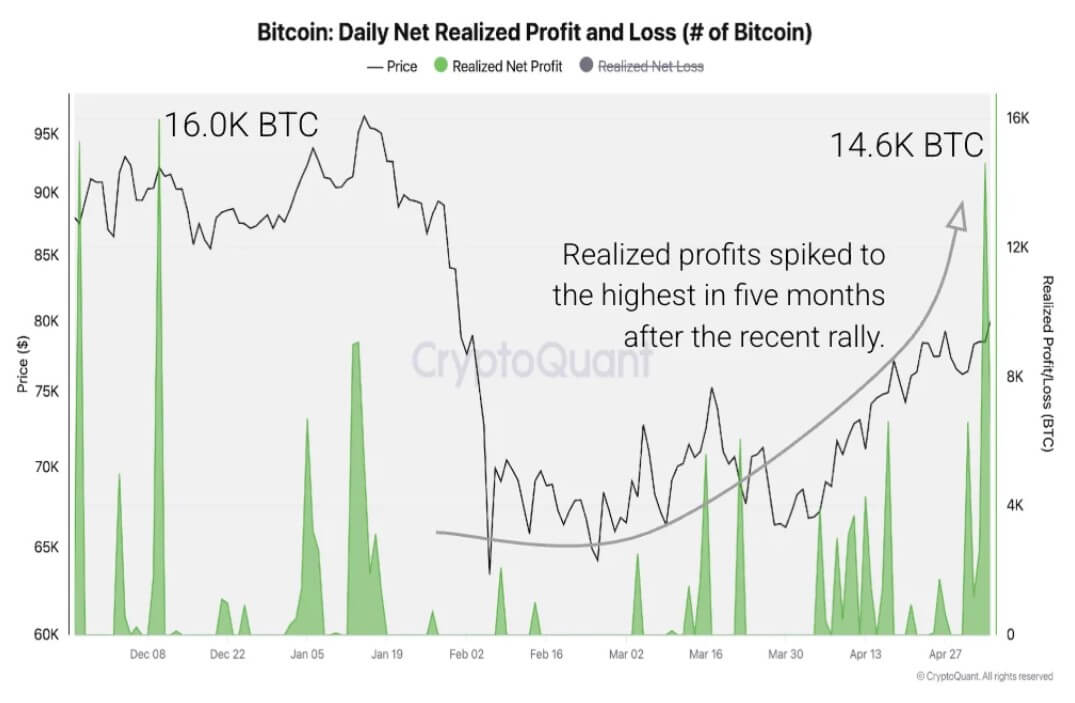
That shift is significant because it shows that newer holders are no longer selling due to distress. Instead, they were selling into the market strength.
The behavior reflects the damage left by the first-quarter drawdown.
During February and March, many short-term traders held unrealized losses of 20% to 30%. April’s rebound repaired much of that damage, creating a natural exit point for investors who had been waiting to get back to breakeven or lock in a modest gain.
Meanwhile, the same pattern is visible in unrealized profits. Bitcoin traders are now sitting on an aggregate profit margin of about 18%, the highest since June 2025.
CryptoQuant said similar levels have historically coincided with heavier distribution, as traders use relief rallies to take money off the table.
Still, the selling has not yet developed into broadholder distribution. Exchange inflows remain muted, suggesting large holders are not aggressively moving coins onto centralized platforms. That limits the bearish signal from the latest profit-taking and points instead to a market digesting gains after a sharp rebound.
At the same time, the second source of pressure came from the derivatives market as Bitcoin’s early-May rally was powered by a rapid return of leverage to perpetual futures markets.
CryptoQuant data show BTC’s open interest, or the total value of outstanding derivatives contracts, recorded its largest increase of 2026. The expansion was even larger than the build-up seen around Bitcoin’s 2025 all-time high.
Binance remained the center of that activity, accounting for roughly 34% of the market, with average monthly open interest reaching $2.5 billion. Gate.io and Bybit also saw elevated activity, reflecting a broader return of risk appetite across major trading venues.
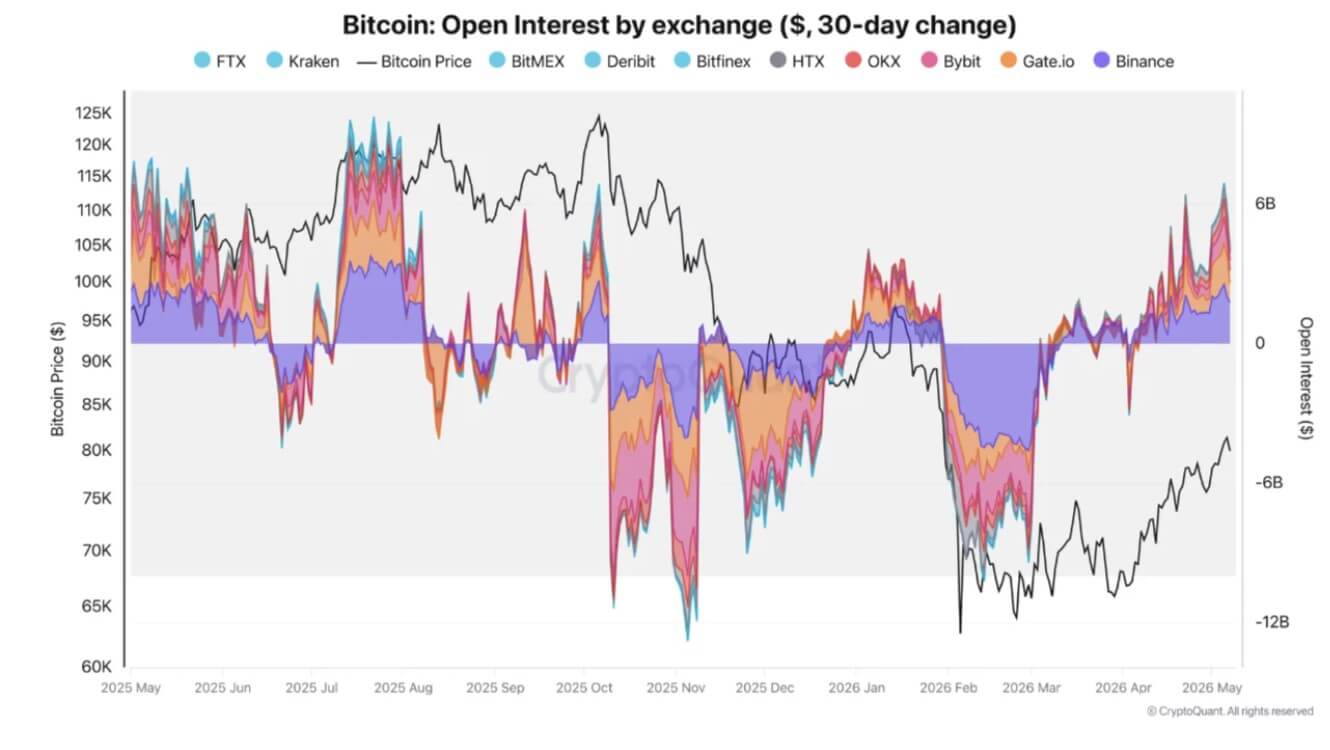
That leverage helped drive the rally, but it also made the move more fragile.
CryptoQuant analyst IT Tech noted that BTC funding rates fell to -0.031% per hour between May 2 and 4, their lowest level since the post-COVID market stress in 2020. The deeply negative funding showed that traders had crowded into short positions just as liquidity was building above the market.
When Bitcoin broke through $78,600, those shorts were forced to unwind. From May 4 to May 6, about $535 million in short positions were liquidated, accelerating the move toward the $82,000 to $83,000 range.
Open interest surged from $26.5 billion to $29.1 billion during the squeeze, showing how much of the advance was driven by derivatives positioning rather than steady spot demand.
The move below $80,000 was the other side of that process.
As the squeeze faded, open interest cooled back to about $26.7 billion. That decline washed out part of the speculative buildup that had carried Bitcoin higher and reduced some of the immediate leverage risk.
Options traders shrug off the pullback
While spot markets digest the selling pressure, the options market was telling a decidedly more optimistic story. Volatility, which had been compressed to its lowest levels since October 2025, is violently repricing higher.
According to Glassnode data, this volatility surge is entirely driven by the front end of the curve. One-week implied volatility has jumped significantly from recent lows, indicating a renewed appetite for short-term optionality.
At the same time, the 25-delta skew, a metric that measures the cost difference between bullish call options and bearish put options, is aggressively normalizing. After briefly flashing a 5% premium for puts, the front-end skew is compressing back toward neutral.
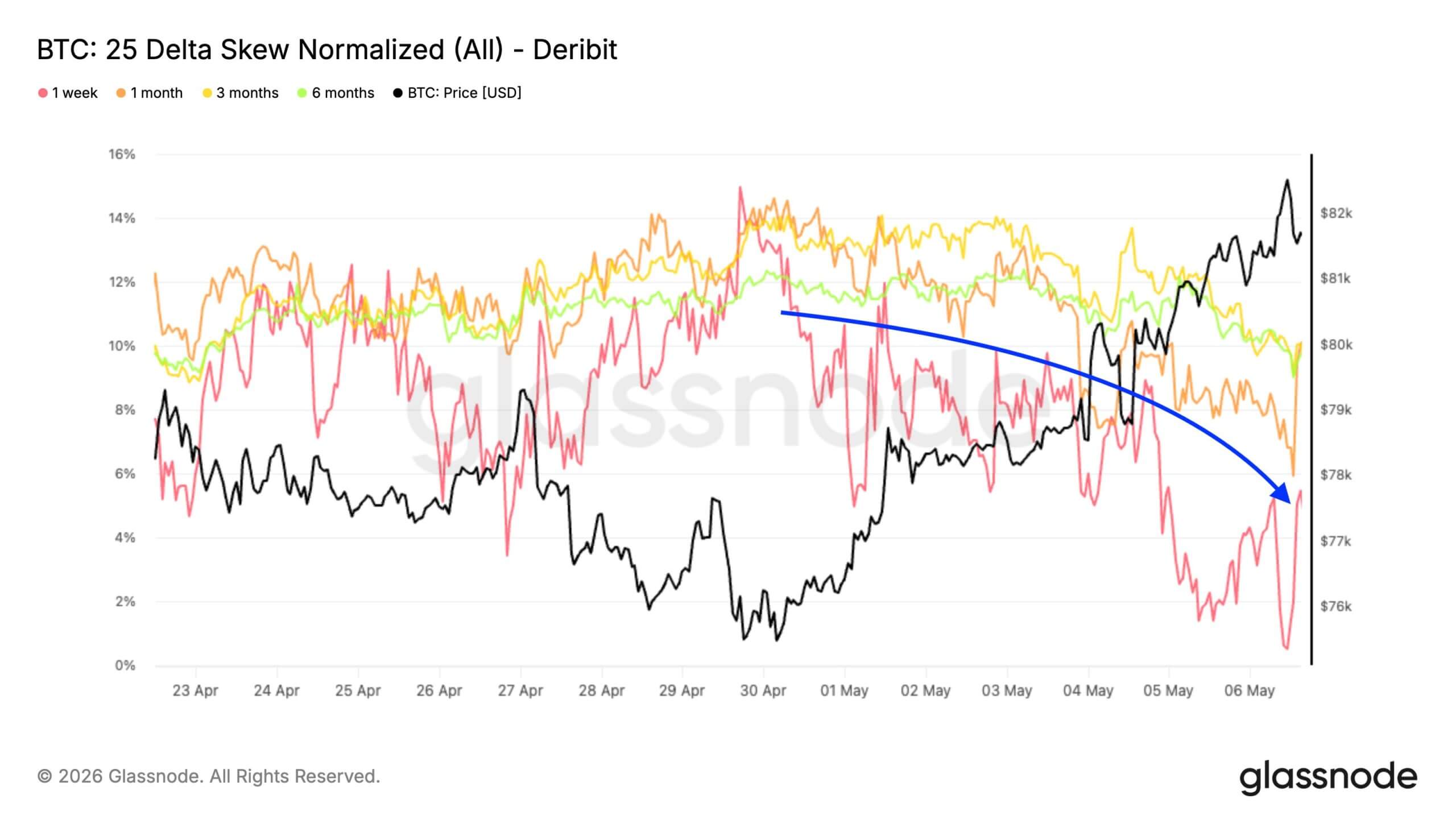
The broader skew index, which evaluates the entirety of the options curve, paints an even clearer picture: downside hedges are being actively unwound, and demand for upside exposure is steadily building.
The market is effectively signaling that while traders are maintaining some baseline protection, they viewed the brief dip below $80,000 as a temporary deviation rather than a structural breakdown.
Further complicating the price action is a massive cluster of short gamma positioned near the $82,000 strike. With a total of nearly $2 billion, this concentration forces options dealers to hedge their books dynamically.
In practice, this means dealers are compelled to buy into market strength and sell into market weakness, a mechanical reflex that naturally amplifies price swings in this specific trading range.
Trading volumes support the thesis of renewed engagement. Blockscholes data shows that daily derivatives volumes, which had been languishing between $800 million and $1.2 billion, exploded to well over $4 billion during the push toward $83,000.
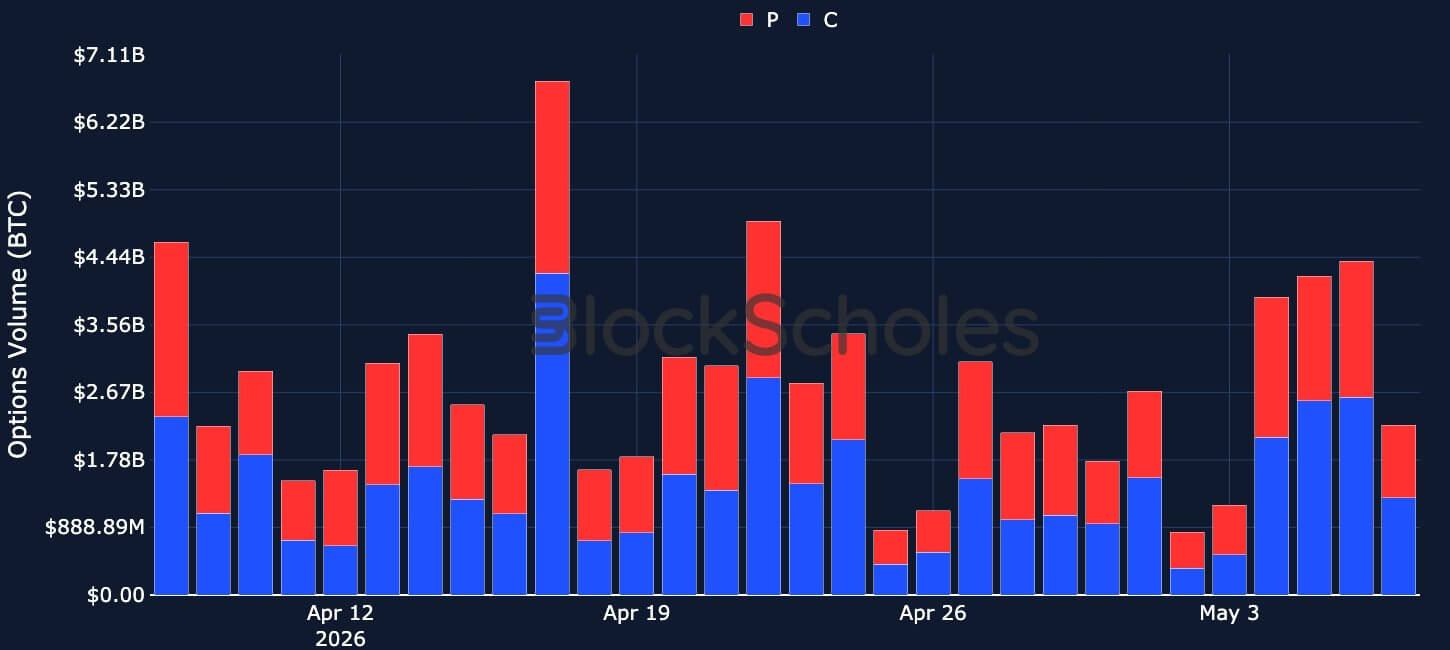
Despite the subsequent price drop, Blockscholes’ internal risk appetite index remains exceptionally strong, registering a +1.1720 reading.
The path to $88,000
Considering the above, the prevailing market question is whether this entire sequence marks the genesis of a sustained macroeconomic bull run or merely the final, euphoric gasp of a prolonged bear-market rally.
The answer likely lies in the behavior of cost-basis clusters.
Data from CryptoQuant shows that the age of unspent transaction outputs (UTXOs) provides a map of where different cohorts of buyers acquired their coins.
Currently, a highly bullish divergence is forming. The cost basis for the one-to-four-week holder cohort has surged from $67,000 to $76,000, recently surpassing the one-to-three-month cohort at $68,000.
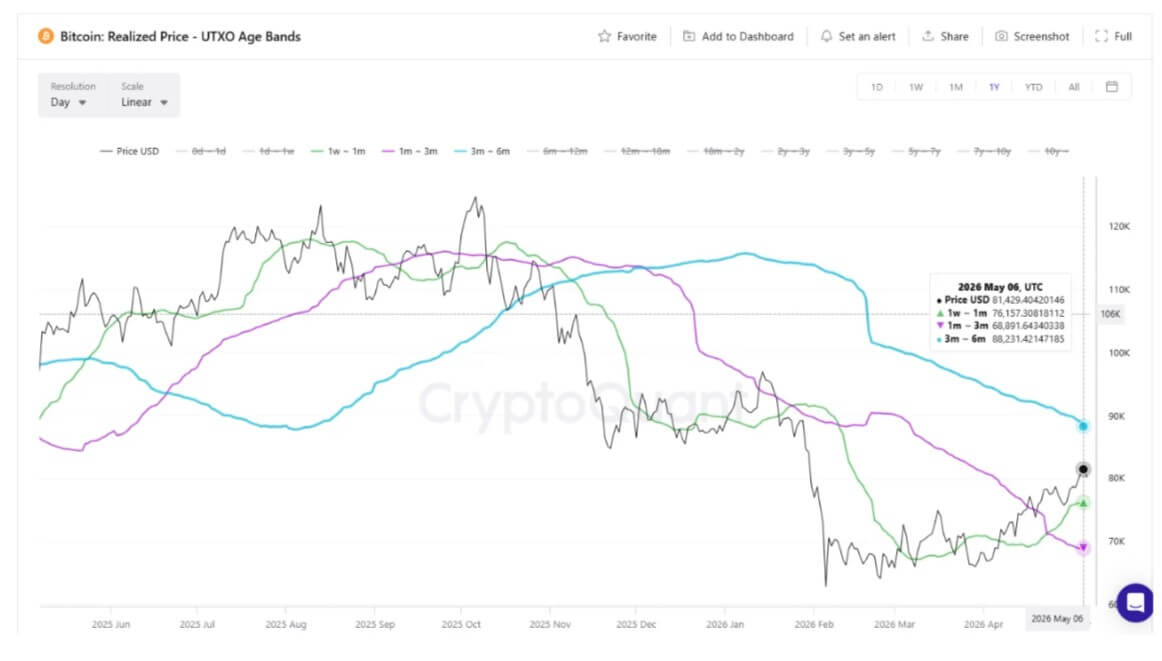
In technical terms, this is a structural golden cross for on-chain sentiment. Short-term holders are the undisputed engine of market momentum.
When their aggregate position falls underwater, they generate relentless selling pressure. However, when their positions align in profit from the bottom up, they form the bedrock of a sustainable uptrend.
This foundational alignment is currently locking into place, setting the stage for the next major psychological and technical battleground: $88,000. This level represents the cost basis of the three-to-six-month holder cohort and stands as the ultimate resistance barrier.
If derivatives demand continues to absorb spot profit-taking and Bitcoin can successfully reclaim and hold $88,000, it would push every single short-term cohort into profit simultaneously.
Historically, that specific trigger has been the undeniable catalyst for a true trend reversal, turning cautious optimism into widespread retail euphoria.

 Bitcoin
  Ethereum
  Tether
  BNB
BNB  USDC
USDC  XRP
XRP  Solana
  TRON
TRON  Figure Heloc
  Hyperliquid