

blackdovfx/E+ via Getty Images
Introduction
Welcome back to the Polygon (MATIC-USD) Series. In my previous 2 articles, here (polygon intro) and here (detailing scaling), we talked about the basics of the Polygon Network, what the suite of solutions offered to achieve, the changes to Polygon post-rebrand in February 2021, and how exactly their sidechains, rollups, and L2 scaling solutions worked to scale Ethereum and other blockchains in general, with an emphasis on their flagship PoS sidechain where most of the activity happened.
Today, we will look at the on-chain metrics of their flagship PoS chain and see how far the network has really come in a matter of 2-3 years. To complement the thesis having already looked at the tech behind it all, it is necessary to analyze the on-chain metrics to get an overview of the Network and Ecosystem adoption. Furthermore, we will discuss the utility of the MATIC token on both networks given its rather interesting tokenomics formulation. Let’s begin!
Utility of the MATIC Token
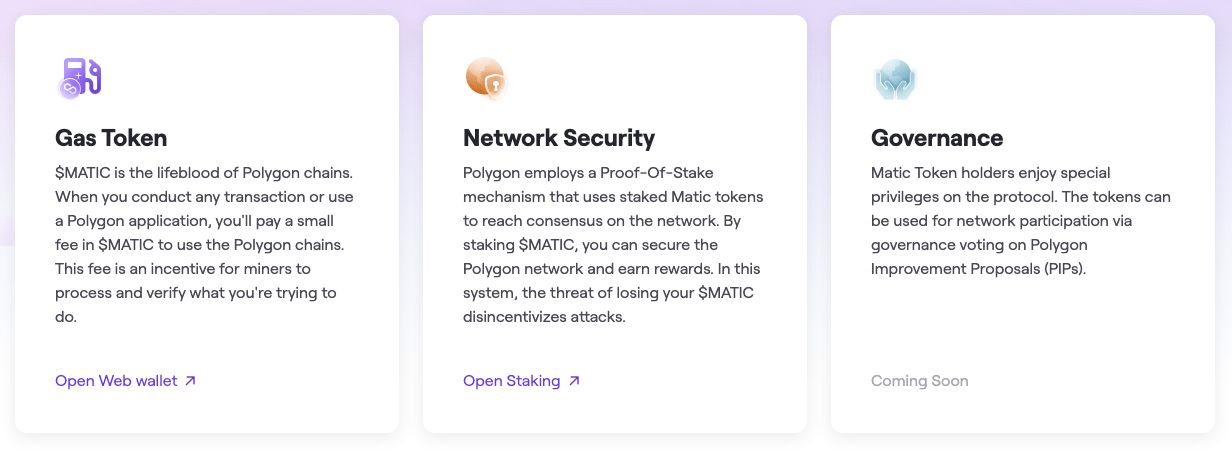
Matic Token Utility (Polygon Technology)
To start with, the MATIC token is used on both the Ethereum Network and the Polygon Network. On the Ethereum Network, MATIC is an ERC-20 token, which essentially means that it has been developed to be compatible for use on the Ethereum network, a technical benchmark that had been created for smart contracts where the tokens adhere to a pre-defined list of rules.
There, the token is used for staking (i.e. to be used as collateral) on validator nodes. Users who stake or lock up their MATIC tokens on the Ethereum network can receive yield paid by the network in the form of fees as a reward for validating transactions on the Polygon network.
Staking can be performed by becoming a validator or a delegator, whereby their job scopes differ slightly and so does the APY they receive as a result, with validators having the more difficult task. Becoming a validator requires the setting up of a computer or a node to perform validation of transactions, while delegation occurs when token holders delegate validation rights to other validators.
On the Polygon Network, MATIC is not an ERC-20 token as it need no longer be one – given that it’s operating on its own chain. Instead, it functions as the base native currency of the Polygon Network, exactly as how ether is used on Ethereum. MATIC is used to pay for gas fees for transactions, be it for a particular dapp use, to execute a smart contract, or for moving tokens from 1 address to another.

Polygon Wallet (Polygon Technology)
The Polygon Wallet displays the balance of each user’s fund on the Polygon PoS Sidechain, and any tokens transferred from the Ethereum network to the Polygon PoS chain will be reflected on the wallet. Moreover, any transaction including MATIC on the Ethereum wallet can be seen on Etherscan while the same transaction but on the Polygon PoS chain can be seen on Polyscan blockchain explorer.
Polygon Mean Transactions Dwarf Ethereum
Moving on to on-chain metrics, the main benefit of using Polygon is for faster processing and cheaper transactions.
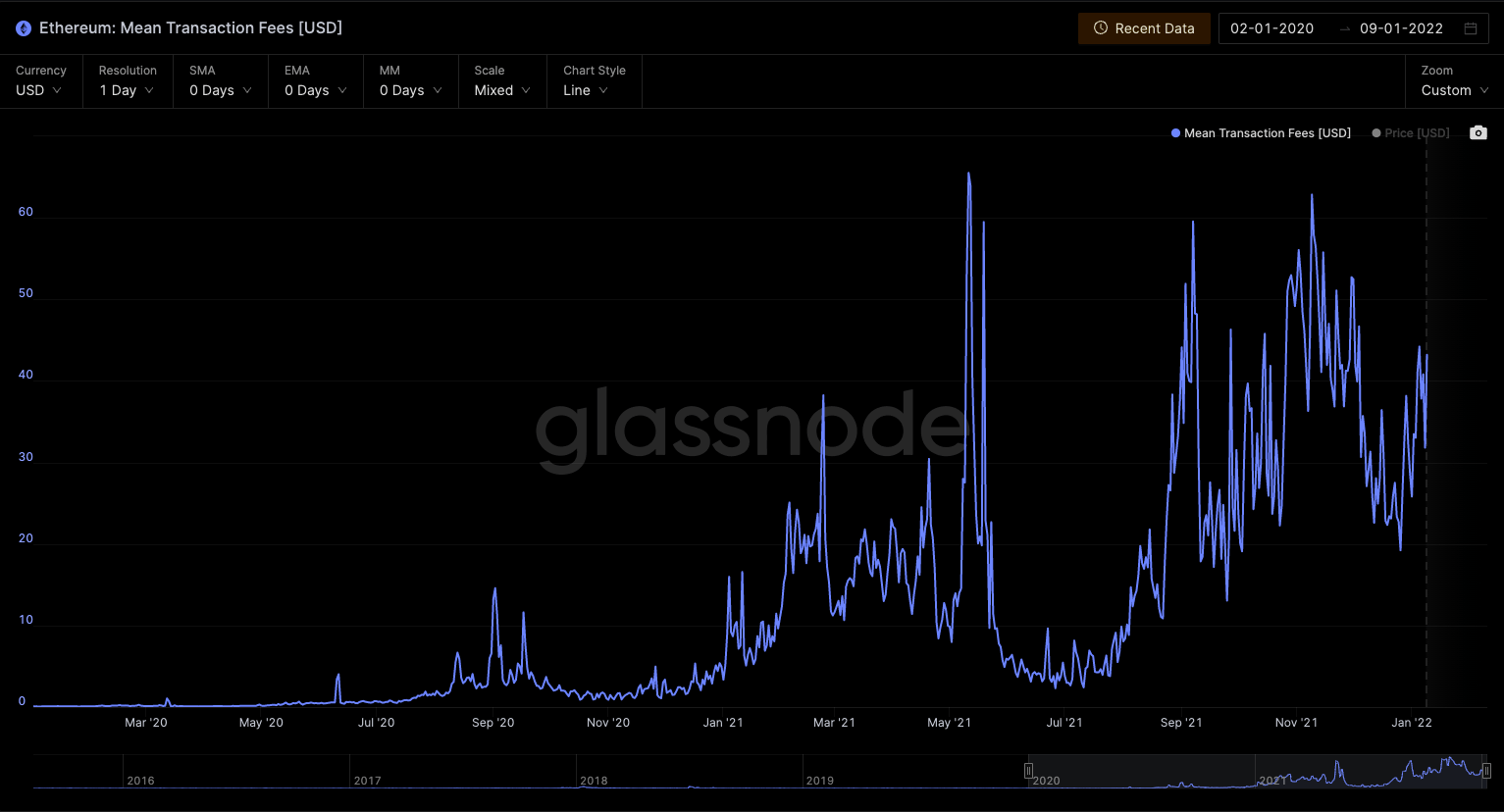
Ethereum Mean Transaction Fees (Glassnode)
Ethereum has limited block space and given the inherent utility and number of dapps operating on their ecosystem, the network can get congested at times, especially in 2017 and in 2020 with the rise of DEFI (decentralized finance). As of 2021, Ethereum’s mean transaction fees come in at around USD$10-20, with fees getting as high as USD$70 at times, and that’s the daily mean. As an individual transaction in itself, it can even cost more than USD$100, especially for a transaction on a DEX (decentralized exchange) like Uniswap V2. I know I’ve paid more than USD$60 for a transaction before.
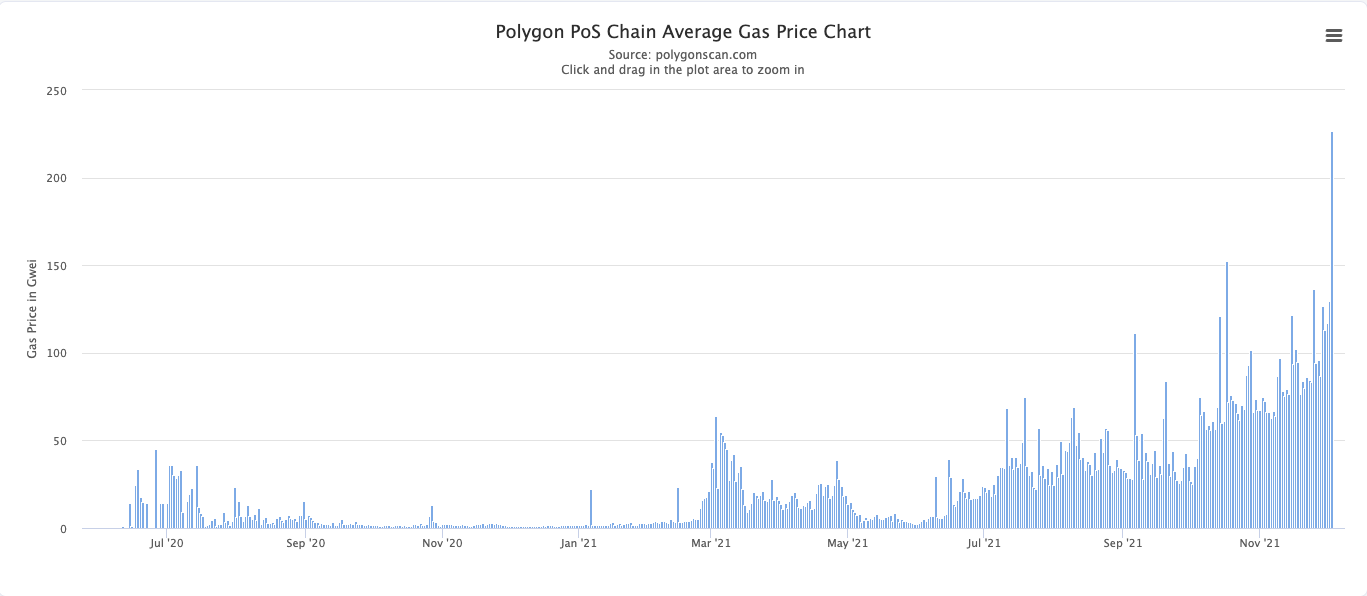
PoS Chain Average Gas (Polyscan)
Instead, when we look to Polygon, we can see that their mean fees on their flagship PoS sidechain comes in at about 60 Gwei which is equivalent to USD $0.00024 per transaction. Even in recent times when the PoS sidechain has gotten more popular, the highs of 250 Gwei only cost about USD $0.001-0.002 max. Comparing an average gas fee of USD $10 on the Ethereum Network with that of USD $0.001 on the Polygon chain, that would represent a transaction cost 10,000x cheaper if it were processed on the Polygon chain instead of it being done locally. Clearly, Polygon’s ‘cheaper’ narrative has played out nicely.
Polygon’s PoS Sidechain’s Active Addresses Is Set to Overtake Ethereum
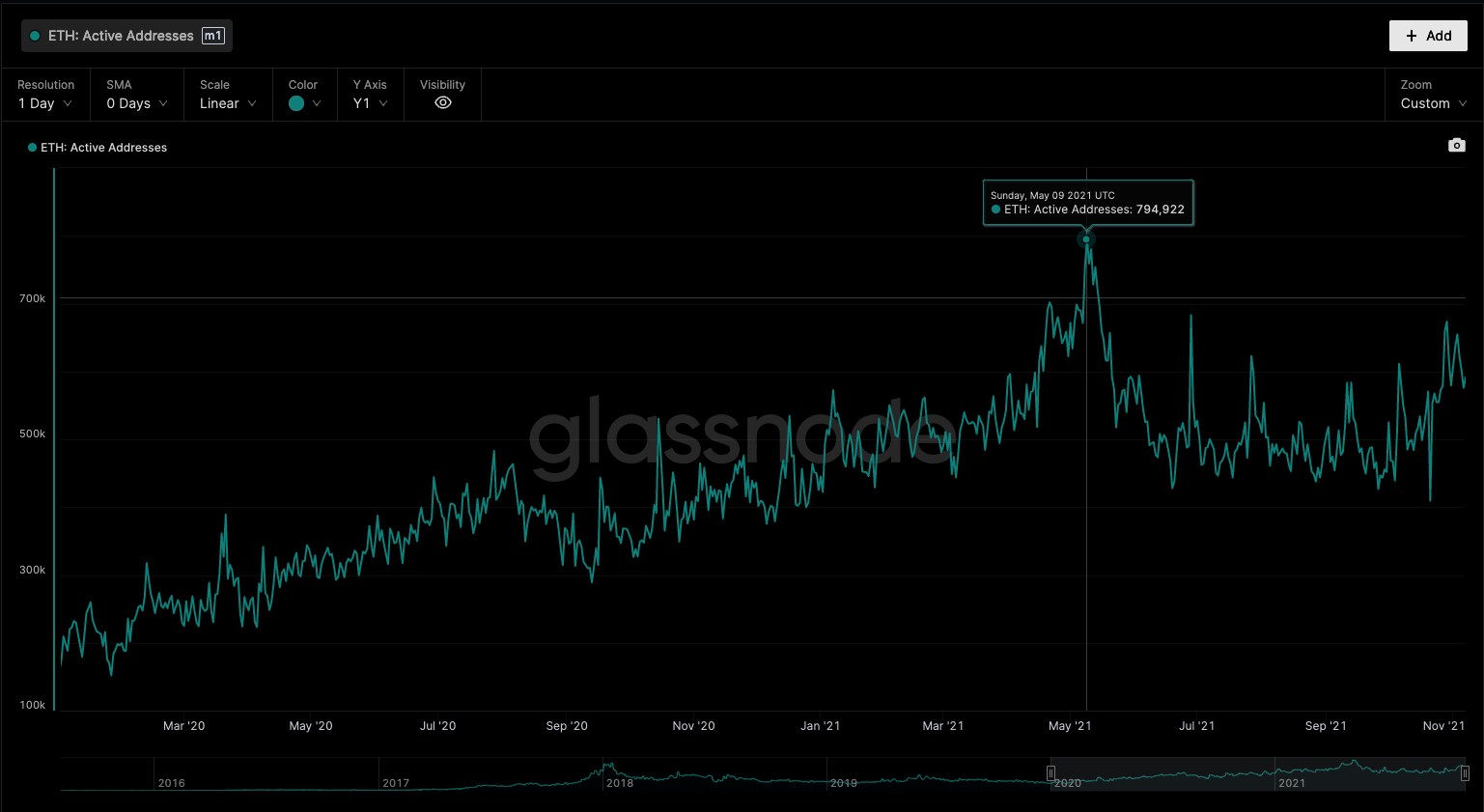
Ethereum Active Address Count (Glassnode)
An active address is defined as an address that is unique to the network and has been active either as a sender or a receiver. This metric has long been one of the most crucial metrics for network adoption in the space and is especially more important for L1 blockchains with an ecosystem of dapps. Generally, Ethereum’s active addresses has trended higher over time and it is evident that the number of network active addresses will continue to grow as more dapps are developed and the network rids itself of its hindrances with a full transition in ETH2.0 by 2022 if we’re lucky.
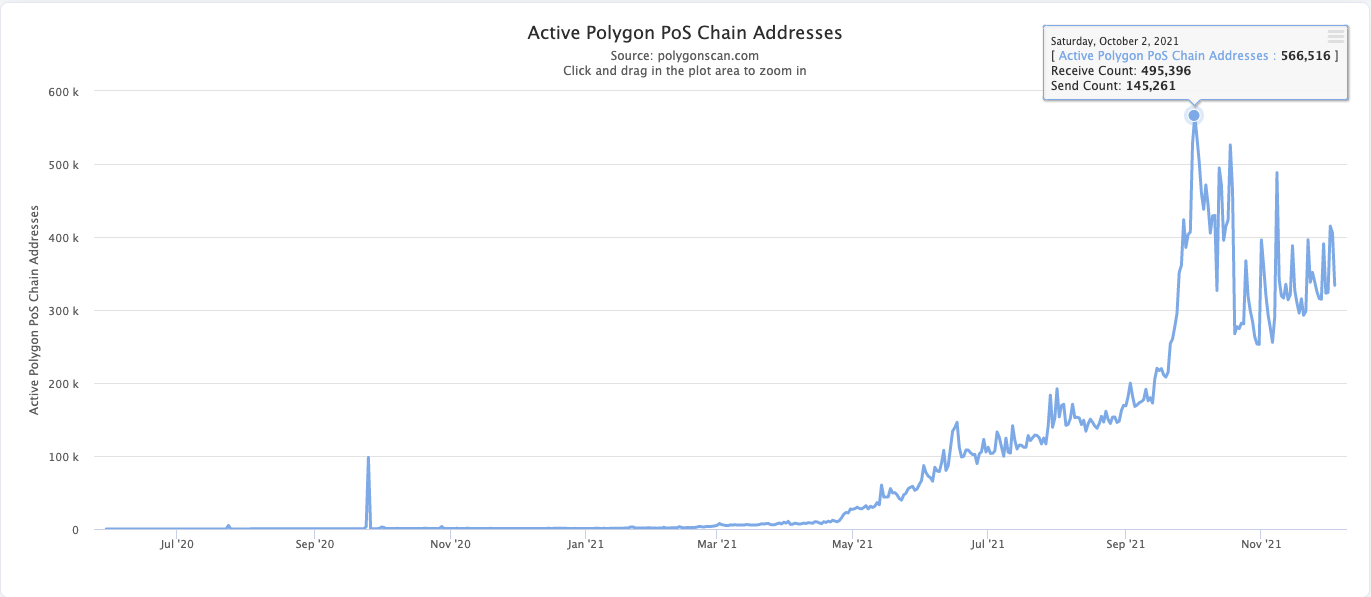
Polygon PoS Chain Address Count (Polyscan)
Looking to Polygon, it is evident that their active address count has been in hyper-growth since May, post-rebrand. For a brief period, the Polygon PoS chain even logged active address count of 566K+, higher/on par with that on Ethereum for the same period, a remarkable achievement. Although it has since trended down since then, current active addresses of 300K+ is far higher than where they were just last year. As the Polygon Network continues to work on their upcoming solutions that have yet to go live and more partnerships are formed such as those with Chainlink and Decentraland, it will only be a matter of time before their active address count continues trending higher for good, on track to overtake that of Ethereum.
Ethereum Active Addresses Correlates Strongly with Price
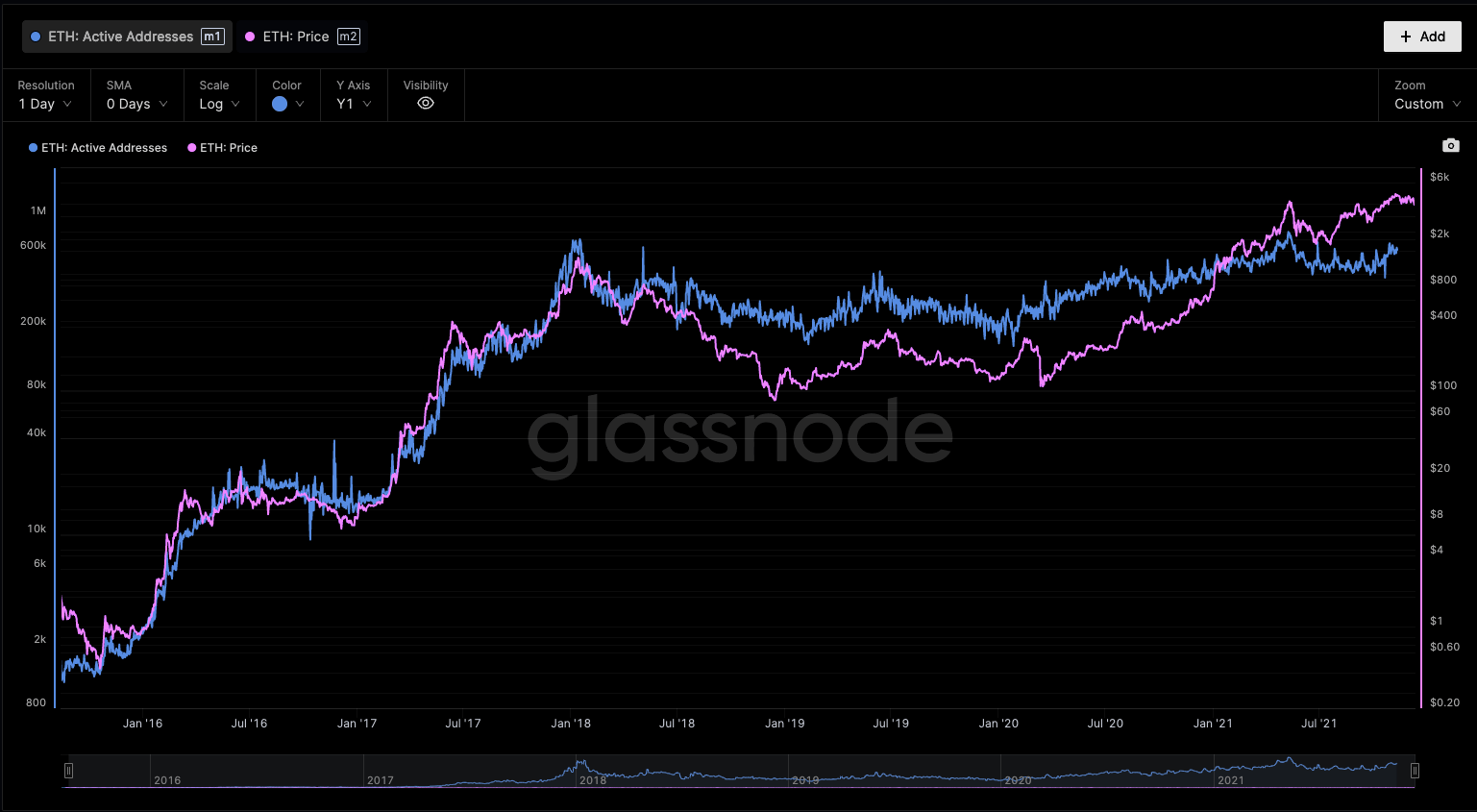
Ethereum Active Addresses (Glassnode)
Ethereum’s price action has historically always maintained a strong correlation with its active address count, and there doesn’t seem to be any evidence of a decoupling anytime soon. Similarly, given how closely Ethereum’s network adoption and Polygon’s are related, coupled with the fact that Polygon’s PoS Sidechain is set to overtake moving forward and as more solutions are deployed by L1s, it would be reasonable to anticipate that the MATIC token is set to gain value in time to come. Through hindsight, we also know that Polygon’s active address boom has returned shareholders more than 10,000% YTD and I’d bet that the trend in active addresses and price action for the MATIC token will continue to do so.
Polygon’s PoS Sidechain’s Daily Transaction Count Has Overtaken Ethereum
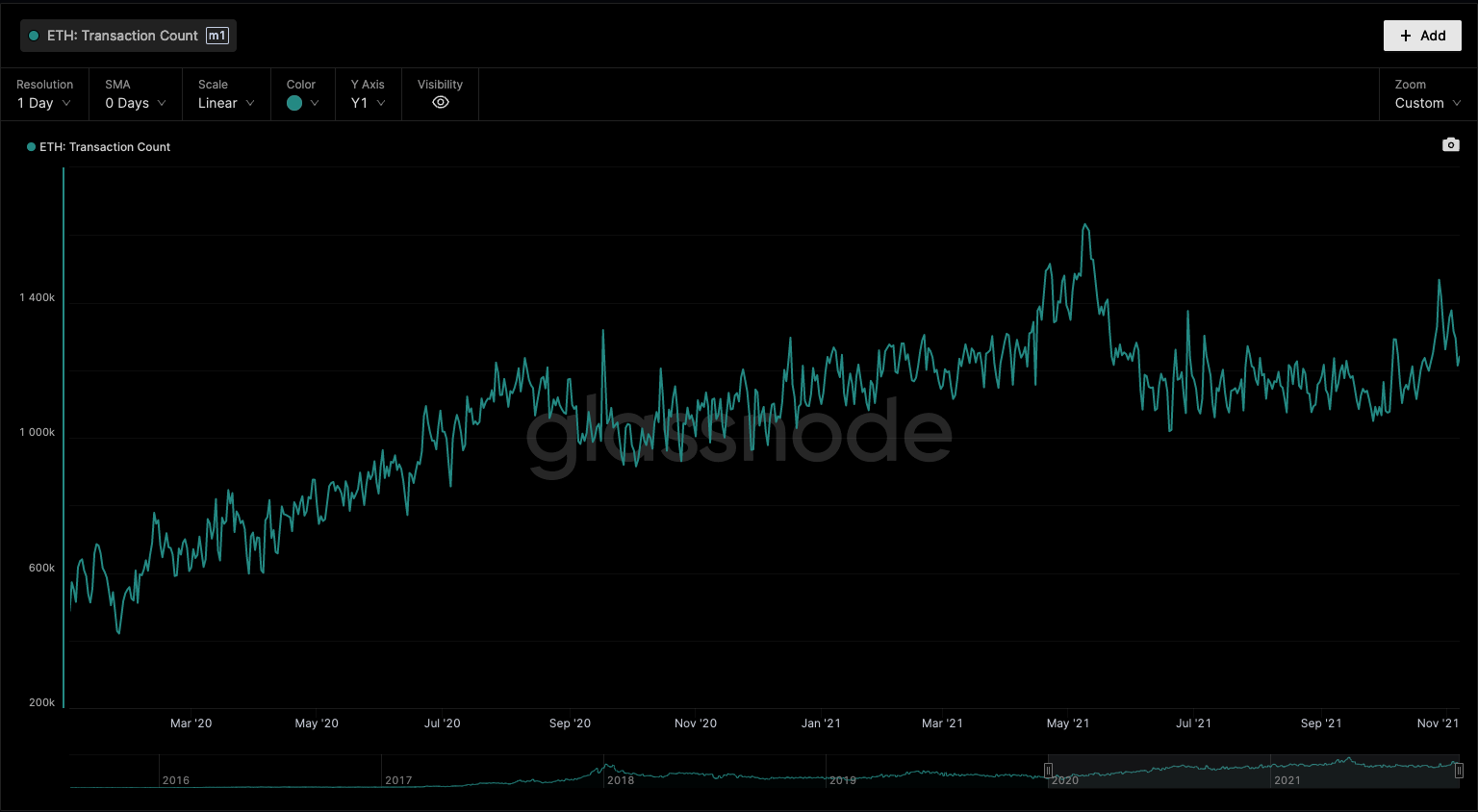
Ethereum Daily Transaction Count (Glassnode)
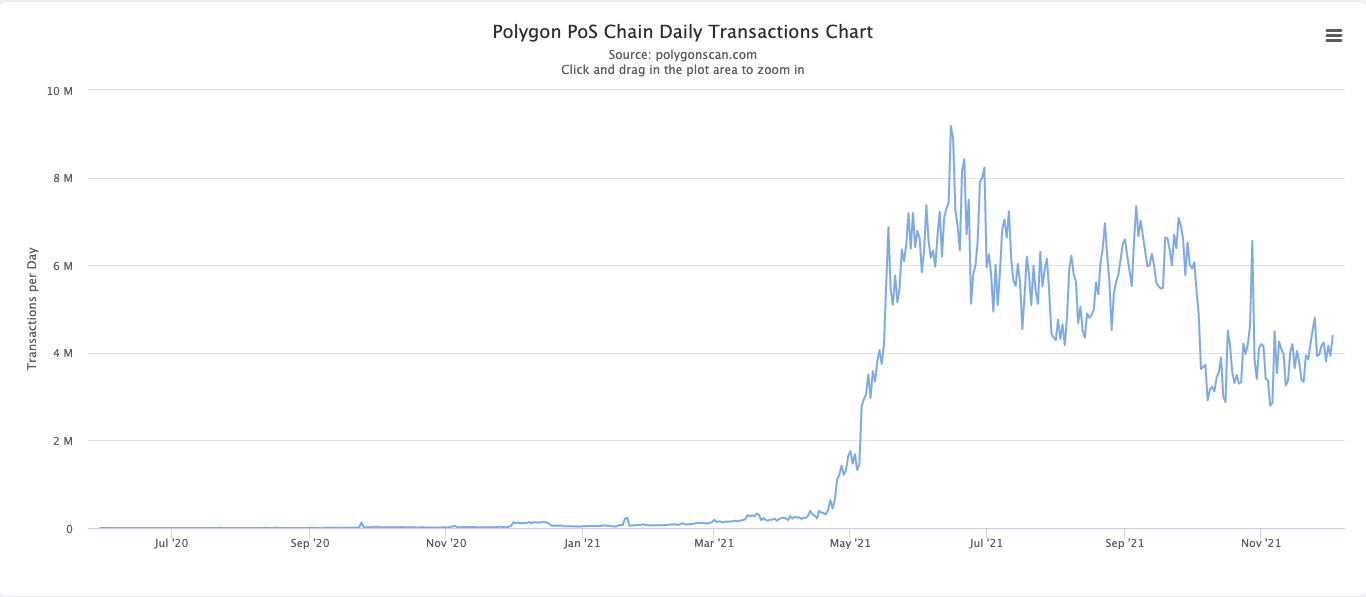
Polygon Daily Transaction Count (Polyscan)
Lastly, Polygon’s daily transaction count logged on their flagship product has since overtaken as early as May, and hence maintained that lead ever since. Ethereum averages a daily transaction count of 1M+/day, while Polygon hit a high of 9M in July before cooling off to settle at 3.5M+/day for the time being. The Polygon Sidechain is seeing healthy levels of usage and will continue to do so as more partnerships are formed and more dapps choose to launch/build on Polygon from the ground up.
Conclusion
To wrap things up, on-chain metrics paint a rosy picture for Polygon. Network adoption is strong with ever growing active addresses, daily transaction count, some even more so than Ethereum. The network charges fees close to 10,000x cheaper than that on Ethereum, has seen more than 3000 dapps launched on their network in under a year, and currently sees close to USD 2 BN of MATIC in TVL (total-value-locked).
Polygon’s growth has been nothing short of remarkable and if anything, is a real testament to the leadership and expertise of the team in execution. Their scaling solutions (sidechains & L2) are seeing real adoption at a mass scale, as blockchains rush to mitigate their high gas fees through 1 of the many pre-set solutions that can deployed within a single click.
I remain bullish on the MATIC token and anticipate that the Polygon Network will continue to grow even when Ethereum fully introduces shards. Once Bitcoin reverses the recent local bear market downtrend within the broader bull cycle with confirmation, I anticipate that Polygon will continue to outperform with the rest of the alts. Thank you.

 Bitcoin
  Ethereum
  Tether
  BNB
BNB  XRP
XRP  USDC
USDC  Solana
  TRON
TRON  Lido Staked Ether
  Figure Heloc