

[Updated 4 October 2022]
Summary
- We look at the latest bitcoin trends, including macro risks and on-chain/flow metrics, to reveal the best time to buy bitcoin and the risks of buying BTC.
- For trading bitcoin over the next two to four weeks, we are neutral to slightly bearish. That means we expect stable to falling prices.
- However, we think bitcoin is a good long-term investment for the next one to three years and are bullish overall. That means we expect the bitcoin price to rise in the long term.
Is Now a Good Time to Buy Bitcoin?
Bitcoin has traded in a range around $20,000 in September and into October, 20% off its mid-August high and just 12% off its mid-June lows. This steady trading is a departure from the decline in other risk assets. The tech-heavy NASDAQ is down 4.25% over the past month, with the S&P 500 close behind at -4.11%.
The generic risk-asset rout is largely central bank driven. 26 August 2022 saw Chair Jerome Powell reaffirm the Fed’s hawkish stance at Jackson Hole, a move that came alongside a new bout of ECB hawkishness. Then came another 75bp hike in interest rates at the September FOMC meeting. Yet perhaps surprisingly for the traditionally volatile asset, BTC held the line around $20,000 and has moved mostly sideways since – prompting some to call a bottom to the beleaguered coin.
Our view remains that the Fed will need to hike considerably beyond market expectations. We also see a strong upside risk for ECB hikes. These two aspects together should sustain the risk-off momentum in the near term. For bitcoin, meanwhile, if the price drops further below current levels, we could see it reaching $16,000, or even $8,250. Amid recession risks in the US and most of the West, plus an energy crisis in Europe, things are not looking great for bitcoin.
Should you buy BTC now? The quick answer is ‘probably not’. The macro backdrop for bitcoin is bearish. We analyse various on-chain/flow metrics for bitcoin, which are bullish. So, overall, we are neutral to slightly bearish. Therefore, if you have a two-to-four-week horizon, now may not be the best time to buy bitcoin.
Why Has the BTC Price Dropped?
Macro Reasons for the Current Bitcoin Price
Crypto markets almost looked like they had partial immunity from the tech sell-off and growing risk aversion. But recent price action has put paid to that notion. The relative stability of bitcoin between mid-January and mid-April, when it choppily trended up with higher highs and higher lows, was simply the calm before the storm. Bitcoin is down 70% since its November high of $67,734 (Chart 2 is a BTC price chart, with bitcoin in orange). And there is likely more to come.

The crux of the matter is that US interest rates are rising. Years of low interest rates since the global financial crisis in 2008 have seen markets reach extreme valuations. Who cares if tech companies are loss-making if the companies can borrow easily? And if companies cannot borrow money, they can attract capital from investors, who themselves have likely borrowed money.
Crypto markets have not been immune to the support from cheap leverage in the fiat markets. After all, crypto offers the tech dream of scalability and regulatory arbitrage. And if there was any doubt that crypto was not benefiting from low interest rates then the recent declines in crypto as US rates have risen should remove it.
Furthermore, the correlation of bitcoin to NASDAQ started to increase sharply just as US interest rates started to rise. This is a common occurrence throughout history. When the liquidity tap turns off, usually by central banks raising rates, the correlation between diverse assets shoots up. This time appears no different.
How Low Can Bitcoin Prices Go?
One exercise is to see how low prices could get were the NASDAQ to suffer a 2000-style crash. After all, the bitcoin and NASDAQ correlation remains around 65%. So where the NASDAQ goes, bitcoin follows.
Back in 2000, the NASDAQ suffered a 78% drawdown. Currently, the NASDAQ is in a 30% drawdown. A repeat of the 2000-style drawdown would put the NASDAQ at 3,500. So where would crypto be if NASDAQ were trading at this level? We estimate a regression between bitcoin/ethereum returns and NASDAQ returns from 2020 onwards. Based on this relationship, we find:
- Bitcoin prices would reach $8,254 if the NASDAQ fell to 3,500. This implies a 72% decline from current levels.
- Ethereum prices would reach $143 if the NASDAQ fell to 3,500. This implies a 92% decline from current levels.
What Else Is Happening in Crypto?
Stocks and crypto both gained on Monday 3 October after the ISM manufacturing purchasing managers index (PMI) fell to 50.9 in September against an expected 52.2. This is its lowest reading since May 2020, which indicates Fed tightening is starting to impact more parts of the economy. However, Fed speakers remained hawkish last week, and we are also expecting nonfarm payrolls data on Friday – any surprises could rile markets. Lastly, recession probabilities remain elevated near 80%. The macro backdrop is still bearish for crypto.
Regulation is becoming more of a theme throughout 2022, with various executive orders signed already. Increased regulation should mean less uncertainty around crypto markets for investors, which would be bullish.
On the flip side, overregulation could stifle innovation. The ongoing regulatory backdrop will be key to monitor.
There are several macro events to keep track of over the coming weeks that will influence crypto prices:
- Rising yields have mechanically increased the probability of a recession within the next 12 months to over 75%.
- Inflation remains at the forefront of investors’ minds, with YoY at a staggering 8.5%.
- Kim Kardashian has had to pay $1.26mn over a crypto ‘pump and dump’, highlighting the murky regulation around sponsored crypto content.
- Fed Vice Chair for Supervision Michael Barr said crypto should have oversight similar to that of traditional banks.
- Crypto hacking is on the rise with around $1.9bn stolen already according to Chainanalysis.
Summary of BTC Analysis
The bottom line is that crypto, including bitcoin, will remain under pressure. For bitcoin, this means the breach below $20,000 could worsen. The main near-term support would be Fed dovishness rather than any crypto-specific dynamics. And for long-term investors, we still think some allocation to crypto makes sense – just like an allocation to equities also makes sense. But be prepared for near-term weakness.
For all our latest analysis on crypto markets, click here.
Bitcoin and Crypto Price Trackers
Crypto markets have had some relief this week after last week’s series of central bank rate hikes. Bitcoin opened the week around $18,800 before rallying to weekly highs of around $20,300 on Tuesday. It is currently trading at around $19,600, which is marginally positive WoW. Ethereum followed a similar path, though it continues to underperform bitcoin – the ETH/BTC cross is still in a broader downwards trend (it is currently around 0.07).
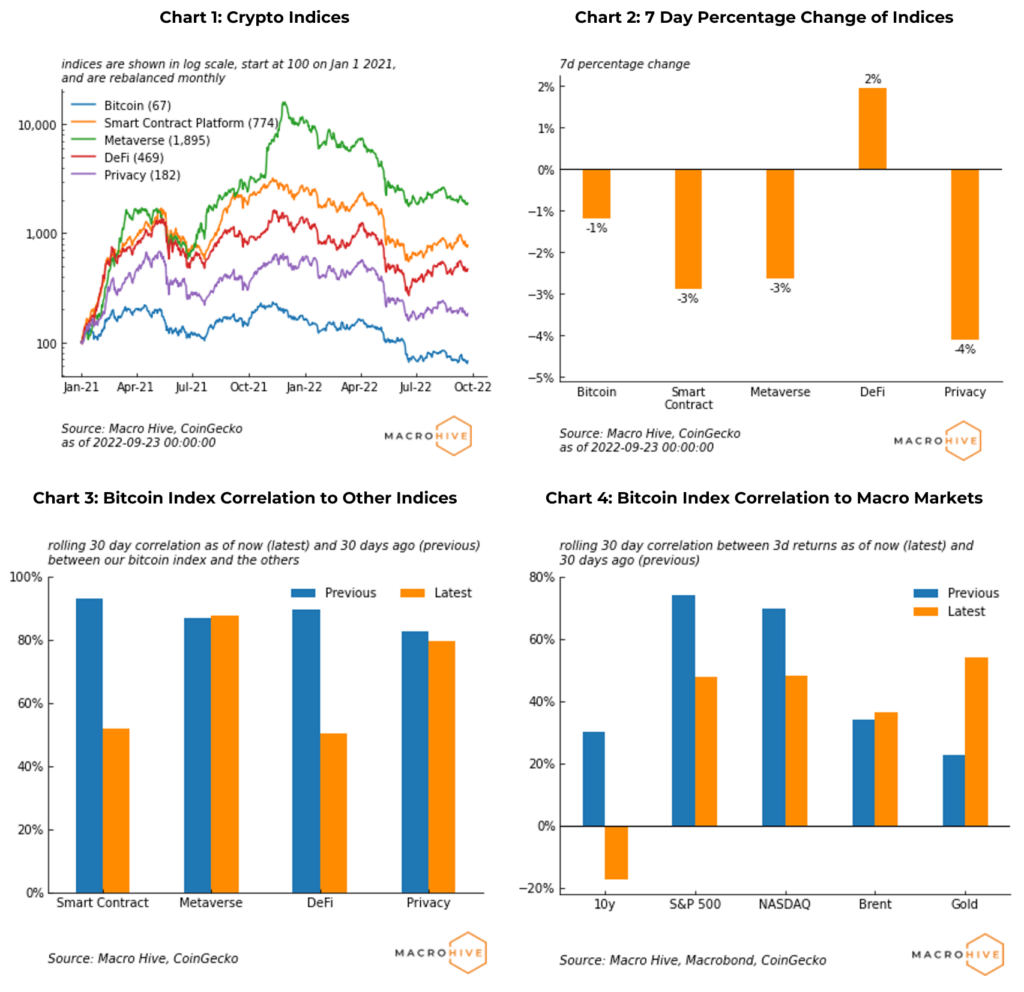
For most of the year, crypto has been trading like a risk asset being driven by broader risk sentiment. Notably, recession fears, rate hikes, and a strong dollar have weighed on sentiment. Now, however, some signs of decoupling from traditional financial assets, such as tech stocks, have started to show. Bitcoin’s correlation to the NASDAQ has come down significantly this month (it is now under 40%, Chart 4). Indeed, the NASDAQ fell ~2.8% yesterday while bitcoin registered a +0.1% return. Zooming out, the NASDAQ is down around 9% month to date compared to around 3% down for bitcoin.
Performance of Our Indices
As for our various indices, our DeFi index (+3% WoW) is up the most (Charts 1 and 2). Our Bitcoin and Smart Contract indices are up around +1% each. Our Privacy index is flat WoW and our Metaverse index is down 4%.
Our Metaverse (85%) and Privacy (76%) indices are correlated most to bitcoin, while our DeFi (42%) and Smart Contract (43%) indices are correlated least to bitcoin (Chart 3). On macro markets, bitcoin’s correlation to tech stocks drops while its correlation to gold (43%) rises (Chart 4).
- Smart Contract Platform Index: Chainlink (LINK) is up the most (+11% WoW) and Cardano (ADA) is down the most (-5% WoW). Ethereum is up just 0.4%.
- DeFi Index: Maker (MKR) is up the most (+14% WoW) and Yearn.finance (YFI) is down the most (-4% WoW).
- Metaverse Index: The Virtua Kolect (TVK) is up the most (+5% WoW) and Ultra (UOS) is down the most (-15% WoW).
- Privacy Index: Monero XMR) is up the most (+3% WoW) and Keep Network (KEEP) is down the most (-3% WoW).
- Bitcoin: this is up 1% WoW.
Should I Invest in Bitcoin? (A Beginner’s Guide)
Bitcoin and the crypto revolution are no longer nascent. With the length of the blockchain continuing to grow and decentralised finance (DeFi) gaining ground over traditional finance, this new asset class is reshaping the investment landscape.
We think bitcoin is a worthwhile long-term investment. However, we also note that bitcoin is extremely volatile. That means it experiences large price movements over short periods. Before investing, you must understand the risks involved: you could lose all or a large portion of your investment. Never invest money that you cannot afford to lose.
How to Make Money Investing in Bitcoin
It is easy to get carried away with the fear of missing out. You are probably aware of Cameron and Tyler Winklevoss, who are reputed to be the world’s first bitcoin billionaires with over 100,000 coins. Or what about Barry Silbert, the owner of Grayscale Bitcoin Trust, Coinbase and Coinbase? Success stories like these often give people FOMO – or the fear of missing out – if they do not invest immediately.
However, to invest in cryptocurrency, we must first understand it. Crypto tokens are unlike any traditional asset class. And they are all different. Just because you understand bitcoin, does not mean you know how ethereum works. Our video on bitcoin fundamentals can help you understand how bitcoin prices fluctuate and how to assess trends in important bitcoin metrics.
Each currency has different underlying protocols and technology. That impacts how they trade, their volatility, and how you can value them. Some are more like stocks, others commodities, and others currencies. And each crypto token has a unique structure of supply.
We think crypto markets are a worthwhile long-term investment. The technology can capture market share on some existing markets like payments and stock trading while creating new markets like valuable scarce digital assets.
Buying the Dip
Your exposure to bitcoin needs to be appropriately sized so that you can survive 50% to 80% drawdowns. Drawdowns provide good entry levels for exposure, but we would not go max long in an environment of rising central bank rates and falling global growth momentum.
Top Three Tips You Need to Know Before Investing in Bitcoin
Where to Buy Bitcoin
To buy bitcoin (BTC) or any other cryptocurrency, you need access to a crypto exchange. A crypto exchange is where buyers and sellers meet to exchange money for coins, coins for other coins, and coins for money. Many options are available such as Coinbase, Binance.com, or eToro – each come with various fee structures, so research which is best for your needs.
You also need access to a crypto wallet to store bitcoin and other cryptocurrencies. Many exchanges provide these, but not all do. You can also buy bitcoin on platforms like Paypal and Robinhood.
Dollar-Cost Averaging
Cryptocurrencies can be extremely volatile. One way to cope with the volatility is to use dollar-cost averaging. Dollar-cost averaging is a strategy where you divide the total amount you want to invest across periodic purchases of the target asset. It simply means that you would invest the same number of dollars each month or quarter, regardless of market trends.
The idea is that when prices are high, you can afford less of the asset. But when prices are low, you can afford more. When the market recovers, you benefit from having bought more shares at the lower price. Please note that using this strategy will not always result in a profit or necessarily protect you from falling prices.
Diversify Your Crypto Portfolio
With the crypto landscape so volatile and diverse, managing risk in a portfolio is critical. That essentially means position sizing and diversification – as with any other kind of investment.
One of the best pieces of investment advice we have heard recently comes from Ari Paul, co-founder and CIO of Blocktower Capital, a crypto and blockchain investment firm. As Paul says,
‘Risk is only sizing. So, if you think bitcoin is too risky, you could size it at 0.1% of your portfolio or 0.001%. Too risky is never a reason not to own an asset. If something is positive expected value, risk adjusted, and relatively low correlation, you have to own it. That’s peak portfolio management 101.’
FAQs
Is now a good time to buy bitcoin?
For trading bitcoin over the next two to four weeks, we are slightly bearish. That means we expect falling prices. However, we think bitcoin is a good long-term investment for the next one to three years and are bullish overall. That means we expect prices to rise in the long term.
When was bitcoin at its lowest?
Since the start of 2021, bitcoin was at its lowest on 18 June 2022, when the BTC price was $17,786. Of course, prior to bitcoin’s major bull run in late 2020, it was much lower – under $10,000. However, bitcoin has not reverted to these lows even amid significant drawdowns.
Can you lose your money buying BTC now?
As with all investments, the value of bitcoin can rise as well as fall. While it is unlikely that bitcoin will suffer a complete loss of value, investors must be prepared to suffer drawdowns of between 50% and 80%. We recommend small allocations and diversification of your portfolio. Never invest what you cannot afford to lose.
When to sell bitcoin?
Traditional wisdom says you should buy low and sell high. But whether you should sell bitcoin depends on your investment horizon, risk appetite and financial goals. Although some websites speculate that certain days of the week are better or worse than others for selling bitcoin, we believe that any decision to buy or sell should be based on an analysis of crypto fundamentals.
Appendix: What Are in the Four Indices?
Bitcoin: the OG of crypto markets deserves its own category and is in many ways the true benchmark for any other crypto market.
Smart contract platforms: after bitcoin, the big innovation was to have blockchains that were more programmable. These could host smart contracts or decentralised applications and have allowed the emergence of the metaverse and defi. Ethereum (ETH) is the most popular version of a smart contract platform. As well as ethereum, we also include some key competitors. The constituents of this index are: Ethereum (ETH), Cardano (ADA), Avalanche (AVAX), Solana (SOL), Fantom (FTM), VeChain (VET), Terra (LUNA), EOS (EOS), and Chainlink (LINK). We also include Polkadot (DOT) which allows interoperability between blockchains and the use of smart contracts via parachains.
Metaverse: coins associated with the creation of a virtual space/digital world on the internet using a combination of augmented reality, virtual reality, and social networks. The constituents of this index are Axie Infinity (AXS), The Sandbox (SAND), Decentraland (MANA), Enjin Coin (ENJ), Aavegotchi (GHST), Terra Virtua Kolect (TVK), Ultra (UOS), Phantasma (SOUL), RedFOX Labs (RFOX), and Gala (GALA).
Decentralised Finance (DeFi): financial services built on top of blockchain networks with no central intermediaries. This can be a broad category, so we narrow this down to platforms that focus on lending/borrowing, yield farming, automated market making and decentralised exchange tokens. The constituents of this index are: Aave (AAVE), Compound (COMP), Uniswap (UNI), Yearn.finance (YFI), Loopring (LRC), PancakeSwap (CAKE), Maker (MKR), 1inch (1INCH), Thorchain (RUNE), and Terra (LUNA).
Privacy Coins: coins that obscure transactions on the blockchain to maintain the anonymity of its users and their activity. The constituents of this index are Monero (XMR), Zcash (ZEC), Dash (DASH), Verge (XVG), Horizen (ZEN), Beam (BEAM), Secret (SCRT), Decred (DCR), Keep Network (KEEP), and Dusk Network (DUSK).
Dalvir Mandara is a Quantitative Researcher at Macro Hive. Dalvir has a BSc Mathematics and Computer Science and an MSc Mathematical Finance both from the University of Birmingham. His areas of interest are in the applications of machine learning, deep learning and alternative data for predictive modelling of financial markets.
Bilal Hafeez is the CEO and Editor of Macro Hive. He spent over twenty years doing research at big banks – JPMorgan, Deutsche Bank, and Nomura, where he had various “Global Head” roles and did FX, rates and cross-markets research.

 Bitcoin
  Ethereum
  Tether
  BNB
BNB  XRP
XRP  USDC
USDC  Solana
  TRON
TRON  Figure Heloc
  Hyperliquid