


Thailand has finalized rules allowing domestic Bitcoin and Ethereum ETFs while restricting retail access to competing overseas investment products.
The Securities and Exchange Commission (SEC) announced on Oct. 8 that 11 regulatory notifications will take effect on Oct. 16, establishing a framework for cryptocurrency exchange-traded funds listed exclusively on the Stock Exchange of Thailand.
Thailand’s move follows the success of spot Bitcoin and Ethereum ETFs in the United States, which have attracted about $70.37 billion in combined cumulative net inflows since their launches.
According to SoSoValue data, the funds held about $121 billion in combined net assets as of Oct. 12, illustrating the scale of the market Thailand seeks to enter.
Thailand prioritizes domestic ETFs over foreign competitors
Under the new framework, Thailand will initially prohibit the issuance and offering of investment products linked to foreign crypto ETFs, including depositary receipts that would otherwise allow local investors to gain exposure to overseas funds through domestic securities markets.
Securities companies will also be restricted from facilitating investments in foreign crypto ETFs for clients who do not qualify as institutional or ultra-high-net-worth investors.
The restrictions are targeted rather than a comprehensive prohibition on overseas crypto investments. They primarily affect specified investment products and brokerage services available to ordinary investors.
The SEC said the measures aim to support the development of Thailand’s domestic crypto ETF ecosystem and strengthen local financial institutions’ capabilities.
The regulator has also expanded the investment options available to existing asset managers.
Previously, Thai mutual funds and private funds could invest in foreign crypto ETFs but not domestic equivalents. Under the revised rules, they may invest in Thai-listed crypto ETFs, subject to existing investment limits.
Together, these changes could establish an additional source of demand for domestic products while reducing the availability of some foreign alternatives.
The framework may also create opportunities for Thai asset managers, custodians and other licensed digital asset businesses to participate in the emerging market.
However, the restrictions could leave retail investors with fewer competing products, making the fees, liquidity and tracking performance of domestically listed funds particularly important once trading begins.
Thailand imposes margin restrictions and investor safeguards
Beyond restrictions on foreign products, Thailand’s framework sets operating requirements to limit risk and ensure crypto ETFs function within the country’s existing securities market.
Initially, only Bitcoin and Ethereum will qualify as underlying assets, with each ETF required to passively track a single cryptocurrency.
Funds must maintain average net exposure of at least 80% of their net asset value to the chosen asset over each accounting year.
Asset managers must demonstrate adequate personnel, operational systems and service-provider arrangements before establishing a fund. Digital assets held by the ETFs must also be safeguarded by custodians regulated by Thailand’s SEC.
Investor protections extend to trading activities.
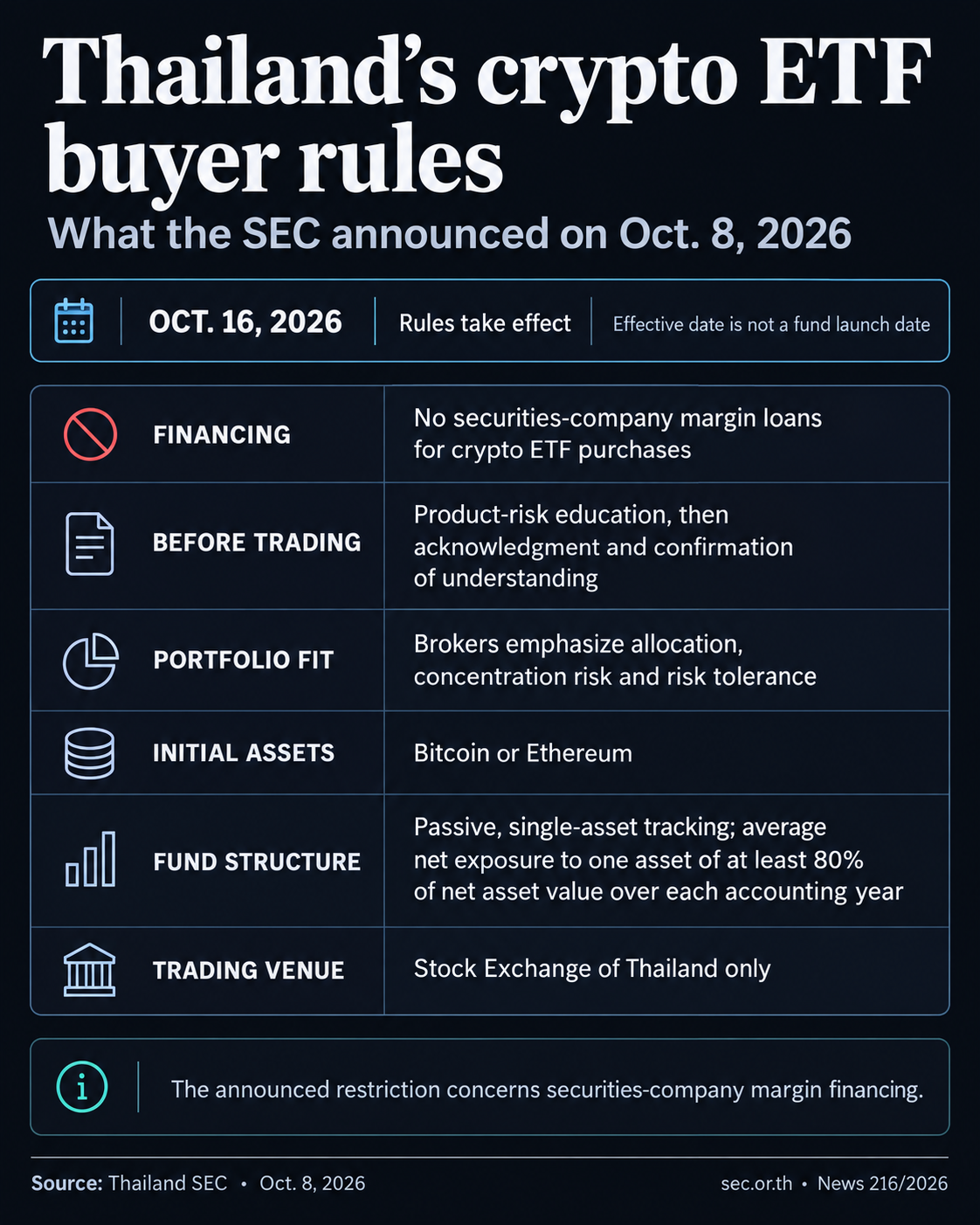
Securities companies will be prohibited from providing margin loans for crypto ETF purchases, preventing investors from using that form of broker financing to increase their exposure.
Before trading, investors must receive education about the products’ characteristics and risks and formally acknowledge their understanding.
Brokers must also emphasize portfolio diversification and investment decisions consistent with individual risk tolerance.
The regulator has separately permitted licensed digital asset fund managers to undertake outsourced investment management functions, while qualified digital asset businesses may apply to serve as mutual fund supervisors.
The final regulations follow consultations conducted between April and September, during which the SEC said most respondents supported the proposals.
The next milestone is Oct. 16, when the regulatory framework becomes effective. The SEC has not yet approved a Bitcoin or Ethereum ETF or announced when either product will begin trading on Thailand’s stock exchange.
 Bitcoin
  Ethereum
  Tether
  BNB
BNB  XRP
XRP  USDC
USDC  Solana
  TRON
TRON  Figure Heloc
  Zcash
Zcash 