

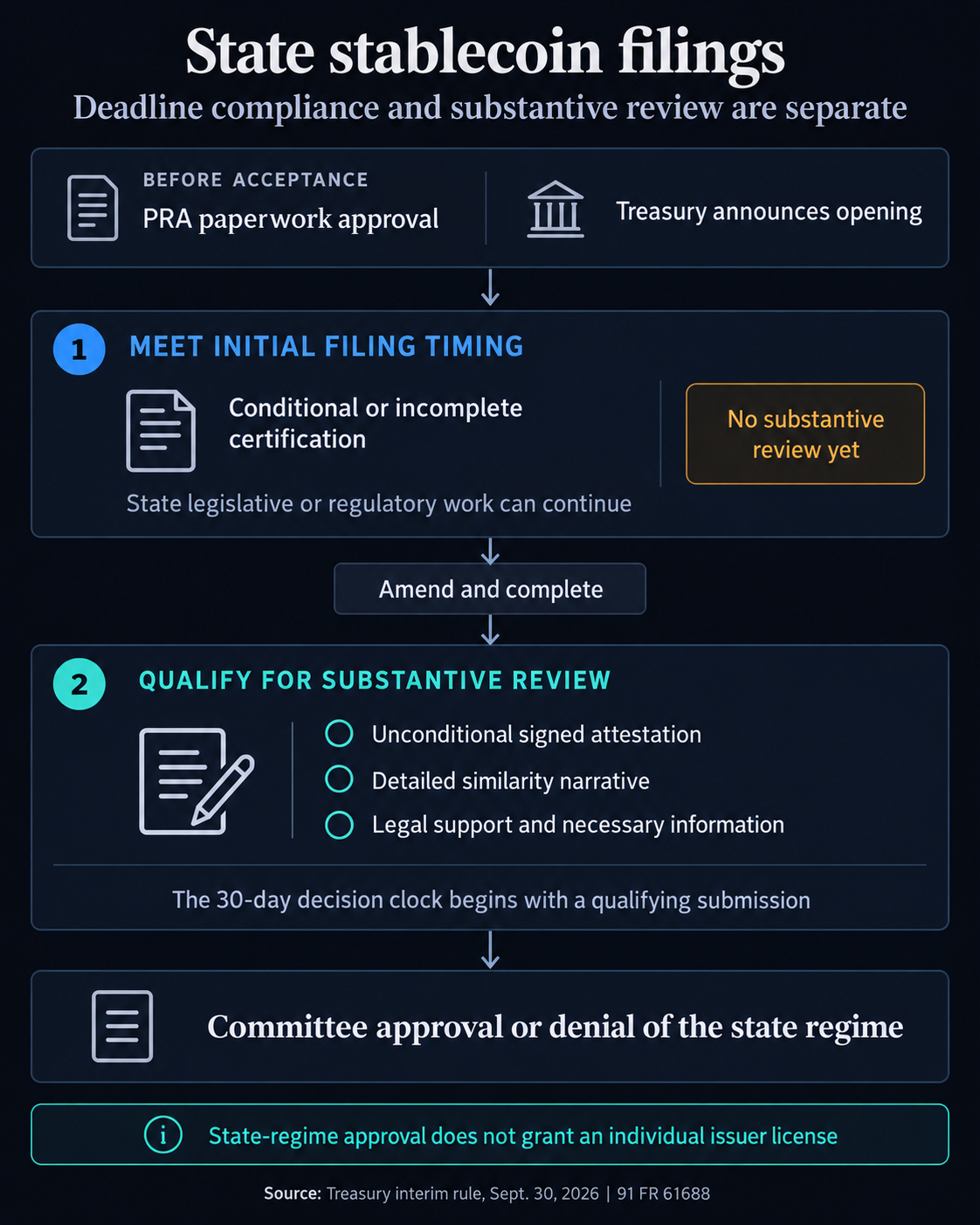
Treasury’s Sept. 30 rule lets states preserve a path toward stablecoin-regime approval while their rules remain unfinished, by filing an initial certification on time and completing the work before substantive review.
The interim final rule sets forms and review procedures for the Stablecoin Certification Review Committee, the federal body that reviews state stablecoin regimes. The Committee says conditional or incomplete certifications can satisfy the initial filing timeframe, even when additional state legislative or regulatory action is planned.
The rule took effect Sept. 30, but says certifications will not be accepted until after Paperwork Reduction Act approval of the information collection. Treasury will post a notice announcing when acceptance begins.
The flexibility matters for state-qualified payment stablecoin issuers with no more than $10 billion in consolidated outstanding payment stablecoin issuance. They may opt for state regulation if the state regulator certifies that its regime meets Treasury’s substantial-similarity criteria and the Committee unanimously approves it as meeting or exceeding the standards and requirements in section 4(a) of the GENIUS Act.
Treasury’s separate proposal on substantial similarity addresses the standards used to compare state and federal regimes. The September procedural rule does not finalize those principles.
How a filing reaches substantive review
A conditional filing can be amended at any time. It does not begin substantive review or start the Committee’s 30-day approval-or-denial clock. That clock applies only once a certification has been submitted in accordance with the procedures.
For that purpose, a state must provide an unconditional attestation signed by an authorized representative, a detailed explanation of how its regime meets Treasury’s similarity principles, supporting legal materials and information the Committee deems necessary.
The distinction gives states room to finish their legislative or regulatory work after meeting the initial timeframe. It does not automatically approve their regimes or grant licenses to individual stablecoin issuers.
CryptoSlate’s July deadline coverage described the difficulty of assessing state equivalence while federal, Treasury and OCC rules were unfinished. The new rule provides forms and review procedures, including initial filing flexibility, while retaining substantive approval requirements.
The rule uses Jan. 18, 2028 for initial certifications, based on its expected Jan. 18, 2027 effective date for the GENIUS Act. The statutory filing deadline is one year after the Act takes effect.
The Act can take effect earlier. Section 20 sets the earlier of 18 months after enactment or 120 days after primary federal payment stablecoin regulators issue any final regulations implementing it.
Comments on the interim procedures are due Nov. 30.
 Bitcoin
  Ethereum
  Tether
  BNB
BNB  XRP
XRP  USDC
USDC  Solana
  TRON
TRON  Figure Heloc
  Zcash
Zcash 