

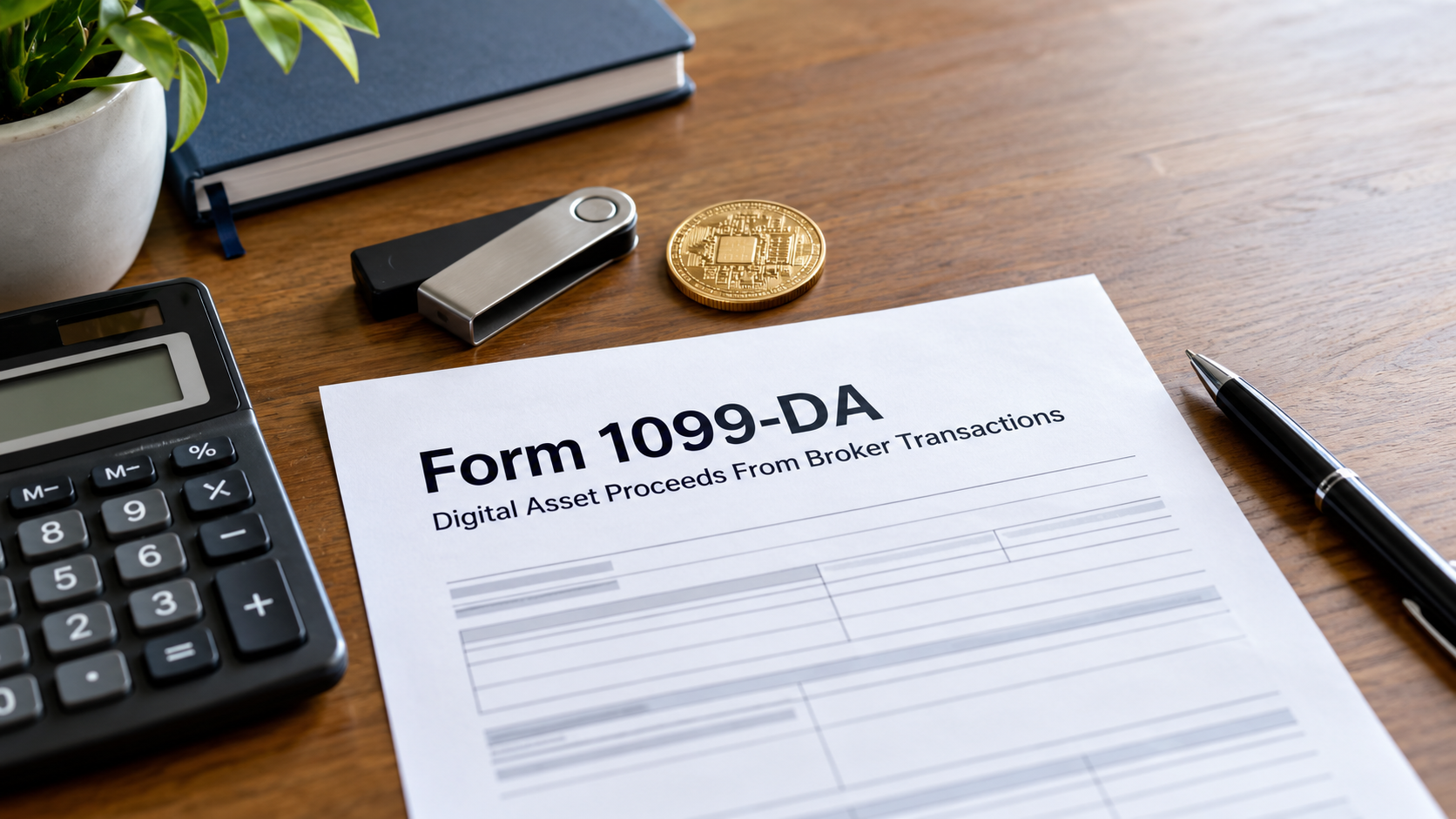
The IRS’s new Form 1099-DA is the biggest change to digital asset tax reporting since the agency started asking “did you receive digital assets” on the front page of Form 1040. Most of the coverage so far has focused on what individual traders should expect. Far less has been written about where the form actually breaks down in practice, and that’s where the real risk sits, for individuals and businesses alike.
What the Form Actually Does
Form 1099-DA is the IRS’s answer to a problem that has existed since crypto trading went mainstream: brokers weren’t required to report digital asset sales the same way stock brokerages report equity trades on Form 1099-B. Starting with the 2025 tax year, digital asset brokers, exchanges, certain custodial wallet providers, and some payment processors are required to track and report gross proceeds from digital asset sales on behalf of their customers. Cost basis reporting phases in the following year.
The practical effect: a business that qualifies as a “broker” under the final regulations now carries the same reporting burden a traditional securities brokerage has carried for decades, except built on infrastructure most crypto-native companies never had to think about before.
The Cost Basis Gap Most People Don’t See Coming
Here is the detail almost none of the plain-language explainers mention: an exchange can only report the cost basis it actually knows. If you bought an asset on that exchange, it has the purchase price on file and can report it accurately. If you transferred the asset in from another wallet or platform, that transfer counts as a “noncovered” asset, and the exchange typically has no record of what you originally paid for it. In that case, the cost basis field on your 1099-DA may simply be left blank.
A blank cost basis field does not mean the obligation goes away. It means the burden shifts entirely to you: you are responsible for calculating and reporting the correct original cost basis yourself, using your own records, and the exchange has no obligation to do it for you. If you don’t, the risk runs in both directions: understating basis overstates your gain and your tax bill, while getting it wrong either way raises your odds of an error the IRS later flags.
DeFi Makes This Worse, Not Better
The IRS has drawn a clear line here: the current broker reporting rules simply don’t reach platforms commonly labeled decentralized or non-custodial, precisely because those platforms never take custody of what’s being traded. In plain terms, there is no centralized broker sitting in the middle of a DeFi swap collecting identity information or custody of assets, which is exactly the definition of “broker” the final regulations are built around. Every trade, swap, liquidity provision, and yield transaction executed through DeFi protocols falls entirely on you, or your business, to track, value, and report correctly. The absence of a 1099-DA from these platforms is not a compliance gap in your favor. It just means the entire recordkeeping burden sits with you, with no third party’s paperwork to fall back on if the IRS asks questions later.
Why Multi-Asset Trading Multiplies the Problem
A trader or business holding a single asset and selling it for cash has a relatively simple cost basis calculation. The moment you are trading between multiple asset classes, crypto-to-crypto swaps, wrapped tokens, cross-chain bridging, staking rewards received in a different asset than what was staked, each transaction is its own taxable event with its own cost basis question, and each one can compound the gap described above. A single missing cost basis record early in a chain of trades can throw off the calculated gain or loss on every subsequent transaction that touched that asset. For active traders and any business processing meaningful digital asset volume, reconstructing this by hand, after the fact, is exactly the kind of project that turns into weeks of unwinding a small number of original data gaps.
What to Do Now
Confirm whether your business meets the definition of a broker under the final regulations, not just the plain-English description most articles use. Separately, and just as important even if you are not a broker: audit your own transaction history for assets transferred in from other platforms or wallets, since those are exactly where a blank cost basis field is quietly left for you to fill in. If any portion of your activity runs through DeFi protocols, assume no 1099-DA is coming for that activity and build your own recordkeeping now rather than reconstructing it later.
This is where proper cost basis reconciliation and compliant tax filing actually comes in. Figuring out accurate gain and loss across transferred-in assets, DeFi activity with no broker reporting, and trades spanning multiple asset classes is exactly the kind of work firms specializing in crypto and money transmitter accounting are built to handle, so your filings are fully compliant and you are not left overpaying tax on gains you never actually realized.
 Bitcoin
  Ethereum
  Tether
  BNB
BNB  XRP
XRP  USDC
USDC  Solana
  TRON
TRON  Zcash
Zcash  Figure Heloc