

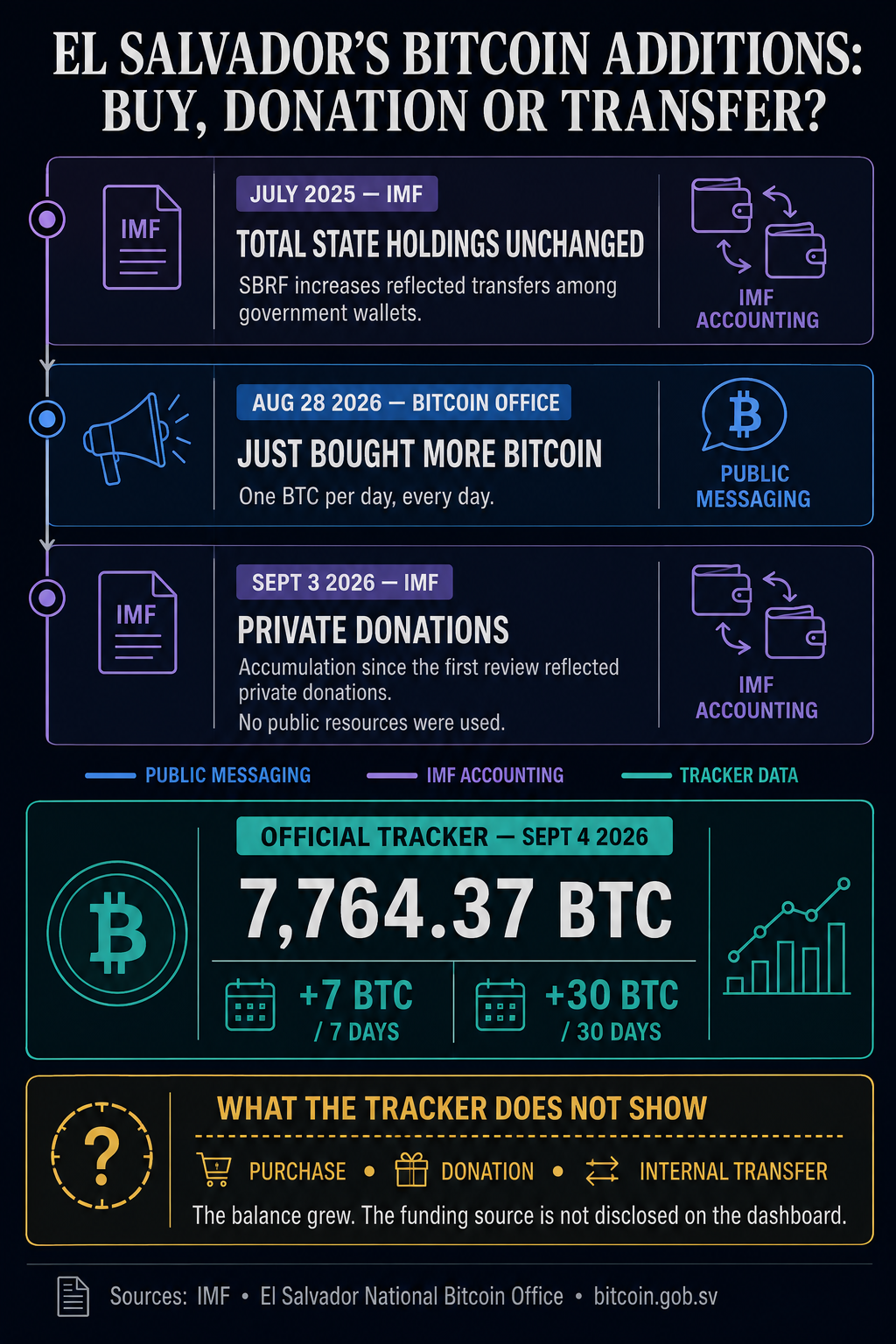
The International Monetary Fund (IMF) says El Salvador’s Bitcoin reserve growth over the past year came from private donations, not new government spending.
In its latest review of the country’s loan program, the global financial agency said documents supplied by El Salvador showed that Bitcoin accumulated since the previous review reflected private donations. It added that no public resources were used and said it expects no further accumulation beyond those documented contributions.
The Fund also reiterated that earlier changes in El Salvador’s BTC position had not necessarily represented new buying.
In previous reviews, it said increases in the Strategic Bitcoin Reserve reflected transfers among government-controlled wallets, while small fluctuations elsewhere were linked to Bitcoin-denominated deposits held through Chivo.
The IMF also noted that the Salvadoran government had “substantially unwound” its stakes in the Chivo e-wallet. It explained:
“Majority ownership and operational control have been transferred to a private operator, while a minority stake and custodial responsibilities for customer assets have been retained by the government.”
El Salvador’s Bitcoin push continues despite the IMF accounting
The IMF’s assessment sits uneasily beside both the size of El Salvador’s growing reserve and the government’s continued pro-Bitcoin messaging.
The country held about 6,224 BTC at the end of June 2025. Its official reserve tracker now shows more than 7,764 BTC, an increase of roughly 1,540 BTC.
If the IMF’s latest assessment is applied to that subsequent accumulation, much of the increase came from private donations rather than taxpayers funding new Bitcoin purchases.
Yet El Salvador continues to describe itself as an active Bitcoin buyer.
As recently as Aug. 28, the National Bitcoin Office said the country had “just bought more Bitcoin” and repeated its longstanding message: “One BTC per day, every day.”
The government has also continued pushing BTC beyond the treasury. President Nayib Bukele has maintained his pro-Bitcoin stance, while El Salvador has kept expanding Bitcoin education initiatives and presenting the asset as part of its long-term economic strategy.
Last year, the country also overhauled its Bitcoin treasury structure, moving away from a single reused wallet and spreading its holdings across multiple addresses. Officials said the change followed digital-asset security best practices and reduced potential long-term exposure to quantum-computing threats.
The new structure keeps the addresses public, allowing observers to verify the reserve balance. However, it does not distinguish BTC bought with public money from private donations or transfers between government-controlled wallets.
That distinction now sits at the center of the disagreement. El Salvador’s reserve has grown by more than 1,500 BTC while the government continues to publicly promote daily purchases, but the IMF says the recent accumulation it verified did not require additional public spending.
The country clearly owns substantially more Bitcoin than it did a year ago. What remains unresolved is whether “one BTC per day” still describes government-funded purchases or simply the pace at which Bitcoin is entering the reserve.
 Bitcoin
  Ethereum
  Tether
  BNB
BNB  XRP
XRP  USDC
USDC  Solana
  TRON
TRON  Figure Heloc
  Zcash
Zcash 