

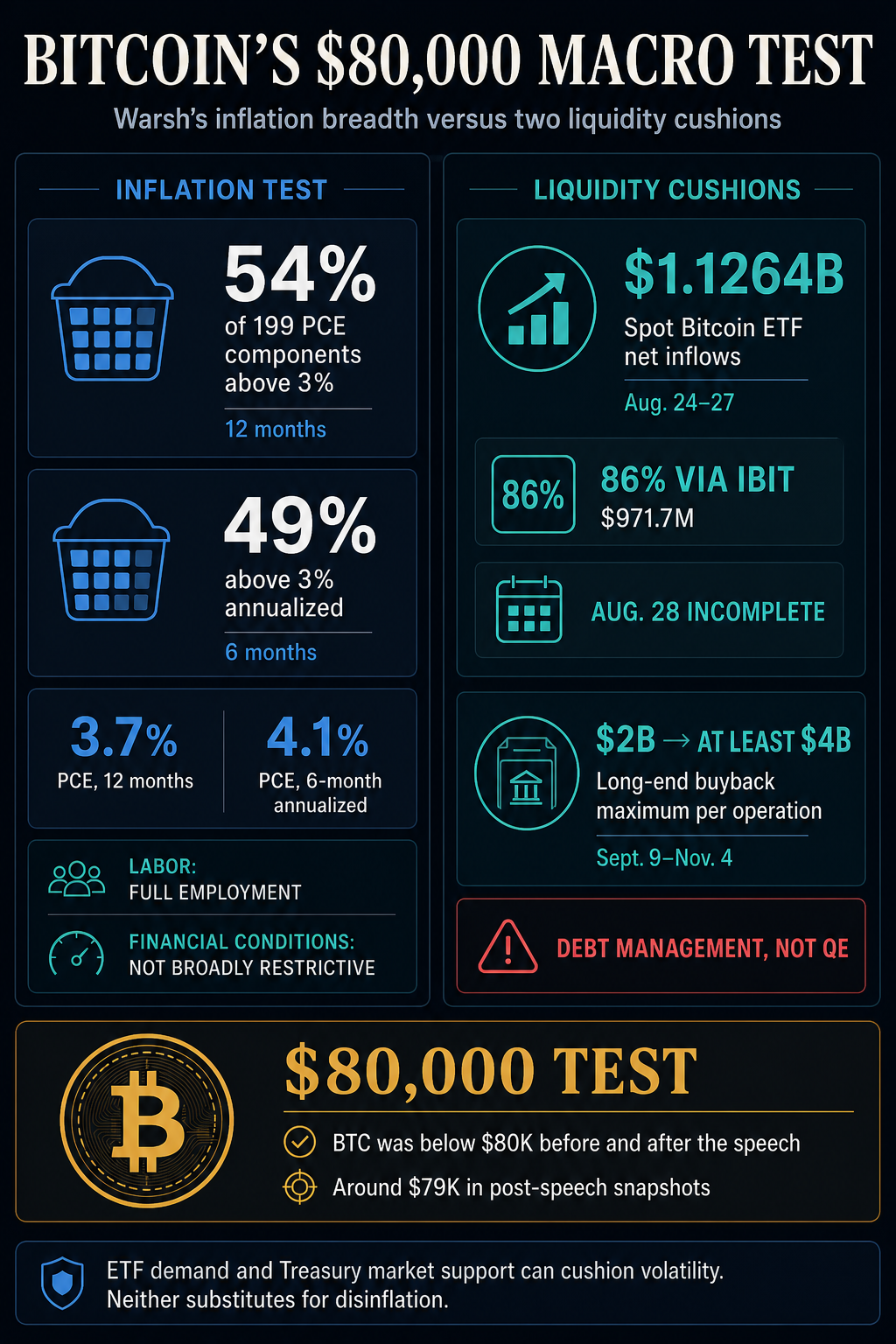
Bitcoin has 54% as a new macro number to defend against, the share of the personal consumption expenditures basket that Federal Reserve Chair Kevin Warsh said has risen faster than 3% over the past year.
His Jackson Hole speech turned an abstract argument about sticky inflation into a measurable test, now sitting beside Bitcoin’s attempt to regain $80,000.
Bitcoin slipped under $80,000 during Asian trading after reaching $81,280 overnight. Successive Bitcoin market data after the text was published kept BTC below the threshold and moving quickly around $79,000.
Warsh’s remarks gave traders a clearer standard for judging the rebound’s rate risk.
US-traded spot Bitcoin ETFs absorbed over $1.1 billion over four completed sessions through Aug. 27. Treasury is also preparing larger liquidity-support buybacks, but those operations begin Sept. 9 and are debt management.
The contest around $80,000 is whether concentrated ETF demand and improved Treasury market functioning can absorb volatility while Warsh’s breadth test keeps tighter policy live.
The 54% reading changes the policy test
Warsh said 54% of the 199 PCE components rose faster than 3% over 12 months, while 49% ran above 3% at an annualized rate over six months.
The 12-month breadth measure has improved from a post-pandemic high of nearly 77%, but it remains well above the 32% average in the two decades before the pandemic.
The 77% peak and 32% pre-pandemic average are 12-month comparisons, so Warsh presented the separate 49% six-month result as a more recent pulse.
Warsh also put six-month annualized headline inflation at 4.1%. The Bureau of Economic Analysis separately reported that the headline PCE price index rose 0.2% in July and 3.7% from a year earlier.
Within Warsh’s framework, those readings make a quick pivot toward easier policy harder to justify. He said the Fed’s firm target remains 2% PCE inflation, described labor markets as consistent with full employment, and found few signs of restraint in credit and loan markets.
He said broad financial conditions were difficult to characterize as restrictive.
Warsh committed to a policy discipline. For Bitcoin, the burden of proof has shifted toward data showing that inflation is narrowing across the basket.
Bitcoin produces no yield. When the market keeps a higher policy path in play, cash and short-dated government debt become more competitive, while the discount rate applied to risk assets rises.
Crypto-specific demand can counter that pressure, but it must keep arriving. The ETF record already shows how concentrated that counterweight has become.
ETF demand meets a live rates test
The strongest argument for Bitcoin’s rebound is visible in the Farside Investors flow table. US-traded spot Bitcoin ETFs took in a net $337.6 million on Aug. 24, $314.3 million on Aug. 25, $232.2 million on Aug. 26 and $242.3 million on Aug. 27.
The composition of this substantial bid weakens the claim that demand is already broad and durable. BlackRock’s iShares Bitcoin Trust (IBIT) accounted for $971.7 million, or roughly 86% of the total.
A concentrated inflow streak can still support price, but it leaves the result more exposed to allocation shifts in one product.
Durability now has three observable tests: whether inflows continue after the policy speech, whether they spread beyond IBIT, and whether Bitcoin can reclaim $80,000. Passing all three would make the ETF channel look more like persistent absorption, while failing them would make the four-day burst look more like a temporary positioning cushion.
The curve kept near-term pressure alive
The Associated Press reported that the two-year yield rose to 4.29% from 4.22% just before the speech.
The 10-year yield edged to 4.69% from 4.67% late Thursday, while the 30-year yield slipped to 5.17% from 5.19%. Those comparisons use baselines from late Aug. 27, so they should not be presented as one synchronized reaction.
For Bitcoin, the two-year move is the more direct warning because it reflects the portion of the curve most exposed to the expected policy path. The mixed long end did not signal a broad bond-market panic. Investors were separating near-term Fed risk from longer-run questions about growth, debt supply and inflation.
A single intraday yield move can reverse. The 54% and 49% readings establish a repeatable policy test, while ETF flows show whether crypto-specific demand is strong enough to absorb the volatility created when that test changes.
Treasury support is debt management, not Fed easing
Treasury announced that maximum liquidity-support buybacks in the 10-to-20-year and 20-to-30-year nominal sectors will rise from $2 billion to at least $4 billion per operation from Sept. 9 through Nov. 4.
Larger operations can improve trading in older, less-liquid securities and reduce market-functioning friction at the long end. Because the Treasury market anchors financing and collateral conditions across the financial system, smoother trading can indirectly help risk appetite.
That makes the program relevant to Bitcoin, but the connection is conditional and indirect.
Treasury has described the buybacks as regular debt-management operations financed through its broader issuance program. Its explanation of the program distinguishes liquidity support from an acute-stress facility.
The operations retire less-liquid Treasury debt while Treasury continues to fund itself through issuance.
Treating the program as QE would merge fiscal debt management with monetary policy and overstate the support available to Bitcoin.
The larger maximum does not take effect until Sept. 9. It cannot explain a Bitcoin move that occurred before Warsh’s Aug. 28 speech, and it cannot neutralize the front-end rate risk implied by broad inflation today.
The conditions for a durable $80,000 recovery
Bitcoin’s support case is credible but conditional. The ETF channel has delivered more than $1.1 billion over four completed sessions, and Treasury’s scheduled operations could make the long end easier to trade.
Those forces can cushion volatility, while Warsh’s framework sets the opposing test.
Inflation is not only above target at the headline level, so price pressure remains broad across the basket. With labor markets at full employment and financial conditions not broadly restrictive, the case for near-term policy relief is not established.
A durable break back above $80,000 would need more than one supportive flow streak. The decisive evidence would be continued ETF demand beyond IBIT, a sustained reclaim of the price level, and subsequent inflation data that pull Warsh’s breadth readings decisively lower.
Until then, ETF demand and Treasury market support cushion tighter financial conditions. Bitcoin can survive that conflict, but the 54% benchmark makes the terms of survival much clearer.

 Bitcoin
  Ethereum
  Tether
  BNB
BNB  XRP
XRP  USDC
USDC  Solana
  TRON
TRON  Figure Heloc
  Hyperliquid