

KULR Technology Group has exited Bitcoin mining, repaid its Coinbase debt, and begun selling its BTC holdings as the battery technology company shifts capital back toward its core business.
The retreat marks a sharp reversal from the Bitcoin accumulation strategy KULR launched in late 2024, which allowed up to 90% of surplus cash to be deployed into the cryptocurrency.
KULR purchased no Bitcoin during the first half of 2026 after spending $69.9 million to acquire 693.81 BTC during the same period last year. Its board has also made the remaining treasury available to fund operations, effectively turning Bitcoin from an accumulation asset into a potential source of corporate liquidity.
Chief Financial Officer Mike Kimel said the strategy had provided financial flexibility, but Bitcoin’s volatility was making KULR’s underlying battery business harder for shareholders to assess.
The company recorded a $10.59 million non-cash Bitcoin fair-value loss during the second quarter, contributing to a $21.97 million net loss. Revenue fell 43% to $2.08 million, while the operating loss widened 19% to $11.2 million.
Since quarter-end, Kimel said KULR has been reducing its Bitcoin position in a “deliberate and disciplined manner” to lower balance-sheet volatility and concentrate capital on its energy platform. He also noted that the company issued no shares through its at-the-market program during the first half of the year.
KULR joins a broader Bitcoin treasury retreat as core businesses take priority
According to its SEC filing, KULR entered the second half of the year with 1,091.69 BTC valued at $63.92 million, down sharply from its $109.8 million cost basis.
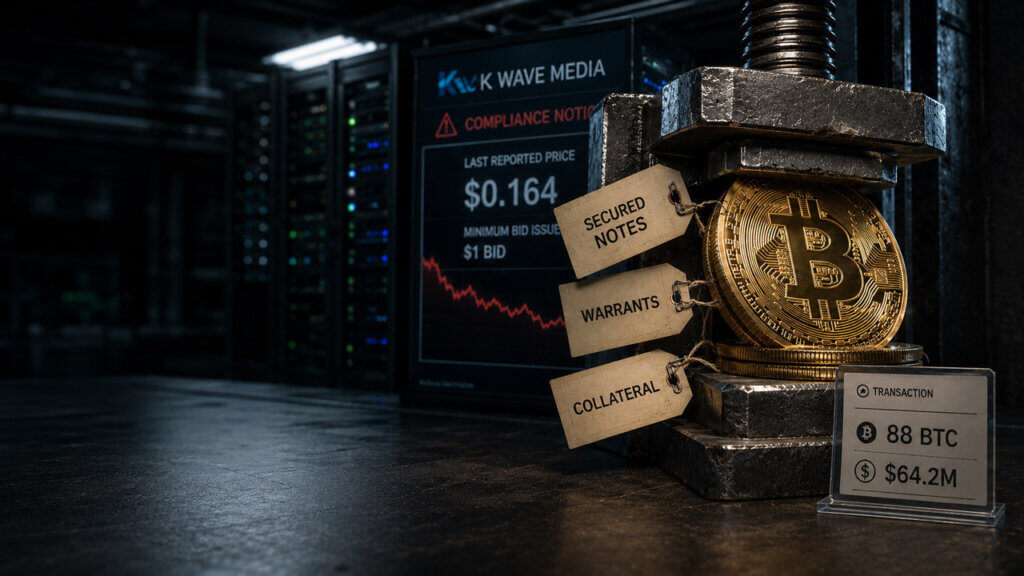
Of that position, 565 BTC worth about $33.1 million were pledged against a $20 million Coinbase credit facility. KULR had drawn $5 million from the facility in March and another $15 million in May.
After June 30, the company sold approximately 333 BTC for $21.5 million and used about $20 million of the proceeds to repay the Coinbase principal. The repayment eliminated the debt and released all 565 BTC that had served as collateral, removing the associated liquidation risk.

The sales reduced KULR’s disclosed Bitcoin position by roughly 30% from its June 30 balance to approximately 760 BTC.
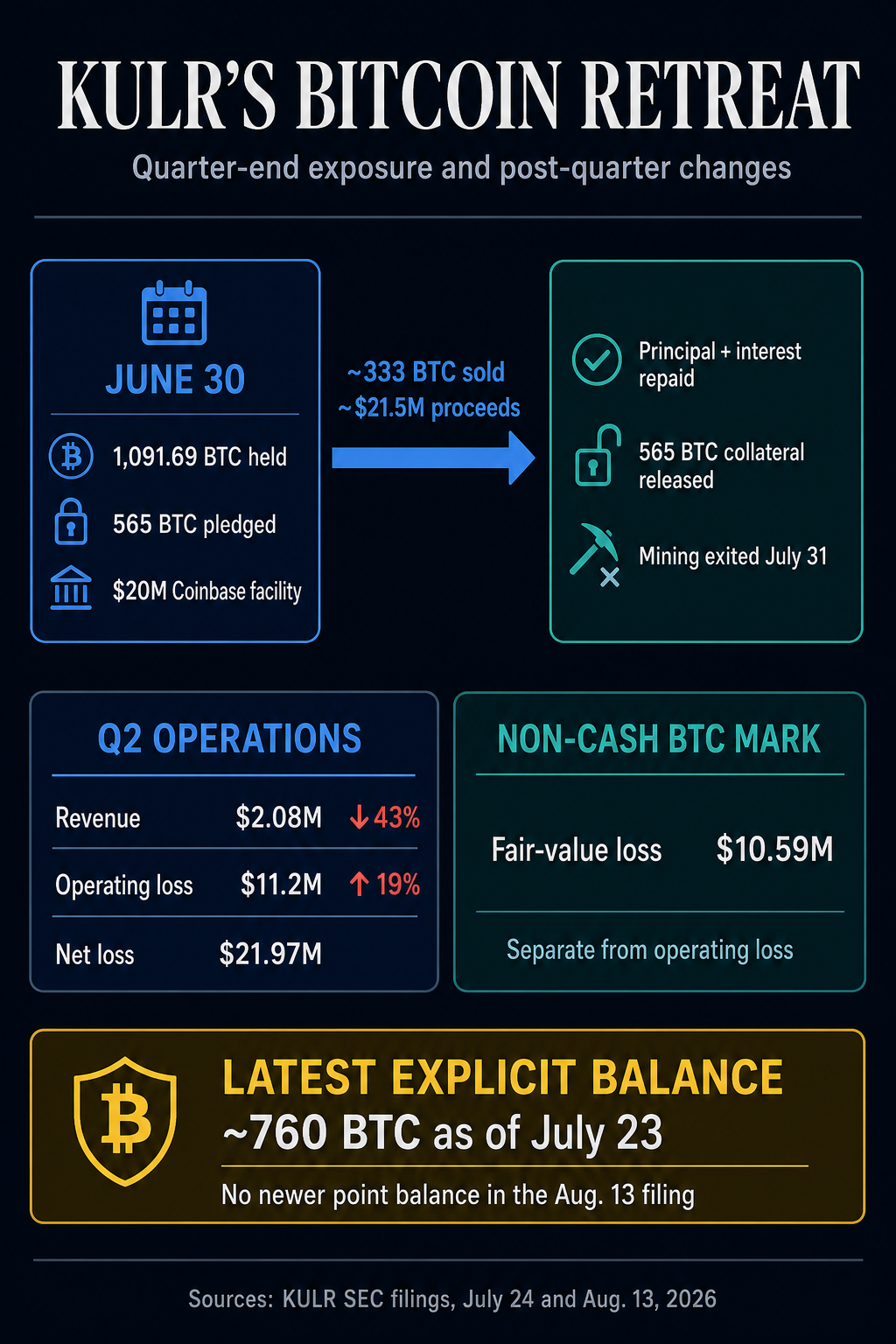
Simultaneously, KULR dismantled its mining operation by refusing to renew one mining agreement which expired on July 30.
A second contract, originally scheduled to continue through October 2027, was terminated early in July. KULR paid $150,000 to end the agreement, which eliminated approximately $2.1 million in remaining commitments.
The decision followed weaker second-quarter mining activity. KULR earned 8.44 BTC during the quarter, compared with 11.25 BTC a year earlier, while quarterly mining revenue dropped to about $606,000 from $1.12 million.
Over the full first half, however, production actually increased to 17.23 BTC from 14.22 BTC. Mining revenue still slipped to $1.27 million from $1.37 million because the average value of the Bitcoin earned fell to about $73,594 from $96,225.
KULR’s reversal is part of a broader reassessment among several companies that adopted Bitcoin treasury strategies during the previous bull cycle but have retreated from the industry due to current market conditions.

Market observers said these firms action show how the treasury trade changes when BTC stops functioning primarily as an appreciating reserve asset and starts competing with debt reduction, operating cash requirements, and investment in core businesses.
For KULR, that shift is now explicit. The company still holds a sizeable Bitcoin position, but it has stopped accumulating, removed its Bitcoin-backed leverage, closed its mining operation and given management authority to sell more BTC when corporate priorities require it.

 Bitcoin
  Ethereum
  Tether
  BNB
BNB  USDC
USDC  XRP
XRP  Solana
  TRON
TRON  Figure Heloc
  Hyperliquid