

American Bitcoin mined approximately 932 BTC and reported $67.015 million in revenue in the second quarter. But its six-month cash flows do not show that the broader reserve strategy was self-funding. The miner finished June with 8,002 BTC, while first-half operations used $63.795 million in cash and digital-asset purchases used another $65.316 million.
The cash-flow statement records $144.088 million of net proceeds from at-the-market share sales as the period’s principal financing inflow. American Bitcoin sold 7,755,671 Class A shares through the ATM during the first half, including 2,151,127 shares that produced $33.585 million of net proceeds in the second quarter. The filing does not say those dollars were earmarked for a particular expense or Bitcoin purchase. Still, the two disclosed cash uses totaled $129.111 million, showing that equity was central to liquidity.

On a coin-count basis, mining did most of the quarter’s work. Holdings rose by approximately 981 BTC from March 31 to June 30, and the 932 BTC produced equaled about 95% of that increase, although the figures do not trace individual coins. Dilution did not erase the per-share gain: reverse-split-adjusted common shares rose 3.12%, while holdings rose 13.97%, lifting implied satoshis per share by 10.52%. The ATM remained available after American Bitcoin’s July reverse split, keeping future equity issuance relevant even as BTC per share increased.
American Bitcoin’s unit-economics metric excludes a major accounting cost. The company reported about $71,900 in revenue per mined BTC and a stated cost of $36,500 per mined BTC. The quarterly results and 10-Q show that the $34.009 million cost-of-revenue figure behind that unit metric excludes a separate $28.237 million depreciation-and-amortization charge, so the company’s cost-per-BTC measure is not fully loaded.
The $57.151 million GAAP net loss also tells a different story from cash use. A $71.178 million digital-asset fair-value loss drove a $74.081 million operating loss, while an $18.315 million derivatives gain and a $22,000 warrant-liability gain provided partial offsets before tax. The cash-flow reconciliation treats the digital-asset loss and derivatives gain as noncash adjustments, so the net loss is not a measure of cash burn.
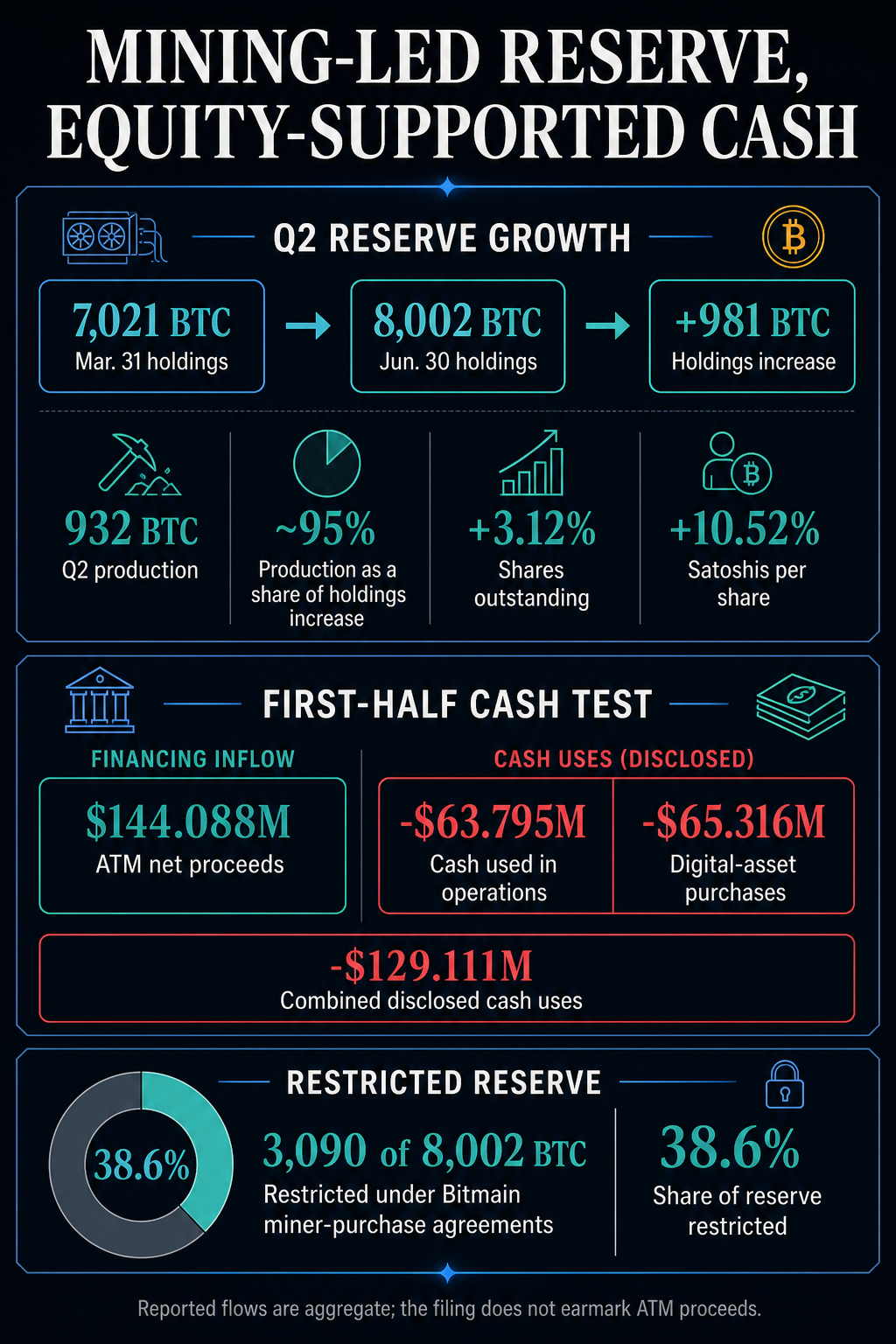
Not all of the reserve was freely held. American Bitcoin classified 3,090 BTC, or 38.6% of its holdings, as restricted under Bitmain miner-purchase agreements and recorded a $371.687 million related liability. Those coins had not been sold or forfeited. They remained on the balance sheet because the company retained redemption or repurchase rights and continued economic exposure.
The quarter therefore supports both sides of American Bitcoin’s model. Mining added BTC faster than the share count grew, but first-half cash flows still drew heavily on equity financing, while nearly two-fifths of the June reserve remained tied to miner-purchase commitments.

 Bitcoin
  Ethereum
  Tether
  BNB
BNB  USDC
USDC  XRP
XRP  Solana
  TRON
TRON  Figure Heloc
  Hyperliquid