


Nasdaq PHLX’s proposed Bitcoin index options remain frozen as CME Group challenges the SEC’s authority to approve them.
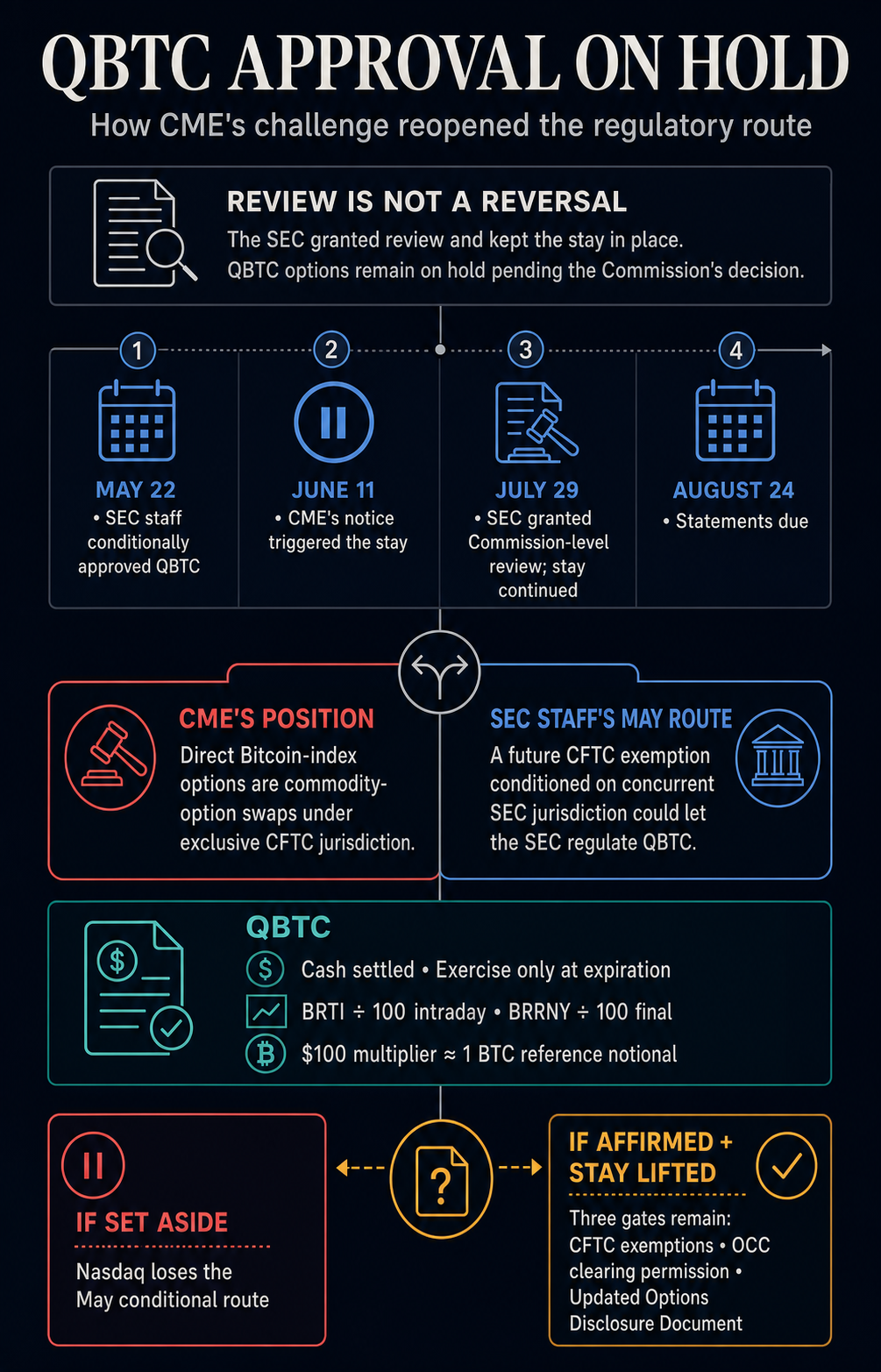
The Securities and Exchange Commission (SEC) granted CME’s petition on July 29 to review the agency’s May approval of QBTC.
The approval had been automatically stayed since CME filed notice of its challenge on June 11, and the agency has set no deadline for deciding the case. Public statements are due Aug. 24.

The dispute combines a jurisdictional test with a commercial fight over institutional Bitcoin options. CME operates the largest US federally regulated crypto derivatives franchise under Commodity Futures Trading Commission (CFTC) oversight, while Nasdaq is seeking to offer comparable direct Bitcoin-options exposure through the securities market.
Nasdaq targets a market built under CFTC rules
Nasdaq’s proposal would bring direct Bitcoin index options into the brokerage and clearing infrastructure investors already use for stocks and ETF options.
QBTC would be a cash-settled contract exercisable at expiration, with intraday pricing linked to the CME CF Bitcoin Real Time Index and final settlement based on the New York variant of the CME CF Bitcoin Reference Rate. Its multiplier would give each contract reference exposure roughly equal to one Bitcoin.
That route places Nasdaq closer to a market CME has developed through CFTC-regulated futures and options.
The timing is significant because growing institutional participation has accelerated demand for Bitcoin options used to hedge exposure, trade volatility and generate yield.

CME said in February that its broader cryptocurrency derivatives suite averaged 407,200 contracts per day in 2026, up 46% from a year earlier, while average daily open interest reached 335,400 contracts.
Meanwhile, Nasdaq’s proposal also relies on the CME CF benchmark family used across CME’s Bitcoin products. The relationship gives CME a direct commercial interest in how similar exposure reaches investors and which regulatory obligations apply to the exchanges offering it.
CME used the commodities framework when it certified options tied directly to the BRRNY benchmark in October 2025.
Those financially settled swaps represented 0.01 Bitcoin per contract and were designated for trading through CME Globex and clearing by CME Clearing under CFTC rules. QBTC would carry approximately 100 times that reference exposure through an SEC-regulated exchange.
CME says Nasdaq would gain permission to offer an economically comparable product without registering as a designated contract market or swap execution facility.
The product would also be cleared by the Options Clearing Corporation (OCC) in its SEC-regulated capacity rather than under the full derivatives clearing framework CME follows.
Its petition describes the approval as a direct competitive injury and warns that similar exemptions could raise compliance costs for CME exchanges and clearing operations. CME has not quantified any potential loss of trading volume, fees, or market share.
CME challenges the bridge behind Nasdaq’s approval
That commercial overlap sits behind CME’s challenge to the legal mechanism SEC staff constructed for QBTC.
CME argues that Bitcoin is a non-security commodity, making a direct option on its price a commodity-option swap under the Commodity Exchange Act. Such contracts fall within the CFTC’s exclusive jurisdiction and ordinarily must trade on CFTC-regulated venues, its petition said.
SEC staff acknowledged that QBTC could not launch without CFTC relief. However, the May approval said Exchange Act Section 3B could deem the contracts securities if the CFTC granted an exemption conditioned on concurrent SEC jurisdiction.
The staff relied partly on Section 717 of the Dodd-Frank Act, which allows concurrent oversight of certain derivatives. It said the language applies to any qualifying contract receiving the specified CFTC exemption and is not restricted to products combining obvious securities and derivatives features.
CME says that interpretation stretches a provision intended to resolve uncertainty around securities-related derivatives. Under its reading, the agencies cannot use exemptions to transfer a conventional commodity option from the CFTC’s exclusive jurisdiction into the securities regime.
The group also identified a classification problem. The staff’s interpretation would deem QBTC itself a security while Bitcoin and the underlying index retained their status as non-securities.
CME says the structure could create uncertainty over the margin, customer-account, reporting and clearing rules governing a contract subject to both securities and commodities oversight.
Additionally, it argues that SEC staff exceeded delegated authority by adopting the interpretation without a vote by the full Commission.
The Commission’s decision to hear the petition does not signal agreement with CME. Instead, it transfers the dispute from the Division of Trading and Markets to the commissioners while leaving the approval suspended.
The challenge could spread beyond Bitcoin
CME warns that the staff’s interpretation contains no clear limit restricting it to cryptocurrency.
Commodity-based ETFs already provide securities-market exposure to gold, oil, corn, wheat and other assets. CME argues that Nasdaq or another securities exchange could use the same reasoning to seek direct options or futures on any commodity represented by an ETF.
Such products could compete with CFTC-regulated contracts while operating under different exchange, intermediary and clearing requirements.
CME says repeated use of the structure could also cause commodity options to become broadly treated as securities, weakening the jurisdiction Congress assigned to the CFTC.
The petition also points to the CFTC’s efforts to defend exclusive federal jurisdiction over prediction markets. CME argues that allowing another agency to regulate Bitcoin index options would undermine the same jurisdictional position the CFTC has asserted in those cases.

SEC staff left those broader consequences for the CFTC to consider when deciding whether to grant exemptive relief. The May order focused on whether Nasdaq’s rules satisfied securities-market standards, with any launch conditioned on the CFTC preserving concurrent authority.
The Commission can affirm, modify, overturn, or return the May approval for further proceedings.
A ruling for CME would close Nasdaq’s current route. If Nasdaq prevails, QBTC would still require CFTC exemptions allowing PHLX to list the contracts and OCC to clear them through its SEC-regulated capacity. OCC would also need the necessary approvals and an updated Options Disclosure Document.
Until the Commission resolves CME’s challenge, Nasdaq’s product remains frozen and the broader question of whether securities exchanges can enter markets historically reserved for CFTC-regulated commodity derivatives remains unanswered.
 Bitcoin
  Ethereum
  Tether
  BNB
BNB  XRP
XRP  USDC
USDC  Solana
  TRON
TRON  Zcash
Zcash  Figure Heloc