


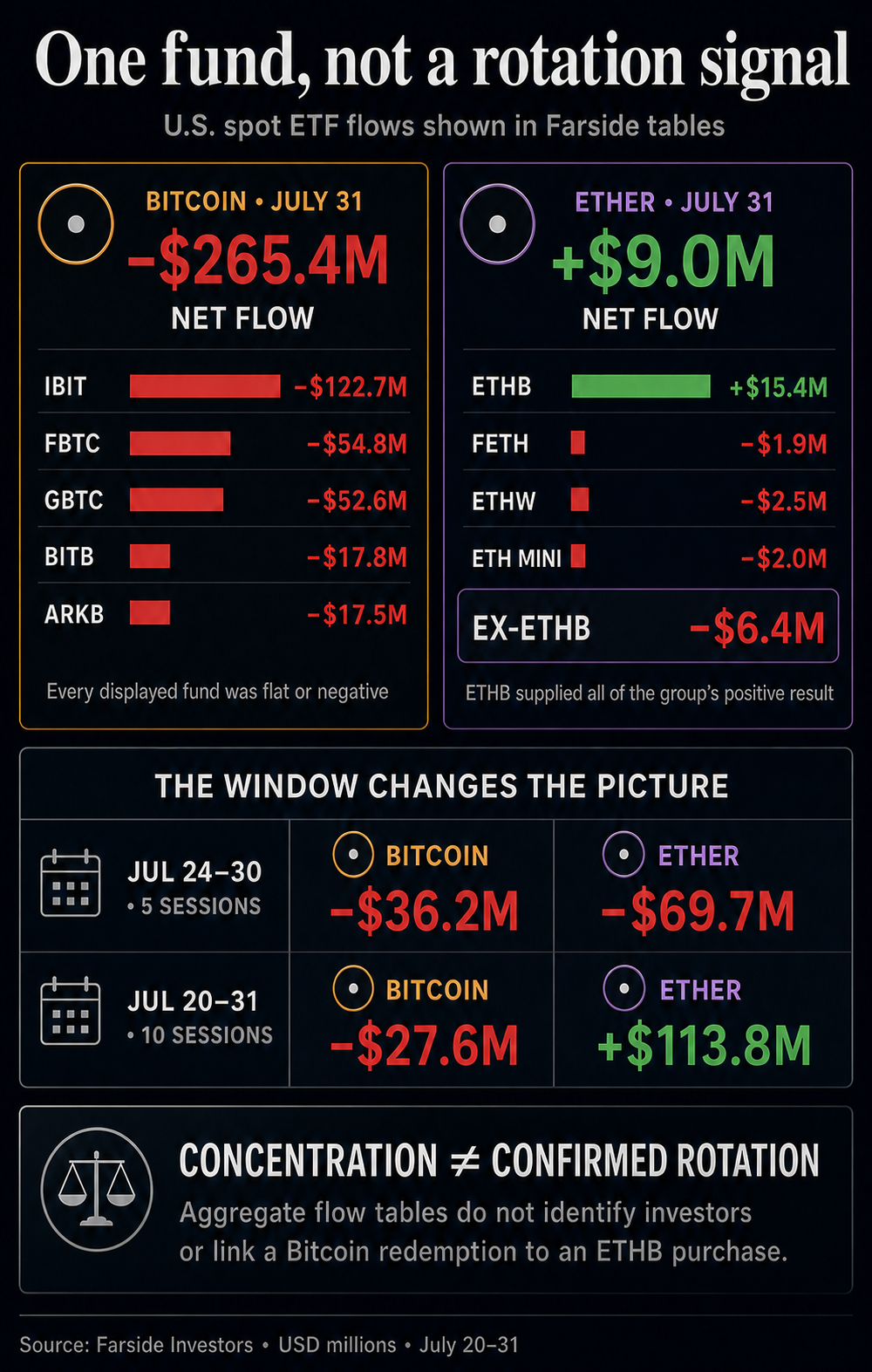
U.S. spot Bitcoin funds posted net outflows of $265.4 million on July 31, reversing a $233.1 million inflow the previous session. Ethereum showed a $9 million net inflow, but only because BlackRock’s staked Ethereum fund drew more than the group gained overall.
Every Bitcoin product displayed in Farside’s July 31 table was flat or negative. BlackRock’s IBIT lost $122.7 million, Fidelity’s FBTC lost $54.8 million, and Grayscale’s GBTC lost $52.6 million. BITB and ARKB lost another $17.8 million and $17.5 million, respectively.

BlackRock’s iShares Staked Ethereum Trust ETF, or ETHB, moved the other way with a $15.4 million inflow. FETH, ETHW and Grayscale’s mini Ether trust lost a combined $6.4 million, while every other displayed Ether product was flat. Without ETHB, the group would have ended the day in outflow.
One fund, not a rotation signal
The five trading sessions from July 24 through July 30 offer little evidence of a persistent shift toward Ether. Bitcoin funds lost a combined $36.2 million, while the Ethereum products lost $69.7 million.
The wider 10-session window, from July 20 through July 31, was more favorable for Ethereum. Those funds gained $113.8 million as Bitcoin funds lost $27.6 million.

BlackRock reported about $546.1 million in net assets on July 31, when its NAV fell 2.85% to $24.04 despite the inflow. Its trailing 30-day staking rewards rate was 1.67%, a backward-looking figure rather than a guaranteed yield.
An iShares filing said that, as of April 15, the aggregate staking fee was 10% of gross staking consideration. Staking consideration net of that fee is intended for distribution monthly, but no less frequently than quarterly; the intended schedule does not guarantee a payment.

The broader market was also lower. CryptoSlate’s August 1 pages show Bitcoin near $62,958, down 2.09% over 24 hours, and Ethereum at $1,868, down 1.09%. The pages were refreshed at different times after the ETF session, so the figures provide context rather than evidence that the flows caused either move.
A stronger rotation case would require Ethereum inflows to persist across sessions and broaden beyond ETHB. July 31 instead shows a product-specific contrast: broad losses among the displayed Bitcoin funds and concentrated demand for one staked Ethereum wrapper.
 Bitcoin
  Ethereum
  Tether
  BNB
BNB  XRP
XRP  USDC
USDC  Solana
  TRON
TRON  Zcash
Zcash  Figure Heloc