

The White House placed longtime teleprompter operator Gabriel Perez on unpaid administrative leave on July 16 after ABC News reported allegations that he used advance access to President Donald Trump’s prepared remarks to earn more than $100,000 on Kalshi.
Sources told the network that the alleged trading covered more than a dozen speeches over roughly three months and that Perez is discussing a potential settlement with the Commodity Futures Trading Commission. The CFTC declined to comment.
Kalshi said its surveillance team promptly flagged, investigated, and referred the trades to the CFTC. NPR separately reported, citing unnamed sources, that the exchange froze about $90,000 and banned Perez from the platform.
Detection without a public clock
Kalshi’s system appears to have caught something unusual, investigated the account, and sent evidence to the federal regulator. The missing piece is when each step happened.
ABC News, The Associated Press, and NPR do not say when Kalshi first flagged the account, when trading was restricted, or when the referral occurred relative to the alleged series of more than a dozen speeches. Without those timestamps, it’s impossible to tell whether Kalshi restricted the account before any further alleged trading took place.
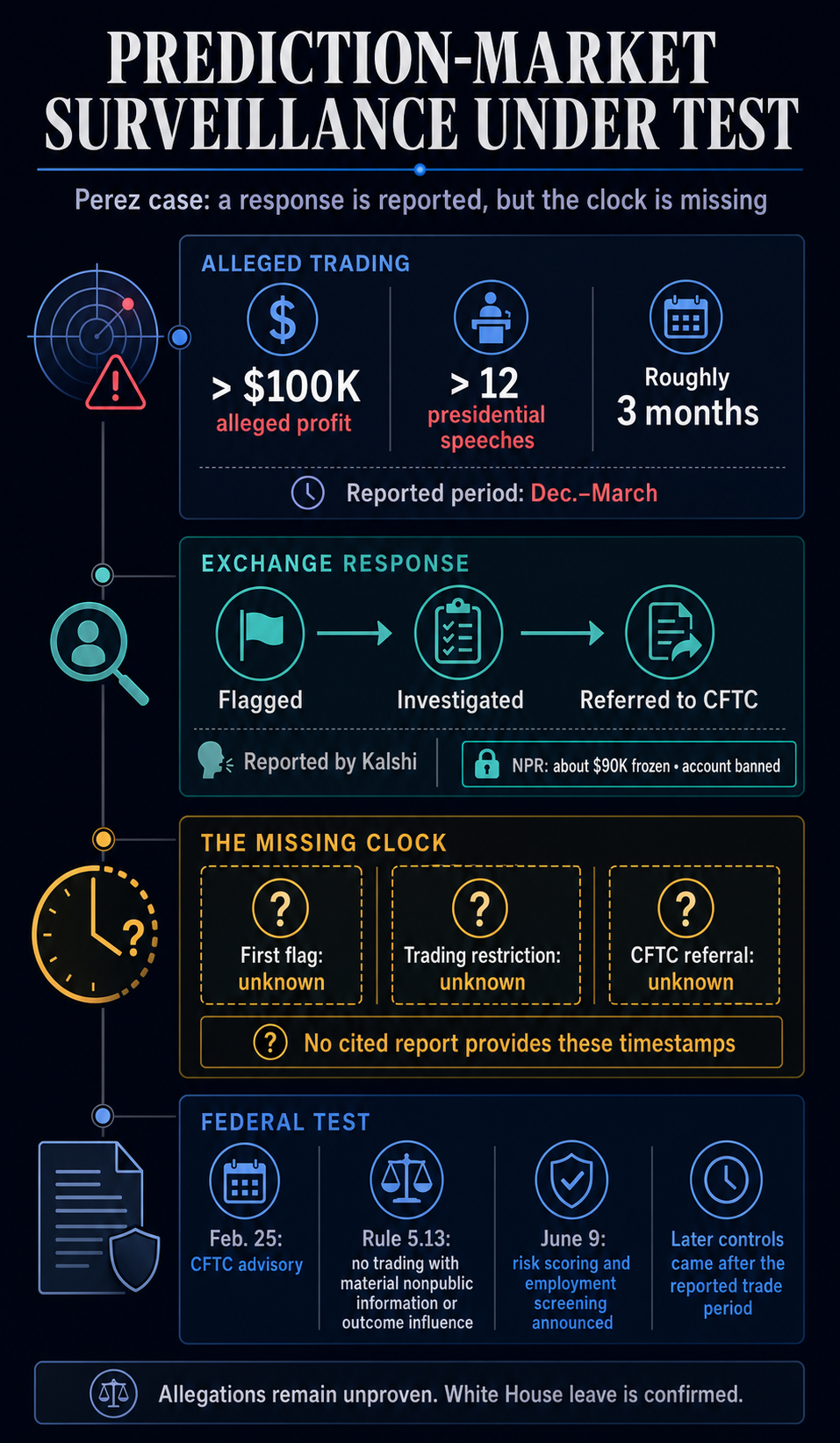
The governing framework is clear, though it has not been publicly applied to Perez. A February CFTC advisory said misappropriating confidential information in breach of a duty can violate Commodity Exchange Act Section 6(c)(1) and Regulation 180.1.
It also said designated contract markets have an independent duty to maintain audit trails, surveil trading, and enforce their rules. Kalshi’s rulebook bars members with material nonpublic information or influence over an outcome from trading the relevant contract, and requires that unusual activity be reviewed and, where appropriate, investigated.
The Perez allegations escalate a pattern reflected in the CFTC’s general prediction-market warning and a separate Special Forces and Polymarket case CryptoSlate covered earlier this year. This time, the claimed edge came from access to White House speeches, and the trades ran through a federally regulated exchange’s mention markets.
The timing also coincides with Trump Media’s July 16 announcement of Truth API, a paid data feed designed to deliver posts from Truth Social’s most influential accounts, including Trump, to institutional customers in milliseconds. The company said the service, scheduled to begin Aug. 1, is aimed partly at high-frequency and algorithmic trading firms for which even brief information delays carry a cost.
Unlike the Perez allegations, the API concerns faster access to information after publication rather than to nonpublic remarks in advance. Still, the two developments expose adjacent markets built around the same commodity: receiving Trump’s potentially market-moving words before slower participants can react.
Kalshi announced new integrity measures on June 9, including market risk scores and employment screening before users can enter certain heightened-risk markets. Those measures came after the reported December-to-March period during which Perez allegedly traded. Kalshi has not disclosed whether those safeguards reached presidential-mention markets after the rollout or whether similar checks were already in place.
For now, the answer is split. Surveillance appears to have worked well enough to generate a referral and reported freeze and ban, but the repeated alleged trading and missing timestamps leave the speed and deterrent effect of the response in this case unproven.

 Bitcoin
  Ethereum
  Tether
  BNB
BNB  XRP
XRP  USDC
USDC  Solana
  TRON
TRON  Figure Heloc
  Hyperliquid