



US President Donald Trump’s family trust executed hundreds of millions of dollars in financial transactions during the first quarter of 2026, including the acquisition of stocks directly tied to the digital asset industry, even as his administration pushed sweeping, pro-cryptocurrency regulatory overhauls.
According to a mandatory 278-T financial disclosure form released on May 14 by the US Office of Government Ethics, the president’s portfolio underwent more than 3,600 transactions between January and March.
The filings indicate the cumulative value of these transactions ranges from $220 million to $750 million across municipal bonds, index funds, and individual corporate equities.
While the vast majority of transactions involved traditional blue-chip stocks and broad-market index funds, the targeted purchases of crypto-adjacent firms have drawn immediate scrutiny from government ethics watchdogs.
Which crypto stocks did Trump acquire?
According to the filing, much of the capital moved through familiar blue-chip names.
The filings show transactions valued at up to $5 million each with several companies, including Nvidia, Apple, Microsoft, Boeing, and Costco. The documents also include activity in banks, defense contractors, technology suppliers, and municipal bonds.
However, the crypto-linked entries are smaller than the largest technology trades, but they carry a different political significance.
The family trust purchased shares of Coinbase, the largest US crypto exchange, across nine transactions during the quarter. The largest Coinbase-related purchase was valued between $100,001 and $250,000.
The trust also reported purchases tied to MARA Holdings, one of the largest publicly traded Bitcoin miners, as well as CleanSpark, Robinhood, SoFi Technologies, and Jack Dorsey’s Block.
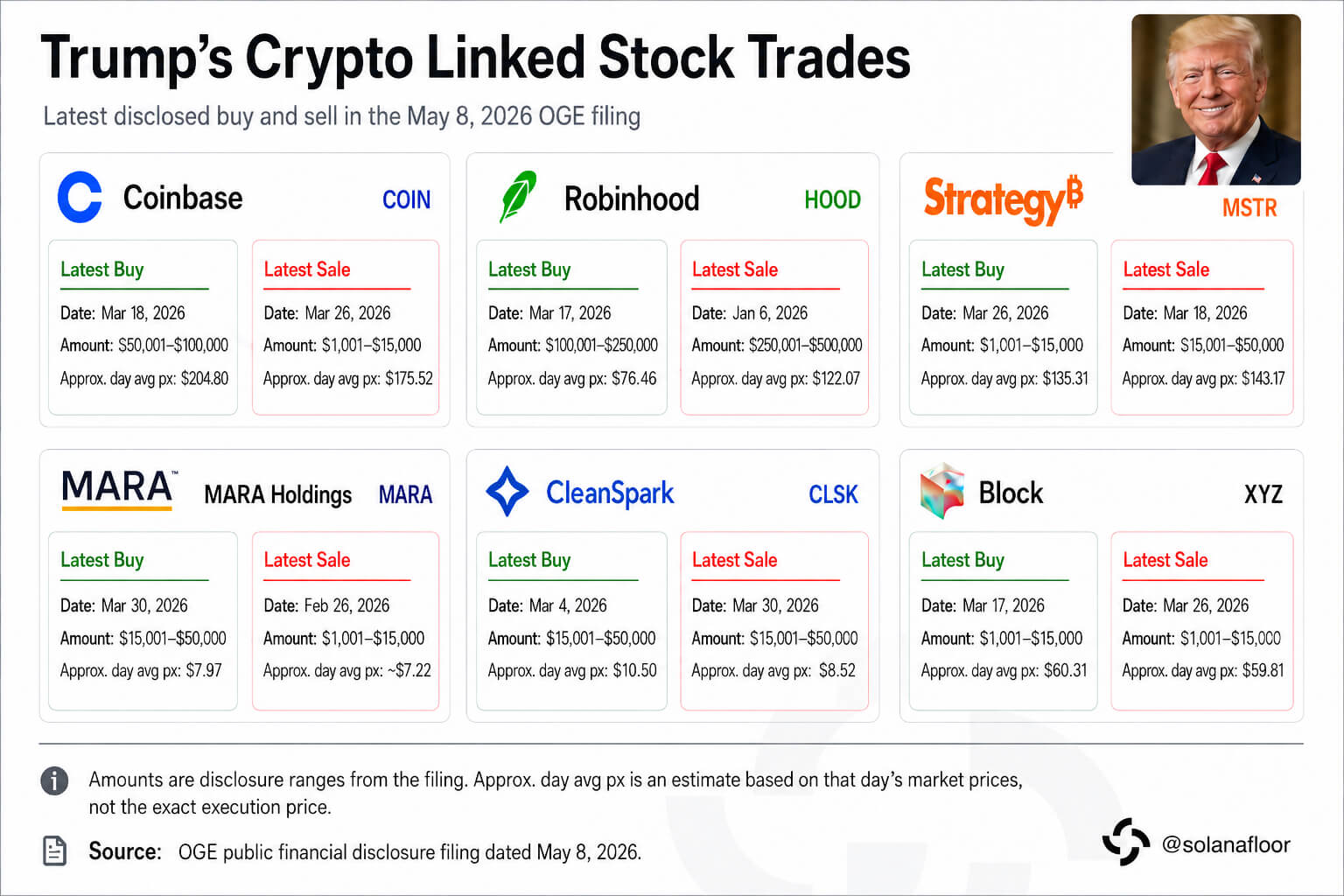
Those companies span several corners of the digital asset and fintech markets, from mining and exchange infrastructure to retail brokerage and payments.
The filings also show active trading in Strategy (formerly MicroStrategy), whose stock has become one of the most closely watched public-market proxies for Bitcoin.
The company has accumulated a large corporate Bitcoin treasury, making its shares highly sensitive to BTC’s price and the financing strategy behind its purchases.
The disclosures list eight Strategy Class A share transactions, including a February purchase valued as high as $100,000 and a January sale valued as high as $50,000.
The documents do not show whether Trump directed any of the trades himself. They also do not identify the specific accounts used for each transaction or clarify whether every entry involved common stock rather than another type of security.
Trump’s assets are managed through a family trust, and some transactions appear to have been executed through brokers.
White House crypto policy shifts reshape the regulatory landscape
The disclosures arrive amid a broader debate over Trump’s transformation from crypto skeptic to one of the industry’s most influential political backers.
Before his 2024 campaign, Trump had repeatedly criticized Bitcoin and other digital assets, describing them as speculative and risky.
During the campaign, however, he embraced the industry, accepted support from crypto donors, and positioned himself as the candidate who would reverse Washington’s enforcement-led approach to digital assets.
Since returning to office, the administration has moved quickly in that direction through personnel changes, executive orders, and support for crypto-focused legislation.
Under SEC Chairman Paul Atkins, the financial regulator has shifted away from the aggressive enforcement posture that defined the previous administration.
Instead, the agency has formed a crypto task force, opened discussions around new rulemaking, and retreated from several high-profile cases that had shaped the industry’s legal landscape.
That policy reversal includes the dismissal of litigation against Coinbase, a company now listed among the president’s disclosed family holdings.
The SEC had previously accused Coinbase of operating as an unregistered securities exchange, broker, and clearing agency, making the case one of the central legal tests for the US crypto market. The agency’s decision to step back marked a major victory for the exchange and the broader digital asset industry.
The SEC has also dropped or paused actions involving other major crypto firms and executives, including Kraken and Robinhood, another firm in the president’s portfolio.
The policy shift has extended beyond the SEC. The Justice Department recently disbanded its national cryptocurrency enforcement team, while the Commodity Futures Trading Commission (CFTC) has advanced several industry-friendly measures designed to encourage growth across the sector.
The White House has also used executive authority to elevate digital assets within federal economic policy.
In March, Trump ordered the creation of a US digital asset stockpile and a Strategic Bitcoin Reserve, directing the government to retain certain forfeited crypto assets instead of liquidating them into the market.
The move gave Bitcoin and other digital assets a formal role inside federal reserve policy and reinforced the administration’s broader support for the industry.
Taken together, the combination of lighter enforcement, friendlier regulators, and reserve policy has significantly altered the industry’s standing in Washington.
Congress and ethics watchdogs intensify scrutiny of Trump’s crypto ties
The overlap between Trump’s disclosed investments and his administration’s crypto agenda has intensified scrutiny on Capitol Hill, where Democrats are already examining the family’s direct ties to digital asset businesses.
Congressional Democrats last year accused the president of using his office to advance his personal financial interests, citing crypto holdings valued at as much as $11.6 billion and an estimated $800 million in income from digital asset sales during the first half of 2025.
The report also raised national security and conflict-of-interest concerns over foreign entities and state-linked actors investing in Trump-linked crypto ventures.
Democrats have argued that the administration’s broader rollback of federal crypto oversight has benefited industry donors and businesses aligned with the president’s policy agenda.
That scrutiny escalated this week after Sen. Elizabeth Warren, a longtime crypto skeptic, asked the SEC to investigate World Liberty Financial, a crypto company founded by Trump and his sons.
Warren’s letter focused on a $75 million borrowing transaction involving World Liberty’s WLFI token. She said the Trump family firm used roughly $440 million in WLFI as collateral on Dolomite, a decentralized lending protocol, to obtain stablecoins. At the same time, outside investors remained restricted from selling their own WLFI holdings.
The letter said the transaction drained substantial stablecoin liquidity from Dolomite and left some depositors unable to withdraw funds.
The SEC has not announced an enforcement action tied to Warren’s request. Her letter remains a call for investigation rather than a finding of wrongdoing.
Still, it adds pressure on the agency at a time when its leadership is already rethinking how aggressively Washington should police crypto markets under an administration that has made digital assets a central part of its financial policy agenda.
Ethics watchdogs argue that the core concern is the lack of separation between Trump’s financial interests and his policy authority. His disclosed holdings span industries heavily influenced by federal decisions, including defense, semiconductors, banking, energy, and digital assets.
NVIDIA and Boeing, for example, operate in sectors shaped by export controls, procurement policy, and diplomatic negotiations. Executives from both companies joined Trump on his trip to China this week, where chip access and industrial policy remain central issues.
Crypto presents an even sharper political challenge because the administration is actively rewriting the industry’s regulatory framework.
Trump signed the GENIUS Act last year, creating a federal framework for stablecoins that imposed reserve-backing and disclosure requirements. Congress is now advancing the Clarity Act, a broader market-structure bill that would shift significant oversight authority toward the CFTC and away from the SEC.
Industry groups have pushed for that framework for years, arguing it would reduce regulatory uncertainty and encourage crypto companies to remain in the United States.
However, consumer advocates and Democratic lawmakers warn that the approach could weaken investor protections, limit agency authority, and reduce compliance burdens for digital asset firms compared with traditional financial institutions.

 Bitcoin
  Ethereum
  Tether
  BNB
BNB  USDC
USDC  XRP
XRP  Solana
  TRON
TRON  Figure Heloc
  Hyperliquid