

Bitcoin has dropped so far this week after recent upward momentum, and on-chain analysis has sought to explain what actually happened.
At the time of writing, Bitcoin (BTC) has suddenly pulled back to $75,800, down over 2.5% in the past 24 hours. If the current momentum sustains, it would be on course for the second consecutive daily closing, an event last seen between April 18 and 19.
The price action completely negates recent momentum, which has seen Bitcoin climb over 11% in April. As waves of uncertainty sweep the market, an analysis claims to know exactly why BTC suddenly changed direction towards the end of April.
Key Points
- Bitcoin’s pullback appears to have been driven less by traditional supply-demand shifts and more by a sudden unwind of leveraged positions across derivatives markets.
- Over the past 24 hours, $342 million was liquidated, with $270.3 million in long positions and a comparably smaller $71.7 million in short bets.
- The speed of the drop points to a liquidity event rather than a gradual change in sentiment.
- The liquidity event began unfolding over the weekend, a period when institutional desks and major liquidity providers are typically less active.
- Institution-led liquidity cluster hunt and growing derivative participation further fueled the market unwinding.
What Caused the Sudden Bitcoin Drop?
CryptoQuant highlighted an analysis by the research firm XWIN Japan explaining what might have caused the drop. According to the commentary, Bitcoin’s late-April pullback appears to have been driven less by traditional supply-demand shifts and more by a sudden unwind of leveraged positions across derivatives markets.
Bitcoin has slid 4% from the intra-week high of $79,500 in two days. During this time, millions in leveraged positions have been wiped out in the crypto market. Over the past 24 hours, $342 million was liquidated, with $270.3 million in long positions and a comparably smaller $71.7 million in short bets.

The analysis noted that the speed of the drop points to a liquidity event rather than a gradual change in sentiment. A forced closure of leveraged long positions triggered this event, cascading into a period of price weakness for the premier asset.
Low Liquidity: The First Fuel
Timing played a major role. The liquidity event began unfolding over the weekend, a period when institutional desks and major liquidity providers are typically less active. With thinner order books, even modest selling pressure can have a larger impact on price.
In this kind of environment, once an asset’s prices breach key margin thresholds, leveraged positions begin to unwind automatically. Exchanges force position closure, creating additional selling pressure for prices. This process can quickly escalate, turning a relatively small weakness into a sharper decline.
Even as the market opened on Monday, Bitcoin had not seen sufficient buying pressure to neutralize the liquidity event. As such, the asset has continued to slide lower even at the time of writing.
Liquidation Clusters and Rising Leverage Raise Risks
XWIN Japan noted that another layer to the move comes from how professional participants approach the market. Larger players often monitor derivatives data and order books to identify areas of massive liquidation clusters. Then they push prices into these zones, triggering a chain reaction of forced selling and effectively releasing liquidity into the market.
This effect becomes even stronger when the overall leverage conditions are elevated. CryptoQuant data shows the total Bitcoin open interest (OI) has been steadily climbing as BTC has recovered, reaching $25.1 billion today. That suggests users have piled on large derivative positions in trading platforms, increasing the chances of a liquidity-driven volatility event.
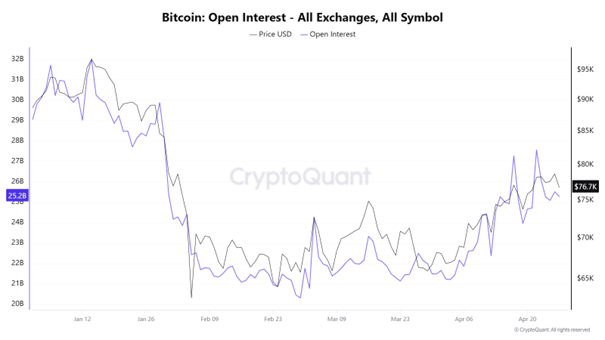
Interestingly, CryptoQuant CEO Ki Young Ju had earlier warned that the recent Bitcoin resurgence is more derivative-influenced than driven by real demand. He cited the 30-day BTC spot and perpetual futures demand growth chart, which remains in negative territory. Consequently, such market conditions create room for a rapid price reversal when momentum fades.
In the meantime, Bitcoin remains above the $73,000 support. Maintaining this level keeps hopes of a rebound alive. However, recent analysis has warned that May and June might be bearish for BTC and, consequently, the broader altcoin market.
DisClamier: This content is informational and should not be considered financial advice. The views expressed in this article may include the author’s personal opinions and do not reflect The Crypto Basic opinion. Readers are encouraged to do thorough research before making any investment decisions. The Crypto Basic is not responsible for any financial losses.

 Bitcoin
  Ethereum
  Tether
  XRP
XRP  BNB
BNB  USDC
USDC  Solana
  TRON
TRON  Figure Heloc
  Hyperliquid