

Bitcoin has shown strength, recovering to $73,000 in the face of market uncertainties from geopolitical tension, spurred by two major catalysts.
The price of Bitcoin has recently shown how quickly sentiment can shift in the crypto market. After sliding into the mid-$60,000 range in late February, the asset rebounded sharply in early March, rallying past $73,000 in days.
Key Points
- After sliding into the mid-$60,000 range in late February, Bitcoin has rebounded sharply in early March, rallying past $73,000 in days.
- The sudden reversal followed a period of heightened volatility triggered by conflicts in the Middle East.
- A key factor behind the rebound is renewed activity surrounding spot Bitcoin exchange-traded funds (ETFs) in the United States.
- Since the start of March, over $1.15 billion has flowed into these funds, providing direct support for spot demand in the BTC market.
- OI grew from $43 billion on March 2 to $49.6 billion on March 5, while funding rates moved into negative territory, providing short liquidity when BTC started to recover.
What Caused the Price Decline
A recent CryptoQuant analysis highlighted that the sudden reversal followed a period of heightened volatility triggered by geopolitical developments in the Middle East. Reports of military strikes by the US and Israel on Iran at the end of February rattled global markets and pushed Bitcoin down toward $63,000 on February 28.
However, the reaction proved temporary. BTC quickly recovered to $67,000 on that day, laying the foundation for further rebounds. By March 2, the asset had already recovered to $70,000. Then, renewed buying pressure in subsequent days drove the rally to a high of $74,000 yesterday, before the momentum cooled off.
ETFs Inflows Crucial to Bitcoin Recovery
A key factor behind the rebound is renewed activity surrounding spot Bitcoin ETFs in the United States. Since the start of March, over $1.15 billion has flowed into these funds, providing direct support for spot demand in the BTC market.
On March 4, $461 million flowed into the ETFs, driven by renewed interest in the BlackRock iShares Bitcoin Trust (IBIT). This movement suggested that large financial participants are once again allocating capital to Bitcoin through ETF products after a period of reduced activity. The additional demand helped strengthen the price recovery push.
Further analysis from Glassnode shows that inflow into BTC ETFs is now stabilizing. The 14-day netflow trend has broken higher, signaling an early stage of re-accumulation as the asset broke past $70,000. While this does not confirm that institutional pressure is back in full force, it suggests that earlier selling pressure is dwindling.
Short Covering Sparks Bitcoin Resurgence
At the same time, derivatives markets added another layer of support to the rally. Specificially, Open interest expanded quickly from $43 billion on March 2 to $49.6 billion on March 5, while funding rates moved into negative territory. Such conditions often indicate that many market participants are shorting the asset.
Consequently, when Bitcoin began to rise, short positions were forced to close, creating a wave of short covering that accelerated the upward move.
Mixed On-Chain Signals Despite the Rebound
While the price recovery has been significant, on-chain data show that the broader market structure remains complex, with some indicators still leaning toward caution.
For context, the 90-day realized profit-to-loss ratio remains below 1.0, suggesting that many coins recently moved on-chain have been sold at a loss. In addition, the number of coins held with unrealized losses has increased during the recent volatility.
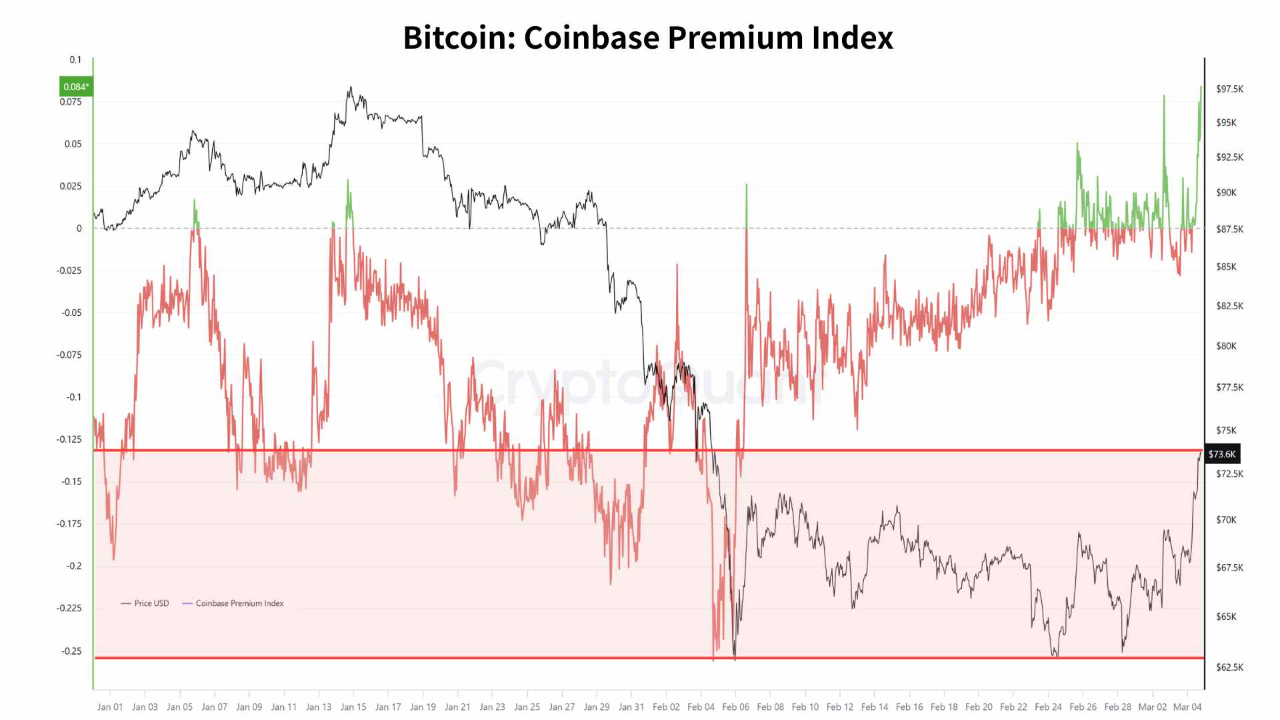
Nevertheless, other metrics have begun to improve. The Coinbase Premium Index turned positive after spending an extended period below zero. This shift indicates stronger demand from U.S. investors.
Meanwhile, the geopolitical conditions continue to influence sentiment. During periods of global uncertainty, Bitcoin comes across to investors through two different lenses. On the one hand, it behaves like a risk-sensitive asset, reacting quickly to macro shocks. On the other hand, it serves as a tool for capital mobility and wealth preservation.
DisClamier: This content is informational and should not be considered financial advice. The views expressed in this article may include the author’s personal opinions and do not reflect The Crypto Basic opinion. Readers are encouraged to do thorough research before making any investment decisions. The Crypto Basic is not responsible for any financial losses.
 Bitcoin
  Ethereum
  Tether
  BNB
BNB  XRP
XRP  USDC
USDC  Solana
  TRON
TRON  Figure Heloc
  Zcash
Zcash 