

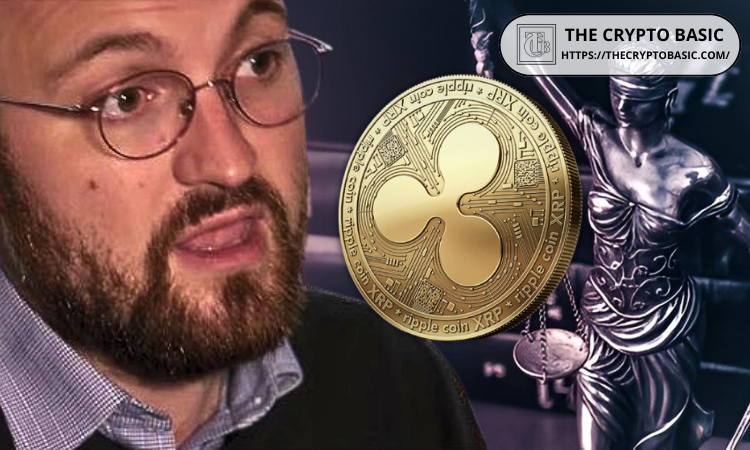
Cardano founder Charles Hoskinson has criticized a proposed rule from the U.S. SEC that would automatically classify most tokens, including XRP, as securities unless they meet a strict decentralization standard.
Hoskinson raised these concerns while outlining certain flaws in the Digital Asset Market Clarity Act, a bill designed to clarify how digital assets should be regulated in the U.S.
Key Points
- Cardano founder Charles Hoskinson argues that XRP would qualify as a security under a proposed SEC decentralization standard.
- The draft rule bars any issuer or coordinated group from controlling more than 20% of a network’s stake.
- Ripple holds over 30% of XRP’s total supply, with most of it locked in escrow.
- Hoskinson believes XRP and other major, established tokens could ultimately be exempt from automatic securities classification.
Requirements for Digital Commodity Classification
During a recent podcast, Hoskinson pointed to a provision in the Clarity Act that requires issuers seeking digital commodity status to formally petition the SEC for graduation.
The draft legislation gives the agency 60 days to review such applications. However, the SEC can pause the review clock or request additional information before issuing a decision, potentially extending the process.
To qualify as a commodity, projects must satisfy several requirements. Most notably, they must prove they are sufficiently decentralized. Citing the SEC’s beneficiary sufficiency standard, Hoskinson explained that issuers must demonstrate that no single entity or coordinated group controls more than 20% of the network’s stake.
XRP Could Be Classified as a Security Under this Rule
Hoskinson suggested that this standard could automatically categorize XRP as a security, despite its prior legal clarity following a multi-year court battle with the SEC. He based this argument on Ripple’s significant holdings of XRP.
For context, out of the token’s 100 billion total supply, Ripple holds approximately 33.61 billion XRP, or 33.6%, in escrow, according to data from XRPL Services. Since this exceeds the 20% control threshold, Hoskinson argued that the SEC could deem XRP a security under the proposed rule.
Furthermore, he described the standard as illegitimate and warned that it could also negatively affect proof-of-stake networks, including Cardano.
XRP Exemption
Meanwhile, Hoskinson argues that the proposed rule could create a two-tier system. Under such a framework, the top 10 crypto projects, including XRP, might effectively be “grandfathered in” and shielded from securities classification. In contrast, smaller and newer projects would need to prove decentralization before achieving commodity status.
Notably, Ripple maintains that XRP’s non-security status remains intact because it stems from a federal court ruling.
The Road Ahead
In the meantime, Ripple continues to support the Clarity Act, arguing that the legislation, in its current form, is better than no bill at all. Ripple CEO Brad Garlinghouse has expressed optimism that the bill could become law next month.
However, the legislation still faces hurdles. Crypto and banking industry leaders remain divided over provisions related to stablecoin yields. Nevertheless, negotiations continue ahead of a potential markup session in the Senate Banking Committee later this month.
DisClamier: This content is informational and should not be considered financial advice. The views expressed in this article may include the author’s personal opinions and do not reflect The Crypto Basic opinion. Readers are encouraged to do thorough research before making any investment decisions. The Crypto Basic is not responsible for any financial losses.
 Bitcoin
  Ethereum
  Tether
  BNB
BNB  XRP
XRP  USDC
USDC  Solana
  TRON
TRON  Zcash
Zcash  Figure Heloc