



The US economy added 178,000 jobs in March, nearly three times the consensus estimate of 60,000, and unemployment dipped to 4.3%. That is the kind of print that resets macro narratives and hits risk assets before traders finish their first read.
Bitcoin traded around $67,000, unfazed by the data. The 10-year Treasury yield climbed four basis points to 4.35%, and the dollar index ticked up to 100.08.
The market’s first-order read was straightforward: a labor market that looks this strong gives the Federal Reserve less reason to cut, which in turn yields tighter financial conditions and weighs on a macro-sensitive asset like Bitcoin.
Why this matters: Bitcoin reacted to more than a jobs beat. The signal was a stronger labor market that reduces the Fed’s urgency to cut rates. If that view holds, yields and the dollar can stay firm, maintaining pressure on liquidity-sensitive assets like BTC.
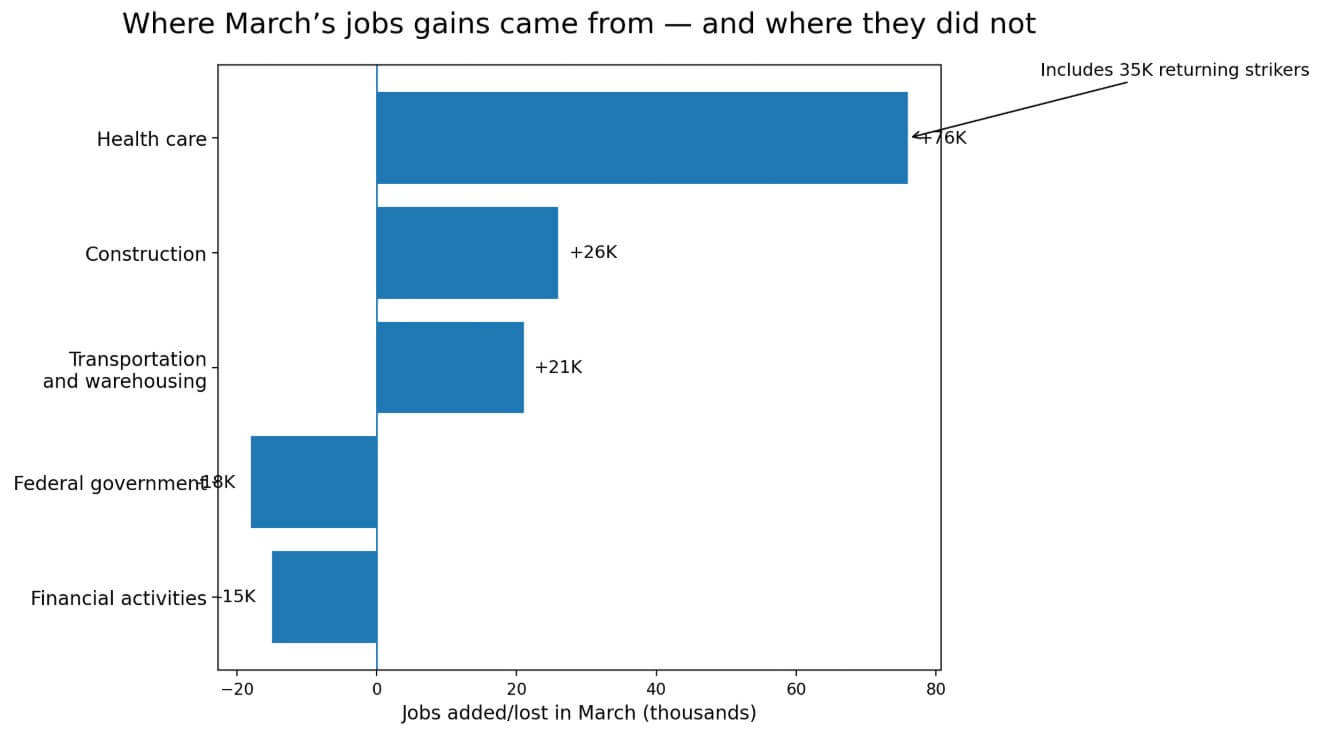
Zoom in on where those 178,000 jobs came from, and the picture gets less clean. Health care alone added 76,000 positions, and 35,000 of those were workers returning from a strike in physicians’ offices. The numbers represented a catch-up hiring.
Construction added 26,000, partly weather-aided, and transportation and warehousing contributed another 21,000. Federal government employment fell by 18,000, and financial activities shed 15,000.

BLS noted that total payroll employment had moved little on net over the prior 12 months.
That backdrop makes March read as a rebound from a noisy February, with sector-specific catch-up doing most of the lifting.
The household survey runs the other way
The household survey, which tracks employed and unemployed individuals across the population, moved in the opposite direction from the payroll numbers.
The civilian labor force contracted by 396,000 in March, with participation falling to 61.9%. Household employment declined by 64,000, and the number of people not in the labor force rose by 488,000.
Marginally attached workers jumped 325,000 to 1.9 million, and discouraged workers climbed 144,000 to 510,000. The average workweek is shortened to 34.2 hours.
Average hourly earnings rose just 0.2% month over month and 3.5% year over year, with no wage acceleration to complement the payroll beat.
| Indicator | March reading | Why it matters |
|---|---|---|
| Nonfarm payrolls | +178K | Strong headline beat versus expectations |
| Unemployment rate | 4.3% | Makes the labor market look firm at first glance |
| Civilian labor force | -396K | Suggests weaker labor-market participation beneath the headline |
| Labor-force participation rate | 61.9% | Fewer people working or looking for work |
| Household employment | -64K | The people-based survey moved opposite the payroll survey |
| Not in labor force | +488K | Reinforces the softer under-the-hood read |
| Marginally attached workers | +325K to 1.9M | Shows weaker labor attachment at the margin |
| Discouraged workers | +144K to 510K | Signals more workers are giving up on job searches |
| Average workweek | 34.2 hours | A shorter workweek can point to softer labor demand |
| Average hourly earnings | +0.2% m/m, +3.5% y/y | No wage reacceleration to confirm the payroll beat |
February’s revision adds another layer. BLS marked February down to -133,000 from -92,000 and revised January up to 160,000 from 126,000. The net two-month revision was only -7,000, making the pattern noisy and lacking a consistent directional pull.
Payroll growth in the first quarter averaged roughly 68,000 per month, a soft pace by any expansion standard.
BLS revises monthly estimates twice as additional employer reports arrive and seasonal factors reset.
Since 2003, the average absolute revision from the first to the third estimate has been 51,000 jobs. A revision of that size would take March from 178,000 to around 127,000, which is noticeably less dramatic.
To erase the entire beat, March would need a job-creation figure exceeding 118,000, roughly 2.3 times the historical average, and ordinary revision noise does not get there.
BLS’s annual benchmark revision stripped 898,000 jobs from the March 2025 payroll level, four times the average absolute benchmark revision of the prior decade.
The revision established that first-print payrolls have recently carried more uncertainty than markets typically price in during the first trading hour following a strong print.
The rates channel behind Bitcoin’s drop
The Federal Reserve held its target range at 3.50% to 3.75% in March.
The median participant’s projection put 2026 unemployment at 4.4%, PCE inflation at 2.7%, and the year-end fed funds rate at 3.4%. March unemployment at 4.3% and a payroll print of 178,000 gave policymakers no urgency to move.
NYDIG’s research frames the Bitcoin-to-macro link in the same terms: BTC trades in line with real rates, liquidity, and risk appetite. A Fed that holds its position on a firm labor market removes the near-term catalyst that Bitcoin most needs.
The February JOLTS report reinforces this without turning alarming. Openings held near 6.9 million, but hires fell to 4.8 million, and the hiring rate dropped to 3.1%, the lowest reading since April 2020.
Initial jobless claims for the week ended March 28 came in at 202,000, near cycle lows.
Together, these data points describe a labor market in stasis, with layoffs contained, new hiring tepid, and firms holding headcount steady.
That environment does not trigger a Fed pivot, and a Fed that does not pivot keeps financial conditions tighter for longer.
Potential outcomes for Bitcoin
Bitcoin’s price action on April 3 ran through the rates channel. Labor strength reduced cut expectations, firmer yields, and a stronger dollar tightened conditions for liquidity-sensitive assets. This channel can reverse.
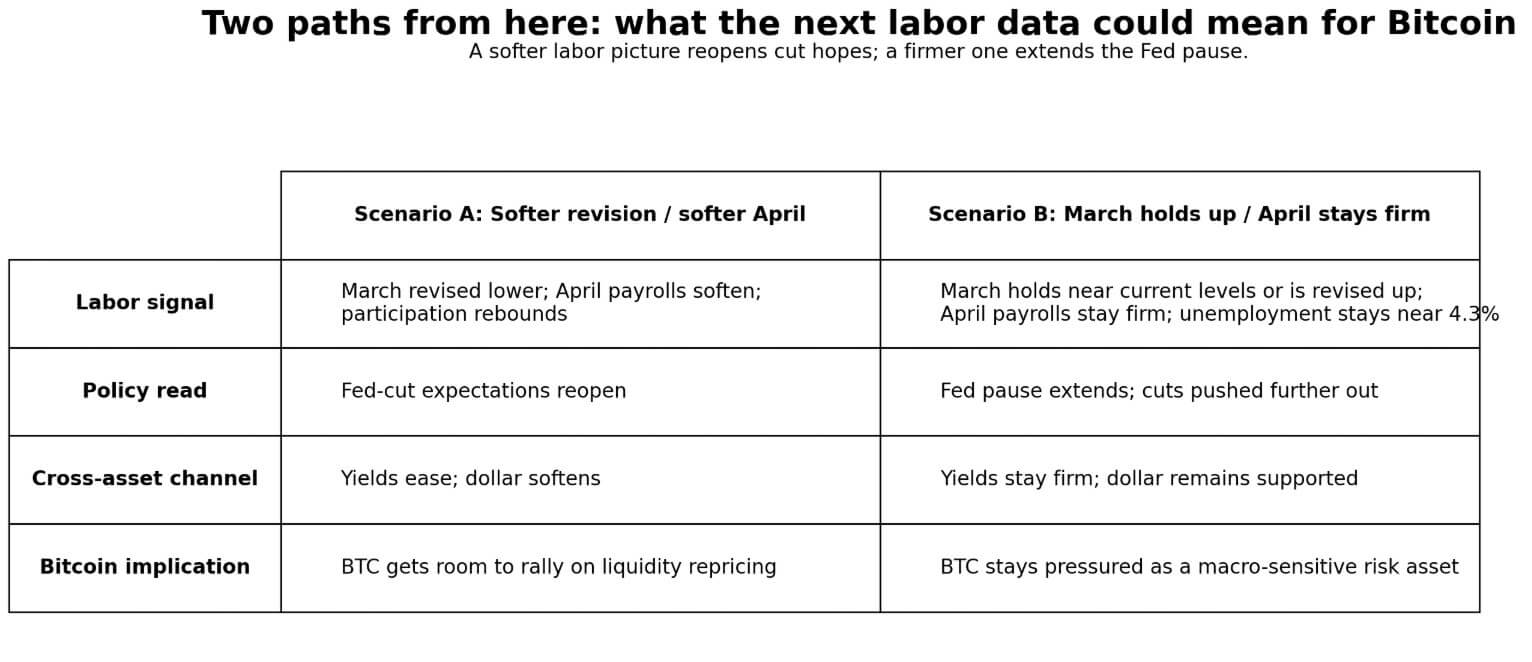
If BLS revises March payrolls materially lower toward sub-100,000, and April payrolls also land soft while participation rebounds, the “headline-only strength” thesis gains traction.
Cut expectations would reopen, yields would ease, and Bitcoin would have room to rally on liquidity repricing. The weakness in the household survey, the strike-return distortion in health care, and the low-hiring JOLTS backdrop each make that path plausible, but April data on May 8 would need to confirm it.
If March holds near current levels or BLS revises it higher, and April payrolls land above roughly 125,000 while unemployment stays near 4.3% or below, February becomes the clear outlier.
The Fed extends its pause with more confidence, cuts get pushed further out, and Bitcoin keeps trading as a macro risk asset with no near-term liquidity catalyst.
The cross-asset move on April 3, with yields up, the dollar up, and BTC down, showed the market had already begun pricing that path.
The next Employment Situation release is scheduled for May 8 at 8:30 a.m. ET, bringing both April payrolls and the first revision to March.
That makes it the real checkpoint for every argument built on the April 3 print. March CPI is released on April 10, and the next FOMC meeting runs April 28-29, two data points the Fed absorbs before setting policy again.
CPI, in particular, will test if labor market firmness pairs with sticky inflation or with the wage deceleration that the March print already hinted at.

 Bitcoin
  Ethereum
  Tether
  BNB
BNB  XRP
XRP  USDC
USDC  Solana
  TRON
TRON  Lido Staked Ether
  Figure Heloc