

On-chain data shows Bitcoin investors have only ramped up their loss realization even as the cryptocurrency’s price has found some stability.
90-Day SMA Bitcoin Realized Loss Has Continued To Climb
In a new post on X, Glassnode lead research analyst CryptoVizArt has talked about the latest trend in the 90-day simple moving average (SMA) of the Bitcoin Realized Loss. This indicator measures, as its name suggests, the total amount of loss (in USD) that the investors are “realizing” through their transactions.
Below is the chart shared by CryptoVizArt that shows how the 90-day SMA of this metric has changed over the last few years.

Looks like the value of the indicator has witnessed some rapid growth in recent weeks | Source: @CryptoVizArt on X
As is visible in the graph, the 90-day SMA Bitcoin Realized Loss was at relatively low levels between July and November, but since then, the indicator’s value has shot up, suggesting investors have increasingly been moving coins at a loss.
Something to note here is that the Bitcoin Realized Loss used in the chart isn’t the usual one, but rather the entity-adjusted version. Glassnode defines an “entity” to be a cluster of addresses that are owned by the same investor. Entity-adjusted on-chain indicators only account for transactions that are occurring between the wallets of two different entities.
From the chart, it’s apparent that even after excluding in-house transactions, the 90-day SMA of the Bitcoin Realized Loss is currently sitting at the $300 million mark, the highest value since early 2023. There were two other capitulation events in this cycle, but they were of a notably smaller scale. The loss-taking spree in mid-2024 couldn’t even hit $100 million, while the one in the first few months of 2025 topped out just beyond the mark.
The current Bitcoin capitulation is still significantly behind the highs of the 2022 bear market, however, as the 90-day SMA entity-adjusted Realized Loss exceeded a whopping $600 million back then.
Nonetheless, the latest investor loss selloff hasn’t shown signs of slowing down yet, suggesting the capitulation could end up with an even higher peak. The fact that the event hasn’t slowed down is interesting, though, given the context that Bitcoin has reached a relatively stable phase since the crash in November.
This trend could potentially imply the top buyers are getting increasingly frustrated by the lack of a bullish return, so they are exiting to avoid going into even deeper losses.
BTC Surges To $90,000 Before Pulling Back
Bitcoin has seen a volatile swing in the past day, with its price first rallying above $90,000 and then declining back to the $87,500 level, essentially erasing the recovery.

The trend in the BTC price over the last five days | Source: BTCUSDT on TradingView
This volatility has resulted in liquidations of over $69 million in the Bitcoin derivatives market, according to data from CoinGlass.
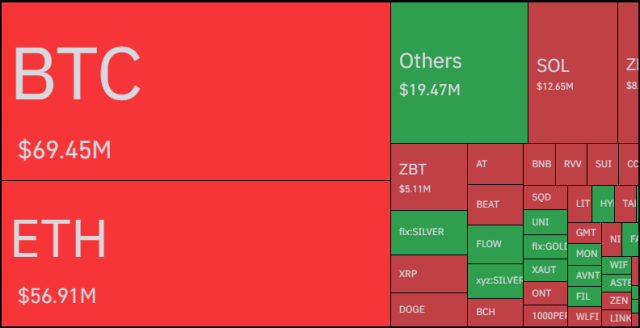
The liquidation heatmap for the cryptocurrency market | Source: CoinGlass
Featured image from Dall-E, CoinGlass.com, Glassnode.com, chart from TradingView.com

Editorial Process for bitcoinist is centered on delivering thoroughly researched, accurate, and unbiased content. We uphold strict sourcing standards, and each page undergoes diligent review by our team of top technology experts and seasoned editors. This process ensures the integrity, relevance, and value of our content for our readers.

 Bitcoin
  Ethereum
  Tether
  XRP
XRP  BNB
BNB  USDC
USDC  Solana
  JUSD
JUSD  TRON
TRON  Lido Staked Ether