

Manufacturers spend a pretty penny managing inventory logistics
(the management of inbound and outbound flows of goods) and
inventory warehousing (the receipt, storage, and distribution of
goods).
In good times, controlling logistics costs presents a
challenge. In times of global disruption, the costs can
border on unmanageable.1
COVID-19 alone caused huge shortages of consumer products and
surges in shipping costs.
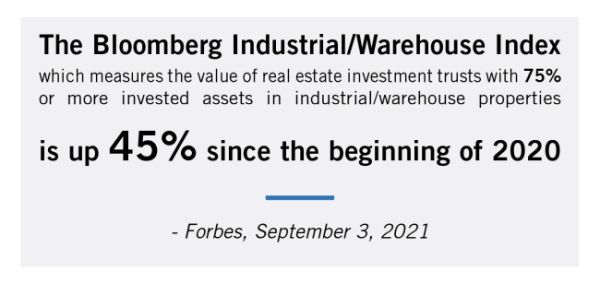
In the warehousing sector, a combination of pandemic-driven
demand and big-box stores racing to compete with Amazon have caused
the cost of warehouse space to skyrocket.3 Companies also face continually
increasing warehouse costs due to a rise in construction costs, as
well as an increase in investment in sophisticated warehouse robots
to automate warehousing.4
Due to the increasing costs involved in managing the flow of
inventory, tools to reduce logistics and warehousing costs, such as
blockchain technology, are more appealing than ever.
Blockchain Basics for Logistics and Warehousing
Blockchain is a distributed ledger that stores immutable data, shared by participating
blockchain network members. A manufacturer can use blockchain
to record and view transactions at every step in the supply
chain. The distributed ledger format provides companies with
a single, unchanging truth to reference for logistics and warehouse
planning, management, and dispute resolution.
Companies also benefit from the secure nature of
blockchain. Because of blockchain’s immutable and
decentralized structure, hackers would find it very difficult to
target encrypted information stored on
blockchain.
Blockchain Benefits for Logistics
Logistics networks today suffer from complexity and
inefficiencies due to lack of visibility and antiquated paper
documentation systems. Blockchain remedies these issues.
Lack of Visibility
Because of the complexity of logistics networks, companies often
have blind spots in their supply chain, making it difficult to
locate products at any given time. Because of this lack of
visibility, companies face difficulties in identifying performance
lapses. Unavailability of real-time tracking further hinders
companies attempting to schedule delivery times and efficiently use
company assets.
Blockchain combats inefficiencies by allowing companies to track
products in real time and store the related data on a tamper-proof
ledger. Blockchain stores information on a shared ledger
viewable by all permitted parties, so companies can also reduce
administrative processes.
Paper-based Systems
Because logistics
networks typically run on paper-based records, each company that
touches a product must manually keep records on that product,
leading to redundant or potentially inconsistent records.
Further, bad actors can easily forge paper documentation.
Finally, supply chain members may be slow to deliver and process
paper documentation in comparison with digital documentation.
In today’s logistics supply chain, containers of product can
become stuck at the port while officials wait for the paper bill of
lading (which acts as contract of carriage, confirmation of product
receipt, and document of title) to arrive.
By shifting data and processes to blockchain, companies have
access to a system that houses trusted data, which is resistant to
cyberattacks and fraudulent manipulation. Blockchain also
allows companies to use smart contracts to automate payments and sign
documents, which can save time in comparison to traditional manual
processes.
With respect to bills of lading, blockchain provides the
technology needed to graduate past paper bills of lading and use
secure electronic bills of lading (“eB/Ls”)
instead. However, a single bill of lading can travel
though many countries and change hands through a variety of
participants (traders, buyers, carriers, etc.). The complexity
inherent in coordinating a manual to digital change in process for
a large number of participants hinders widespread adoption of
eB/Ls. One challenge is that not all participants may want to
engage in the blockchain. Another challenge is that many
jurisdictions have not definitively addressed the legal status of
electronic transferable records. In order to pave the way to
digitize the centuries-old bill of lading format, the United
Nations Commission on International Trade Law has published a model
law to govern the use of electronic transferable records (such as
bills of lading and bills of exchange).7
Blockchain Benefits for Warehousing
As the demand for warehousing increases, the challenges of
tracking and managing warehouse inventory have become ever more
apparent. Blockchain alleviates the challenges presented in
tracking and managing inventory.
Moving Beyond Reactive Inventory Management
Companies usually operate warehouses on a very reactive basis,
meaning that companies order more inventory only when stock runs
low or predictive models (which can take time to populate) forecast
the need to order more inventory.
Blockchain allows companies to track exactly which product is
located in the warehouse at a given time. Blockchain
technology also allows manufacturers to see end user demand in real
time, allowing for better management of manufacturing planning and
nimble inventory allocation and replenishment. Warehouses may
still rely on a minimum stock volume or predictive models, but
blockchain optimizes the determinations more accurately and more
timely.
Minimizing Manual Processes
Companies largely operate warehouses using manual processes,
including for tracking locations of inventory, picking inventory,
and monitoring inventory. While companies continue to phase
out manual processes with the advent of warehouse automation
advances (such as drones that count inventory and robots that
assist laborers with picking), smart warehouses can further
increase automation by implementing blockchain. Blockchain
increases stocking, replenishing, picking, and packaging
efficiencies due to digitization of recordkeeping and use of smart
contracts.
Smart Contract Solutions
Blockchain technology allows for implementation of “smart
contracts,” which are computer programs that automatically
execute an action according to a pre-determined set of rules.
This feature can simplify transactions between supply chain
members and offer an audit trail for those transactions. Supply
chain members can be paid faster and reduce administrative
costs. Logistics and warehouse companies can use smart
contracts to:
- Automate recordings of delivery times and receipt of goods into
inventory. - Automate payments for inventory received.
- Alert relevant parties if product held in inventory will expire
or if the price of product held in inventory has met a strike
price. - Work with IoT devices to trigger alerts if warehouse or
shipping container conditions change, such as temperature and
humidity. - Automate payment of credits for failure to meet Service Level
Agreement (SLA) and Key Performance Indicator (KPI) metrics. - Automate recording of product transfers between supply chain
members from factory to consumer. - Execute trade deals automatically by connecting importers,
exporters, and their respective banks to the blockchain to reduce
duplicative paperwork and redundant quality assurance
processes.
See Article 5 of this “Blockchain in
Supply Chain” series for more information on smart contracts
and the various legal issues to be considered when using
them.
Designing Blockchain for Logistics and Warehousing
Blockchain can uniquely address the challenges faced by
companies in the logistics and warehousing steps of the supply
chain by providing streamlined delivery processes and improved
inventory management. However, complexity of supply chains
and hesitancy to invest in the blockchain infrastructure could pose
barriers to blockchain adoption in the logistics and warehousing
spaces.
As a result, leading companies, such as UPS, Penske, and
Salesforce, formed the Blockchain in Transport Alliance
(“BiTA”) the largest commercial blockchain alliance in
the world.8 BiTA has over 500
members in 25 countries,9 including 3PLs/4PLs, logistics
companies, air freight companies, railroads, trucking companies,
blockchain consulting services, SaaS technology companies, and
original equipment manufacturers.10 BiTA aims to drive the adoption of
blockchain technology forward and develop a framework and standards
for marketplace participants to effectively build blockchain
applications.
In another effort to digitize the logistics industry, Maersk and
IBM developed the TradeLens platform, designed with blockchain
technology to create greater collaboration and trust across the
global shipping industry. 11
IBM and Maersk built the TradeLens platform using Hyperledger
Fabric blockchain technology and IBM cloud12 to digitally connect shippers,
freight forwarders, ports and terminals, customs brokers, and other
important members of the global supply chain ecosystem.13
Still, there is no standard blockchain solution for logistics
and warehousing, so companies should evaluate whether blockchain
would be a cost-effective solution for obtaining a leaner and more
efficient supply chain.
Footnotes
1. Ziady, Hanna,The Shipping Crisis
is Getting Worse. Here’s What that Means for Holiday
Shopping, CNN Business (August 23, 2021).
2. Id.
3. Levy, Ari, Soaring Warehouse Demand
Boost Commercial Real Estate Market as Office Vacancies
Mount, CNBC (July 10, 2021).
4. Id.
5. Resource Real Estate Diversified Income Fund, Certified Shareholder
Report of Registered Management Investment Companies,
United States Securities and Exchange Commission (September 30,
2018).
6. Friesen, Garth, No End in Sight for the
COVID-Led Global Supply Chain Disruption, Forbes
(September 3, 2021).
7. Clyde & Co LLP, The Legal Status of
Electronic Bills of Lading; A Report for the ICC Banking
Commission, The International Chamber of Commerce
(2018).
8. BiTA Members,
BiTA, (last retrieved September 6, 2021); Blockchain in Transport
Alliance, BiTA, (last retrieved September 6,
2021).
9. Blockchain in Transport
Alliance, BiTA, (last retrieved September 6,
2021).
10. BiTA Members,
BiTA, (last retrieved September 6, 2021).
11. About TradeLens,
Maersk, (last retrieved September 6, 2021).
12. The Platform,
Maersk, (last retrieved September 6, 2021).
13. The Ecosystem,
Maersk, (last retrieved September 6, 2021).
The content of this article is intended to provide a general
guide to the subject matter. Specialist advice should be sought
about your specific circumstances.

 Bitcoin
  Ethereum
  Tether
  XRP
XRP  BNB
BNB  USDC
USDC  Solana
  TRON
TRON  Lido Staked Ether
  Figure Heloc